Difference between 4-Auto and 4-Lock

Disclaimer: Links on this page pointing to Amazon, eBay and other sites may include affiliate code. If you click them and make a purchase, we may earn a small commission.

OP
OP
corneileous

corneileous

Senior Member
Joined
Sep 6, 2016
Posts
7,139
Reaction score
4,142
Location
Podunkyville, OK
Ram Year
2018 Ram 1500 Limited 4X4
Engine
Hemi 5.7
Sounds about right, the 2nd/3rd gen trucks and Dakotas were the ones that it was pretty common.

I’m almost pretty certain that if I hadn’t of taken them the places I took them, they mighta been fine...lol. But needless to say, I was pretty happy to hear that my 2008 Ram I had before didn’t have the LSD. I was kinda surprised it didn’t since it was a Laramie. But then again I figured maybe it was because that truck had traction control and ESP. I didn’t think those two things could go together with that LSD but my new truck has all three.


Sent from my iPhone using Tapatalk Pro
 

BWL

Embrace the skeptisism
Joined
Oct 14, 2017
Posts
8,847
Reaction score
8,915
Location
BC Canada
Ram Year
2017
Engine
hemi 5.7
I've seen a few go, but they're expensive to rebuild and easy to swap so as long as they make it out of warranty as most do its way cheaper to install a low km one out of a wrecked truck. Probably why the dealer doesn't see too many or at least a factor.
 

Woody332

Junior Member
Joined
Mar 22, 2013
Posts
4
Reaction score
1
Ram Year
2009
Engine
5.7 Hemi
4 auto engages the transfer case but only engages the hubs when the abs detects slippage from the rear end. 4 Lock engages both the transfer case and the hubs...
 

boblonben

Senior Member
Joined
Jul 23, 2016
Posts
587
Reaction score
298
Location
Texas
Ram Year
2017
Engine
Hemi 5.7
I could be wrong but I thought i read that in 4 auto it will engage when it senses slipping and then disengage once it senses no more slipping. Then in 4 lock it will engage once it senses slipping but will stay engaged until you let off the gas. Again I could be wrong lol
You are correct !!!!! Most people get it wrong, you got it right!!
 
OP
OP
corneileous

corneileous

Senior Member
Joined
Sep 6, 2016
Posts
7,139
Reaction score
4,142
Location
Podunkyville, OK
Ram Year
2018 Ram 1500 Limited 4X4
Engine
Hemi 5.7
4 auto engages the transfer case but only engages the hubs when the abs detects slippage from the rear end. 4 Lock engages both the transfer case and the hubs...

Are you sure about all that? The hubs to my knowledge are still not like anything else and should be locked in all the time like they always have been ever since the second-Gens.

Seems to me the only logical explanation to how this works is what someone else said while back which was that while in either mode, the front diff will lock together in all three; the only time the transfer case engages while in Auto is when there’s rear-wheel slippage defected and while it’s in either Lock or Low, the transfer case locks in once slippage is detected, but stays engaged until you let off if it.

I dunno, I may be wrong but I think the hubs are always locked all the time like they always have been.


Sent from my iPhone using Tapatalk Pro
 

joshuaeb09

Senior Member
Joined
Apr 5, 2016
Posts
1,426
Reaction score
2,403
Location
Medina County, TX
Ram Year
2022
Engine
6.7 Cummins
Are you sure about all that? The hubs to my knowledge are still not like anything else and should be locked in all the time like they always have been ever since the second-Gens.

Seems to me the only logical explanation to how this works is what someone else said while back which was that while in either mode, the front diff will lock together in all three; the only time the transfer case engages while in Auto is when there’s rear-wheel slippage defected and while it’s in either Lock or Low, the transfer case engages when you step on the pedal, irregardless of whether or not the back wheels are losing traction.

I dunno, I may be wrong but I think the hubs are always locked all the time like they always have been.


Sent from my iPhone using Tapatalk Pro

4-Auto and 4-Lock operate identically in the FCA programing of the 44-44. Once in any 4WD mode the front axle locks in and power to the front is controlled by the clutchpack in the T-Case coined as Torque on Demand by BW. @Brandon-w has done a lot of work with experimentation on the auto case to make it work more like Ford programing on BW case where it actually locks in 4WD Lock. Coming from Fords with BW auto cases the Ram implementation is pretty annoying, but I'm looking forward to being able to pick up one his plug and play mods to fix that.
 
OP
OP
corneileous

corneileous

Senior Member
Joined
Sep 6, 2016
Posts
7,139
Reaction score
4,142
Location
Podunkyville, OK
Ram Year
2018 Ram 1500 Limited 4X4
Engine
Hemi 5.7
4-Auto and 4-Lock operate identically in the FCA programing of the 44-44. Once in any 4WD mode the front axle locks in and power to the front is controlled by the clutchpack in the T-Case coined as Torque on Demand by BW.
I wouldn’t say 4-Auto and 4-Lock were necessarily identical if Auto only engages the t-case when the back wheels slip, thus immediately disengaging it once slip is no longer detected.

@Brandon-w has done a lot of work with experimentation on the auto case to make it work more like Ford programing on BW case where it actually locks in 4WD Lock. Coming from Fords with BW auto cases the Ram implementation is pretty annoying, but I'm looking forward to being able to pick up one his plug and play mods to fix that.

I guess I could see the importance of that for a more-controlled 4-wheel drive experience if you actually do some next-step-up-from-amateur off-roading, or if you just want to play in a mud hole or on a snow-covered parking lot but for normal driving, besides what I talked about above, why do you really need the front wheels to be powered all the time when the back wheels have no problem moving you along? Quite frankly that day where I mentioned I dropped it down into 4-Low to go up to that big waterfall in Ouray, it’s actually kinda nice knowing I probably more than likely drove all the way up there in basically 2-Lo. It was nice having the extra torque to climb with and descent with but also nice to save wear on the steering components from all the binding while tackling the switchbacks that I had to 3-point turn on.

I could see it beneficial sometimes to have a switch that would fully lock in the transfer case when you wanted true full time 4WD but I would guess that that would be another reason to sway away from a halfton and spring for a HD if you ever need that much 4-wheel capability. Just my opinion.


Sent from my iPhone using Tapatalk Pro
 

joshuaeb09

Senior Member
Joined
Apr 5, 2016
Posts
1,426
Reaction score
2,403
Location
Medina County, TX
Ram Year
2022
Engine
6.7 Cummins
I wouldn’t say 4-Auto and 4-Lock were necessarily identical if Auto only engages the t-case when the back wheels slip, thus immediately disengaging it once slip is no longer detected.

That's the problem that's burned up a few t-cases, but mostly guys dealing with snow and ice in 4-Lock. It doesn't lock up the clutch with full power so things slip and generally don't work that great when one might really need 4wd. It's basically a 2nd 4-Auto switch the way FCA is operating the case where as Ford locks up the clutch 100% when you put an F150 with the same case in 4 Lock.

I love 4-Auto for when the road conditions get hairy or I'm not sure what the conditions of a crossing are, but when I know I'm about to go through a sticky mud hole I want it lock like the 44-45. I drove a loaner for a week that had a 44-45 (1500 Tradesman) and that week it was super rainy flooding out some of our roads again. Going through some of the crossings I have to around here it was certainly noticeable comparing the two trucks that I was always getting power to the front wheels (And it had the craptacular SRAs). Now I've never gotten stuck anywhere with my 44-44 so it's not a limitation, but I do worry about it when it starts slipping which is more wear and tear on the T-Case clutch pack.
 

prodog87

Junior Member
Joined
Jun 21, 2016
Posts
1
Reaction score
1
Ram Year
2014
Engine
3.0L ECO DIESEL
4 Auto allows the front and rear axles to have a difference in speed due to slight variations in tire rolling radius and while turning (the from wheels travel in a shorter radius and therefore have to turn faster than the rear wheels). 4 Lock (or 4 High) has the front and rear propshafts mechanically locked together not allowing that speed differential between them to occur. 4 Lock (or 4 High) should be used only on wet or slippery surfaces like dirt, sand, snow or mud. If used on dry pavement driveline bind will occur, causing loss of fuel economy and driveline wear. Use on ice will cause instability because either one axle or the other will be in constant skid. 4 Auto can be used anytime and is the safest in winter conditions. If you don't believe me, try 4 Lock on a crowned, icy road and see where you end up.
 

LouM

Senior Member
Marine Corps
Joined
Sep 8, 2016
Posts
788
Reaction score
1,055
Location
Greeenwich/Easton upstate NY
Ram Year
2015 Ram Ecodiesel crewcab old/ 2019 Laramie Hemi old/ 2022 RAM 2500 6.7
Engine
eco diesel old / now Hemi missing the eco's mileage/ now back to enjoying diesel torqueesel
I'm an engineer by education, though i don't work in the field. I took an interest in how the 44-44 works, and took mine apart.

I looked of its guts scratching my head, put a multimeter on the clutch pack wire, drove around with wires n **** stretched around the door and running into the cab to my multimeter.

I even put it up on jackstands once, in gear with the tires spinning and crawled under it with a multimeter. In and out, over and over, measuring **** in different 4x4 modes.

This is what i figured out, and keep in mind, however unlinely it is (im kinda arragant), it IS remotely possible for me to be mistaken!


Theres alot to understand with regard to this t-case, for anyone who's interested in how it works.

The inner workings of the ball ramp actuator, multi plate wet clutch and the electrically powered rotor/stator assembly, while really simple in operation, are kinda difficult to splain.

The electric part (rotor/stator) has 2 parts. The stator is fixed to the housing (stator means static/fixed), and the rotor is on the same splined shaft as the clutch plates.

When the stator is powered, ( as in wheel slip detected), a magnet pulls the rotor (rotating with the clutch plates) into contact with the stator (fixed), and the friction/drag between the two causes the ballramp to expand and clamp the clutch plates together. The ballramp, when engaged, will also force the electrical rotor back out of contact with the stator.

As long as the rear wheels have less traction than the front and the engine is trying to make the truck go, the ballramp will keep the clutch plates clamped together and all 4 wheels will be pulling. Any changes to the electrical power to the stator will have no effect.

As soon as the rear wheels get good solid traction, the ball ramp stops mashing the clutch plates together and your back to 2 wheels pushing.


The difference between 4 auto and 4 lock is in the programming of the computer, and how/when power is sent to the stator.

In 4 auto:
The computer will send power to the stator when your in gear, the throttle is pressed and rear wheel slip is detected. It will stop sending power when the wheelspeed sensors detect that the rear wheels arent slipping any more. If the rear wheels arent slipping anymore, obviously, the ballramp actuator will also release because because, well, it cant work if both ramp plates are spinning in sync with each other.

In 4 lock:
The computer will send power to the stator when, your in gear, pressing the throttle. Rear wheel slip isn't required in 4 lock, BUT, some throttle input is required AND the power to the stator is ramped up from a low value to a high value over a small period of time.

This can cause problems, but is designed to prevent a sudden hammer hit engagement of the ballramp/clutch when the rear wheels start spinning. It ramps up power in 4 auto as well.


But...

If your in 4 lock, driving up a mountain road, and arent really spinning your rear wheels, you will usually still feel the front wheels pulling. Youll feel it in the steering wheel. This doesn't seem to make sense considering what ive outlined above!! Untill..

Untill you think a little deeper about the rest of the truck and the situation.

Your on gravel/dirt, the weight of the engine is over the front wheels, your applying power to the rear wheels, the rear tires are flexible rubber and are rolling over dirt and gravel. The rear wheels are rotating just a little faster than the front wheels. This is obvious if you look at the tracks your leaving in the dirt/gravel. Little rocks and some dirt are displaced. Not possible without some, however small, amount of slipping. Maybe only a few degrees of slip relative to the front tires, per revolution.

Remember, when the stator/rotor is powered, the rear half of the ballramp actuator only needs to rotate a bit less than 120° relative to the frant half, to put the clutch pack in compression, thus engaging the front wheels.

So, in 4 lock, going up a mountain road, unless your on good tractable pavement, you very likely are being propelled by 4 wheels.

Before i swapped in my 44-45, i drove up many steep gravel roads powered by my 44-44. Even without the rear wheels apparently spinning, i could most definitely feel the front wheels pulling in the steering wheel.

An easy test you can do to prove/disprove how much slip there is, even when you dont feel any:

Find a steep, uphill, strait as possible, gravel n dirt road. Stop and mark a front and a rear wheel both on the bottom, with a marker or chalk. Drive a couple hundred yard in 2wd, then check the marks. See if they stay in sync with each other.

If the traction is poor enough to let those chalk marks drift out of sync by 120° or more (take into acct gear ratios), then the ballramp would have engaged were u in 4lock.


You where doing fairly well till this;
As soon as the rear wheels get good solid traction, the ball ramp stops mashing the clutch plates together and your back to 2 wheels pushing.
You have this off a bit, the more traction the rear has the tighter it clamps the clutch with the ball and cam. If you get into a very low traction situation it will not clamp the front drive in. And it will disengage when the fronts over ride the rears.

The front axle will shudder and shake and think about driving but it will not.
This case is the reason I am thinking of a different brand truck.
This case has left me to walk at least once a winter, except this one so far.
It fails completely in my driveway. My wifes AWD Equinox has driven right by where this truck has spun out and refused to hookup and move. Both vehicles on Nokia studded snows.
I have backed down past it with my plow truck (2000 Chevy K2500) and sanded the driveway, walked back and then driven this fancy RAM up to the house.
This case works good in halfway decent traction situations, it is great pulling out of a field road with a wagon behind it, the case will work and hook up strong. Its good enough on snow covered highways.
The more traction the rear has the more it will give the front. Get in a situation with no traction at the rear it's lousy.
Even with decent traction it has to spin the rtears a bit to bring in the front, so backing uphill on a grassy splippery surface you will spin every time you start and stop.
 

Ken226

Senior Member
Joined
Mar 12, 2017
Posts
2,286
Reaction score
5,914
Location
Washington State
Ram Year
2013
Engine
Hemi
You where doing fairly well till this;
As soon as the rear wheels get good solid traction, the ball ramp stops mashing the clutch plates together and your back to 2 wheels pushing.
You have this off a bit, the more traction the rear has the tighter it clamps the clutch with the ball and cam. If you get into a very low traction situation it will not clamp the front drive in. And it will disengage when the fronts over ride the rears.

The front axle will shudder and shake and think about driving but it will not.
This case is the reason I am thinking of a different brand truck.
This case has left me to walk at least once a winter, except this one so far.
It fails completely in my driveway. My wifes AWD Equinox has driven right by where this truck has spun out and refused to hookup and move. Both vehicles on Nokia studded snows.
I have backed down past it with my plow truck (2000 Chevy K2500) and sanded the driveway, walked back and then driven this fancy RAM up to the house.
This case works good in halfway decent traction situations, it is great pulling out of a field road with a wagon behind it, the case will work and hook up strong. Its good enough on snow covered highways.
The more traction the rear has the more it will give the front. Get in a situation with no traction at the rear it's lousy.
Even with decent traction it has to spin the rtears a bit to bring in the front, so backing uphill on a grassy splippery surface you will spin every time you start and stop.


Ponder it a little more. Keep in mine the effect the moving road surface has on these parts, via the tires/wheels.

If the transmission powers the transfer case, and inputs torque into the rear ramp plate of the ballramp actuator, and the front ramp plate is 'powered by' the torque -from- the rear ramp plate, then

The more traction (resistance to rotation) the front tires have, the more force is requirrd be input into the rear ramp plate. More force into the rear ramp plate, puts more compressive forces into the clutch pack.

Less traction in the rear tires, while still having good front tire traction, (ie, front ramp plate puts force to the road, rear ramp plate spins tires ), means i higher percentage of the total force is put into the rear ramp plate and converted into axial (compressive) force via the balls being force up the shallow side of the ramps.

Once the rear and front tires have equal taction, then the 4 tires will be rotating over the road surface, or spinning in the snow, with equal speed. Then, the front and rear ramp plates will be rotating in sync and no more compressive force will occor in the ball ramp.

Im trying to be articulate, but sometimes the description isn't as clear as the idea.

Does this make sense?

Your transfer case may not be working this way, but its supposed to. The condition of your individual transfer case will necessarily determine how close, or not, it works with respect to how its supposed to work.

In order for it to work right, the roughly machined friction producing surfaces of the rotor/stator must be in good shape, and the clutch plates themselves must have good friction producing surface finished.

Pics in a few minutes.

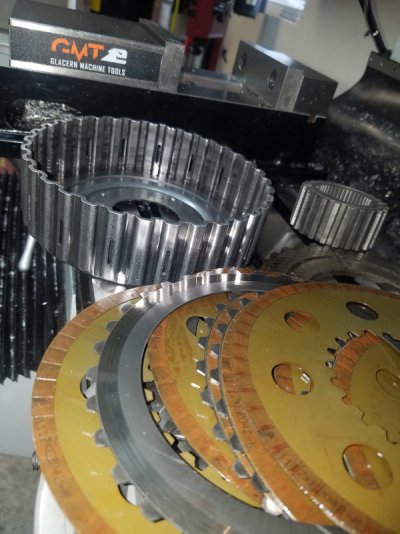
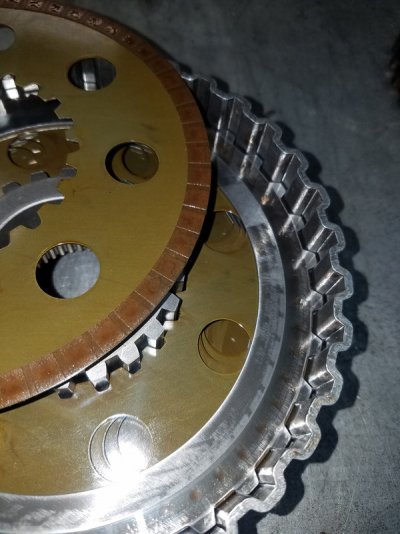
Clutch plates in decent condition. Notice how small and narrow the friction producing material is. These plate cannot take alot of slipping/friction/heat. They must engage and disengage without alot of slipping, or theyll burn up quickly.
20190311-103634.jpg

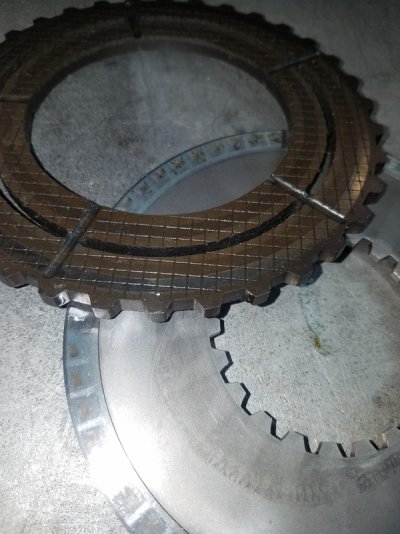
Friction surfaces of stator/rotor in good condition. The crosshatch pattern in the rotor plate MUST be in good condition for fast engagement of the front wheels. This friction producing surface creates the drag that starts the process of engaging the ballramp actuator. If this surface wears smooth, the clutch plates will engage more slowly and generate alot of heat:
20190311-103643.jpg

Notice the shiny circular portion of the rotor plate face. The upper part, wear area is around the outside of the front face. This is the area that contacts the stator face and starts the ballramp actuator. Once it wears smoothe or glazes, the clutch plates wont last much longer.

My truck now has a 44-45 installed, and programmed via alphaobd. It works perfectly. If your 44-44 is smoked and working poorly, consider swapping in a 44-45, it took me 1-1/2 hours to do.
It was a direct, drop in replacement. Very easy. The AlphaOBD programming took 10 seconds.

My 44-44 is now a science experiment, which i've studied to the n'th degree. Someday, i may rebuild it shimmed to perfection, and with upgraded Rockland clutch plates.

I have a degree in mechanical engineering technology, and my specialized electives which differentiate the various engineering technology disciplines, were in mechanical design, CAD and mechanical power transmission systems (gearboxes). My final project for Mechanical Design III, was to design a complete manual transmission for a large tractor using AutoCAD and submit a complete design package, with drawings, a bill of materials and stress analysis with a finite element analysis run using Autodesk software. Designing involute helical teeth on a conical hypoid geat is pretty tough.

I also own a machine shop, fully equipped with CNC and manual VMCs and turning centers. I'll manufacture the parts and shims needed.
If i ever motivate myself enough to start, given the lack of need, ill swap it back in and see how it works.

One of the weakest links in the system, in my opinion, is the clutch pressure plate (bottom pic, bottom part). The pressure face (shiny circular face around the outer portion of the plate), is the part that forces the clutch plates into compression (forced by the ballramp).

The ballramp applies force to the center of the pressure plate, and the pressure plate applies force to the clutch pack at the perimeter. Flexure between the center and perimeter reduces the magnitude of this axial force and refuces the effectiveness of the overall system. This pressure plate should be made of 4140 steel rather than aluminum, should be thicker, and should have radial ridges to add support and rigidity.

These weak points are what convinced me to put in a bw44-45!

 
Last edited:

Quyonmob

Senior Member
Joined
Dec 29, 2018
Posts
778
Reaction score
855
Location
Canada
Ram Year
2017
Engine
3.6
Did somebody acutally say hubs in here? Not relevant to the discussion, especially with the awesome tech info getting posted.
 

chrisbh17

Senior Member
Joined
Oct 12, 2017
Posts
6,720
Reaction score
7,525
Ram Year
2017
Engine
Hemi 5.7
@Ken226 do you know if the upgraded Rockland plates have more clutch material on the "face" of the plate instead of just the edges?
 

Ken226

Senior Member
Joined
Mar 12, 2017
Posts
2,286
Reaction score
5,914
Location
Washington State
Ram Year
2013
Engine
Hemi
@Ken226 do you know if the upgraded Rockland plates have more clutch material on the "face" of the plate instead of just the edges?


No, i dont know for certain.

The best i can do is a guess based on the parts that wouldn't be replaced, in a clutch pack upgrade.

The pressure plate shown in the bottom pic above, has a polished surface around the perimeter of the front face, that directly contacts the friction material of the clutch plate.

Each of the steel clutch plates (no friction material, inside the drum in top pic), have a similar surface.

Also, the inside of the clutch drum itself has one of these surfaces.

A wider friction material band would require a pressure plate with a wider contact surface, steel plates with wider surfaces, and a pressure plate with a wider contact surface.

To the best of my knowledge, the Rockland clutch pack comes with replacement friction plates only. I could be wrong here.

My guess is, they used a better quality friction material. But, to find out for sure, someone would need to contact them and ask.
 

Ken226

Senior Member
Joined
Mar 12, 2017
Posts
2,286
Reaction score
5,914
Location
Washington State
Ram Year
2013
Engine
Hemi
Ill take back the last statement, about a wider friction material band.

I went back out and looked closer at the steel plates.

While the pressure plate and interior of the drum have raised contact areas for the friction plate contact, where a wider friction material band wouldnt help,

The steel plates have enough area for a friction material band thats twice as wide. A wider by double friction material band would near double the abount of gripping force the clutch could transmit.

Rockland could very well have noticed this and done it in their plates. But, i dont know if they did.

20190311-133553.jpg

Im not even sure where i read that they are making better clutch plates. I cant find anything on their website. Hopefully it isnt BS.
 
Last edited:

chrisbh17

Senior Member
Joined
Oct 12, 2017
Posts
6,720
Reaction score
7,525
Ram Year
2017
Engine
Hemi 5.7
I reached out to George at RS, will post what he says.

Im kinda stuck with the 44-44 because of my MaxCare warranty....Im sure they will fix it if it breaks, but I just dont want to deal with the inconvenience (assuming it leaves me stranded in snow when it breaks)
 

LouM

Senior Member
Marine Corps
Joined
Sep 8, 2016
Posts
788
Reaction score
1,055
Location
Greeenwich/Easton upstate NY
Ram Year
2015 Ram Ecodiesel crewcab old/ 2019 Laramie Hemi old/ 2022 RAM 2500 6.7
Engine
eco diesel old / now Hemi missing the eco's mileage/ now back to enjoying diesel torqueesel
Ken226;

I have not pulled my case out or apart. A couple of years ago looking at the info BW had published greater torque being sent to the transfer case amounted to greater torque being applied to the front drive, to achieve that greater torque the rears had to have the traction to develop it.
I do know that my case will put considerable power to the front axle when the rear has good traction, you can feel it in the entire front end, with sufficient rear traction it will almost crowhop in the front. Like a conventional case.
Out of curiosity last year when my driveway was quite icy I set my floor jack under the rear differential (on a 2 x 12 plank so the jack could roll) hooked a chain from my trailer hitch to rear of my tractor and set the brake on the tractor.
With the truck in Hi Lock at an idle the rears spun free and the front would shudder but not spin, with more throttle applied the front would intermediately spin a tire, a revolution or so and pause then turn again and then pause.
I didn't keep this up very long to avoid damaging it.
I then tried low range with the same results, when the transmission shifted up a gear it would spin the front for a couple of seconds.
But with no rear traction almost no power (torque) was applied to the front axle.

Lou
 

Ken226

Senior Member
Joined
Mar 12, 2017
Posts
2,286
Reaction score
5,914
Location
Washington State
Ram Year
2013
Engine
Hemi
Ken226;

I have not pulled my case out or apart. A couple of years ago looking at the info BW had published greater torque being sent to the transfer case amounted to greater torque being applied to the front drive, to achieve that greater torque the rears had to have the traction to develop it.
I do know that my case will put considerable power to the front axle when the rear has good traction, you can feel it in the entire front end, with sufficient rear traction it will almost crowhop in the front. Like a conventional case.
Out of curiosity last year when my driveway was quite icy I set my floor jack under the rear differential (on a 2 x 12 plank so the jack could roll) hooked a chain from my trailer hitch to rear of my tractor and set the brake on the tractor.
With the truck in Hi Lock at an idle the rears spun free and the front would shudder but not spin, with more throttle applied the front would intermediately spin a tire, a revolution or so and pause then turn again and then pause.
I didn't keep this up very long to avoid damaging it.
I then tried low range with the same results, when the transmission shifted up a gear it would spin the front for a couple of seconds.
But with no rear traction almost no power (torque) was applied to the front axle.

Lou


Yes, that sounds fairly normal for that type of test.

The basic mechanics involved with the transfer case operation gets weird with most testing, and pretty weird in some real world situations as well, due to an unrelated outside system.

The fly in the ointment, is the traction control and the electronic stability control.

In the test you described, picture the following happening:

You have the rear up on jackstands so the rear wheels are hanging in the air, and the front wheels are resting on ice.

You put it in 4 lock, in drive, and take your foot off the brake.

The front wheels have more traction than the rear wheels, so the rear wheels start to rotate first, which compresses the transfer case ballramp/clutch and starts to force the front wheels into rotation.

But, immediately the traction control senses rear wheel slip and clamps the brakes on one, or the other rear brake disks. Now, the front wheels have started rotating on the ice so have some rotational momentum, which un-compresses the ballramp/clutch. Then the front wheels stop again.

With the front wheels stopped and the rear wheels still turning, the ballramp/clutch compresses again, the front wheels start rotating, the traction control starts slowing the rear wheels, the front wheels stop rotating, the traction control turns off, the ballramp compresses and the front wheels start going again

Over, and over, a couple times per second.

So, basically, in your test... and also in any rear world situation where the rear wheels ore on a surface with less traction than the front, traction contro can create that cyclical engage-disengage loop.

Rear wheel start turning, then front wheels start turning, traction control slows the rear wheels which disengages the front wheels, over and over

Does that sound like the results of your test?

Rear wheels would have been rotating with small changes to rotational speed as the traction control works.

Front wheels would have been starting and stopping, over and over?

Turning off the traction control helps the transfer case work better, but, with open diffs gives you 1 wheel per axle useable. It sucks!!

Thats why i bought a used 44-45 on ebay.

I was crawling through deep, freshly fertilized, dookey smelling blueberry feild mud mud the other day.
My 44-45 kept both axles engaged, and the traction control kept all 4 wheels turning. The systems compliment each other pretty well.

With the 44-44, traction control and transfer case tend to work against each other. Especially on really slick surfaces and low throttle inputs. Which, ironically, is when you need them the most!


Then, to even further foul up the works, the ESC kicks in, and starts shutting down your throttle input. And when/if the traction control/esc starts working on the front wheels too, at the same time as the rear wheels, that ballramp/clutch would be going *******. Next thing ya know, your hooking up the wifes Prius to pull you out. (Joking).

Oh, forgot to add. Theres also a very strong torsion spring in the ball ramp actuator which pushes the ramp plates apart unless theres enough front wheel grip/rear wheel slip to overcome this torsion spring.

Put all 4 corners of the truck on jackstands, in 4wd and let it idle in gear. Youll hear all kinds of mechanical clunking and as the traction control and transfer case fight.
 
Last edited:

chrisbh17

Senior Member
Joined
Oct 12, 2017
Posts
6,720
Reaction score
7,525
Ram Year
2017
Engine
Hemi 5.7
LouM's situation seems to be the biggest drawback of the 44-44. Does it happen often in real life? Maybe, maybe not.

That test should be re-done without traction control enabled, because remember that traction control will apply brakes to the rear wheel that is slipping the most (assuming they arent spinning at the same speed). That will give the rear traction, which in turn will "release" the transfer case from driving the front wheels. If the slipping rear wheel slips again, tc applies brakes, over and over and over again, you'll see the fronts kinda freak out between moving and not. All the while heating up the clutches in the xfer case.

Remove TC from the equation and I bet everything behaves a lot better. Add in Brandon's upcoming mod to actually lock the clutches in place, and you have the 44-44 acting as close as it possibly can to a 44-45. The Rockland Standard mod kit that actually provided a real lock would be best, but Im not sure they ever got it working (Im still interested to see if Alfa changing the xfer case setting would make the encoder work correctly with the kit)
 
Back
Top