


CowboyKyle
Member
- Joined
- May 19, 2010
- Posts
- 96
- Reaction score
- 105
- Location
- Rapid City, SD/Gonzales, TX
- Ram Year
- 2003
- Engine
- 5.7
Vehicle Recovery
When you stop respecting it, it becomes deadly.
This is for people who do it the wrong way.
Quote from Billavista's Tech Article @ Pirate 4x4:
Jerking is probably the most common type of recovery because most people have a tow strap in their rigs, although a “tow strap” is not what you need to recover a stuck vehicle. Tow straps are for flat easy towing of a vehicle, not jerking of a vehicle. You need a recovery strap, because its ability to stretch helps rebound a stuck vehicle with its stored energy when it comes back to its normal state. Use a strap for the amount of pulling you plan using it for. You need to calculate the weight of your rig and add other variables; only you can determine this as it is vehicle specific. Do not use straps in combination with chains or wire rope (tree savers exempting) and do not fasten 2 straps by knotting them together. If it is absolutely necessary to join two straps together, use a square knot to join the two. Here is a square knot and how it's tied.
Easy to join and easy to separate without fear of forever tied straps

Make sure the strap has a label stating its strength and manufacturer's information stitched in the webbing. Your rig has to be able to handle all these pressures of being ******. Use suitable tow hooks that are properly fastened and can handle the load. Do not use a trailer ball as a recovery point as it can break and become a deadly projectile. I recommend a “D” ding shackle/clevis of some sort in the receiver hitch as a suitable recovery point. See bottom of page for load ratings.
Do not rig to any suspension or steering components as failure of these components can cause harm. Take care of your straps by keeping them free of water, dirt, or harsh chemicals. Prolonged storage in direct sunlight can also cause premature wear. If your strap happens to become soiled, wash it out with water then allow dry completely, and store it in an appropriate location. As you use your strap it may develop cuts and tears in it. It will be up to you when to deem it unusable. If there is any doubt, the strap probably should not be used on your next outing.
Some people also like to use big rope for recovery which is fine too, so here is what you need to know. How to make an eye splice, and the ropes strength. A knot reduces breaking strength by 40% while a splice retains 95% of the ropes strength. Most people say the rope will break before the eye splice will come apart.
Here is a picture of the splice, literature will follow.

Step 1--Tape the ends
Cut rope will have been sealed with a hot knife to prevent the ends from unraveling. To make a splice, you need to unravel a short length of one end, but you do not want the individual strands to unravel. Put a couple of wraps of masking tape around one end of the rope and slice through it with a sharp knife to cut off the melted end. Untape the rope and tightly tape the ends of the three individual strands.
Step 2--Unlay the strands
Pick one strand (it doesn't matter which) and unwind it, making eight revolutions around the other two. Tape the rope tightly just below where this "loose" strand joins the others. Now untwist the other two strands.
Step 3--The first tuck
Form a loop in the rope the size you want the eye. The splice begins at the wrap of tape on the rope, so this marks the closing point of the eye. If you are doing an anchor line, make the loop tightly around the thimble. I generally secure the thimble in position with a wrap of tape on each leg. With the loop formed and the unlayed end on top of the standing part and pointing away from you, fan the unlayed strands naturally, i.e., with the center strand leading directly away from you, the right strand spread to the right, and the left strand spread to the left. Commit to memory that the first tuck is always the center strand and you will avoid confusion in the future about the start of splice. Lift a strand on the standing part of the rope at the point where you want the eye to close and tuck the center strand under it. On smaller and/or soft-lay rope you will be able to make the tucks just using your fingers. Large, stiff, or old line may require use of a fid or marlinespike to open the strands in the standing part of the rope. Pull this first tucked strand all the way through so that the eye is closed, but don't pull so hard that you distort the lay of the line.
Step 4--The second tuck
The second tuck is always the left-hand strand. The strand on the standing part it goes under is the one above the one you just tucked the center strand under. I remember "left-above" to keep me straight. Again, pull all of the loose strands through.
Step 5--The third tuck
This is where you are most likely to go wrong, so be careful. If the left strand goes under the "above" strand, then the right strand must go under the below strand. The confusion is not which strand, it is which direction. All tucks go right to left. The easy way to avoid doing this wrong is to flip the eye over to tuck the third strand. Once this third tuck is made, pull on all three strands in turn to snug the closure of the eye evenly.
Step 6--Over and under
The rest is easy. Pick one strand and tuck it under the strand on the standing part that is two above the one it is already under. In other words, each strand goes under one strand, over the next one above it, then under the next above that. Tuck each loose strand in turn, one tuck at a time. Turning the rope counterclockwise about a third of a turn after each tuck will help you keep the sequence and the strands straight. Give each strand a total of six tucks. Once all of the tucks are completed, place the splice on the floor and roll it back and forth under your foot to smooth it. Then loop the eye over something and put a strain on the line. Cut off the projecting "tails' of the strands and the splice is finished.
Literature from Don Casey at BoatUS.com: BoatUS Home Page
Finished product tested.
When you stop respecting it, it becomes deadly.
This is for people who do it the wrong way.
Quote from Billavista's Tech Article @ Pirate 4x4:
I first off want to say I got this information from other web sites, and have simplified it to where most people can understand. There are 2 common types of recovery that most people use; Jerking and Winching. Both of these have their advantages and disadvantages. I will explain to the best of my ability the safe and proper way to extract a stuck vehicle.
Jerking is probably the most common type of recovery because most people have a tow strap in their rigs, although a “tow strap” is not what you need to recover a stuck vehicle. Tow straps are for flat easy towing of a vehicle, not jerking of a vehicle. You need a recovery strap, because its ability to stretch helps rebound a stuck vehicle with its stored energy when it comes back to its normal state. Use a strap for the amount of pulling you plan using it for. You need to calculate the weight of your rig and add other variables; only you can determine this as it is vehicle specific. Do not use straps in combination with chains or wire rope (tree savers exempting) and do not fasten 2 straps by knotting them together. If it is absolutely necessary to join two straps together, use a square knot to join the two. Here is a square knot and how it's tied.
Easy to join and easy to separate without fear of forever tied straps
Make sure the strap has a label stating its strength and manufacturer's information stitched in the webbing. Your rig has to be able to handle all these pressures of being ******. Use suitable tow hooks that are properly fastened and can handle the load. Do not use a trailer ball as a recovery point as it can break and become a deadly projectile. I recommend a “D” ding shackle/clevis of some sort in the receiver hitch as a suitable recovery point. See bottom of page for load ratings.
Do not rig to any suspension or steering components as failure of these components can cause harm. Take care of your straps by keeping them free of water, dirt, or harsh chemicals. Prolonged storage in direct sunlight can also cause premature wear. If your strap happens to become soiled, wash it out with water then allow dry completely, and store it in an appropriate location. As you use your strap it may develop cuts and tears in it. It will be up to you when to deem it unusable. If there is any doubt, the strap probably should not be used on your next outing.
Some people also like to use big rope for recovery which is fine too, so here is what you need to know. How to make an eye splice, and the ropes strength. A knot reduces breaking strength by 40% while a splice retains 95% of the ropes strength. Most people say the rope will break before the eye splice will come apart.
Here is a picture of the splice, literature will follow.
Step 1--Tape the ends
Cut rope will have been sealed with a hot knife to prevent the ends from unraveling. To make a splice, you need to unravel a short length of one end, but you do not want the individual strands to unravel. Put a couple of wraps of masking tape around one end of the rope and slice through it with a sharp knife to cut off the melted end. Untape the rope and tightly tape the ends of the three individual strands.
Step 2--Unlay the strands
Pick one strand (it doesn't matter which) and unwind it, making eight revolutions around the other two. Tape the rope tightly just below where this "loose" strand joins the others. Now untwist the other two strands.
Step 3--The first tuck
Form a loop in the rope the size you want the eye. The splice begins at the wrap of tape on the rope, so this marks the closing point of the eye. If you are doing an anchor line, make the loop tightly around the thimble. I generally secure the thimble in position with a wrap of tape on each leg. With the loop formed and the unlayed end on top of the standing part and pointing away from you, fan the unlayed strands naturally, i.e., with the center strand leading directly away from you, the right strand spread to the right, and the left strand spread to the left. Commit to memory that the first tuck is always the center strand and you will avoid confusion in the future about the start of splice. Lift a strand on the standing part of the rope at the point where you want the eye to close and tuck the center strand under it. On smaller and/or soft-lay rope you will be able to make the tucks just using your fingers. Large, stiff, or old line may require use of a fid or marlinespike to open the strands in the standing part of the rope. Pull this first tucked strand all the way through so that the eye is closed, but don't pull so hard that you distort the lay of the line.
Step 4--The second tuck
The second tuck is always the left-hand strand. The strand on the standing part it goes under is the one above the one you just tucked the center strand under. I remember "left-above" to keep me straight. Again, pull all of the loose strands through.
Step 5--The third tuck
This is where you are most likely to go wrong, so be careful. If the left strand goes under the "above" strand, then the right strand must go under the below strand. The confusion is not which strand, it is which direction. All tucks go right to left. The easy way to avoid doing this wrong is to flip the eye over to tuck the third strand. Once this third tuck is made, pull on all three strands in turn to snug the closure of the eye evenly.
Step 6--Over and under
The rest is easy. Pick one strand and tuck it under the strand on the standing part that is two above the one it is already under. In other words, each strand goes under one strand, over the next one above it, then under the next above that. Tuck each loose strand in turn, one tuck at a time. Turning the rope counterclockwise about a third of a turn after each tuck will help you keep the sequence and the strands straight. Give each strand a total of six tucks. Once all of the tucks are completed, place the splice on the floor and roll it back and forth under your foot to smooth it. Then loop the eye over something and put a strain on the line. Cut off the projecting "tails' of the strands and the splice is finished.
Literature from Don Casey at BoatUS.com: BoatUS Home Page
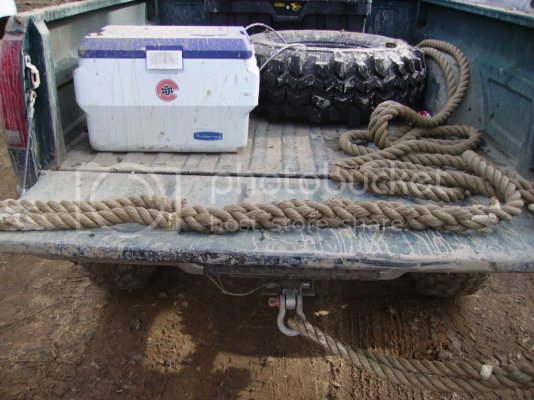
Finished product tested.