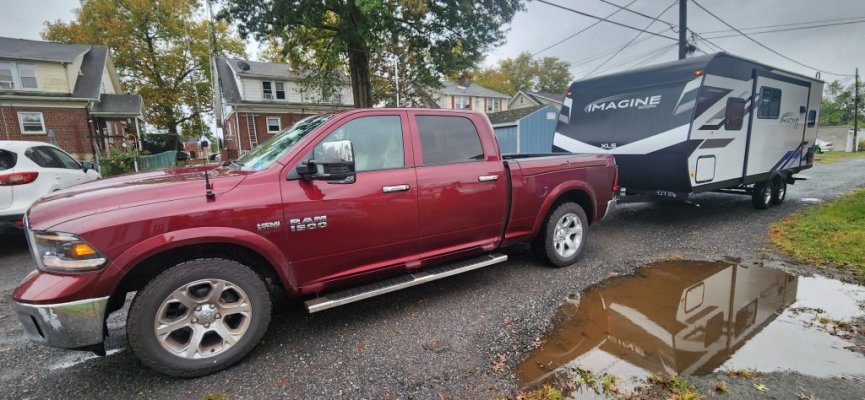
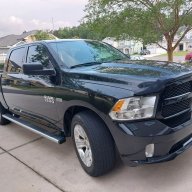
I'm going to presume you're looking at an RV since you don't give us any other details. If you AREN'T looking at an RV, a lot of what I say next will be useless...but that's still a HEAVY trailer for your 1500. You also don't tell us much about your truck, such as axle ratings and payload. You also aren't telling us what the GVW of the trailer is - dry weight is incorrect at best and useless for figuring out if you're 'good' or not. I honestly don't know why they publish a 'dry' weight, other than to tell you how much stuff you 'should' be allowed to pack in the thing. It is NOT USEFUL for figuring out if you can (or should) pull it.
Having been around the RV industry for a LONG time, I'm going to make some educated guesses.
You're looking at a GVW of probably 8500-9000 lbs. So a tongue weight somewhere in the neighborhood of around 1,000 lbs.
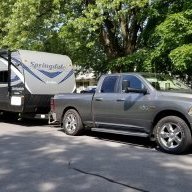
You probably have a Bighorn as it's most common. Payloads on ANY 1500 is usually in the 1000-1200 lb range, so you're close to max on that. SOME have payloads well UNDER those numbers, so it's possible you're already over just by hitching up, but without seeing your stickers we have no way of knowing.
Your axle ratings will make things look better, but you're still probably around 75% of max capacity or so. Again, this is a guess, not gospel. I would need more info on your truck and the trailer you're looking at.
Will your truck do it? Most likely. Make sure you've got a good quality WDH AND sway control, and get it set up properly to put most of the weight back on your front axle.
There is a high probability that, once you have the camper loaded, every family member/animal in the truck, and whatever else you want in the bed of your truck, that you're going to be very close to, if not well over, all of your official weights. Is it going to blow up? No. Will the truck like it? Probably not, especially your suspension. It's a pull that, as someone who has been pulling trailers of all sizes and styles for almost 30 years, I'd hesitate to do for very long, if at all.
You see, these aren't the old days where 1500 trucks were massively overbuilt, or just scaled-down versions of 2500/3500 trucks. They're built more like passenger cars with a box on the back, and the handling/ride/ratings reflect that. Sure, they ride and corner like a dream, but that comes at a trade-off of capability. My dad used to be able to pull a 28-foot fifth wheel with his 1979 F150. You'd be hard pressed to find a 28-foot fifth wheel you could put behind today's F150s, even with their heavy-duty package.
Trailers, or RVs rather, are also built a lot longer, and thus heavier, than they were in years past. I remember a time when a 35 foot camper of ANY kind was rare to find because they were so BIG. Now it's just barely the high side of average, because people want amenities in their RVs like microwaves, tvs, slideouts, etc. etc. and the easiest way to fit more stuff is to make it longer.
TL,DR: Your truck can PROBABLY do it, but you're going to be close to if not maxxed out on the truck's capabilities. Personally? I wouldn't. I'd look for an RV that is a bit smaller and lighter that will still suit your needs. Or, if you are dead-set on this trailer and you can swing it, get a 2500. It'll be a MUCH more comfortable tow.
You're going to get guys who are going to tell you 'yeah you're good, just get a set of air bags.' That is not advice I put much faith in, because the physics just don't show that it is a good solution, but rather a band-aid.