Throttle body spacers are an absolute rip off, no gains what-so-ever. You need to understand where it is physically situated, where the fuel(!) is introduced to the combustion process, with this info and an understanding why throttle body spacers are used on older NA carburated engines you see precisely how $100+USD is a total waste of hard-earned cash.
In fact, if you can hear it making noise, it is actually impeding airflow by creating parasitic drag..
OEM throttle bodies on the 5.7/6.1 flow in excess of 900cfm. Aftermarket machined units that still retain the OEM butterfly and 80mm internal cross section are just as much a rip-off as throttle body spacers. Bigger in fact...because you pay more for the privilege of owning one.
In aerodynamic terms (I won't elaborate unless someone asks), the smallest cross-sectional area dictates maximum rate-of-flow. At 30Hg these devices are no different than the OEM (unmachined) units.
Surprise surprise...no one will tell you this though, but they will definitely take your money. The existing rhetoric (in print) is overwhelming and disgusting; the HP/TQ gains are fabricated. It is a well-known that one can put the bone stock HEMI on a dyno and by making a pull at 140-150F from a cold-start can show 20+ HP/TQ without touching or changing a single part or programming parameter compared one another run at or near heatsoak. Instant performance values have now(!) been generated for those unscrupulous enough to employ them in their advertising. Sounds harsh I know, but this is one of the realities of online buying.
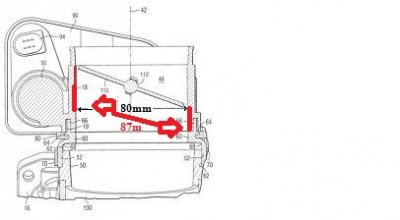
Now the standard value used for OEM throttle bodies that have been machined, is 85mm. Five extra millimeters...if you look at the wall thickness of a cast throttle body, you will see with your own eyes this is impossible. So how do they come up with this value? Simple, and cheeky to-boot; if you look at a side cross section of a throttle body you will see that at idle the butterfly resides at ~10 degree angle off of vertical. The 85mm measurement is derived from the top roof of the inlet side of the throttle body butterfly to the bottom floor and backside on the outlet side. What makes this 85mm possible is the throttle bore is not a straight shot from front to back, it's offset(!) at the butterfly. Now I can't speak for you good folks, but personally I despise being ripped off. The absolute true maximum amount of diameter increase possible on these stock cast throttle bodies by machining is ~3mm. To me that means the bore has gone from 80mm to some value less than 84mm. Get your slide rule/calculator out and figure out the percentage increase over an OEM unit. Again...given the stock butterfly is still present along(!) with the surrounding 80mm (unmachined) wall area, it matters not. There is zero increase in rate-of-flow over an unmachined unit. The principles of fluid dynamics in closed-area apertures has not changed in over 100 years.
Now throttle bodies that have actually increased the I.D. along with a larger butterfly (new - billet bodies as opposed to the OEM cast units); again, no gains. Folks over on LX Forums who are doing their own dyno testing are unfortunately finding this out. Without proper tuning the speed-density systems Chrysler employs on our platforms means the lower velocity present within the intake plenum forces the MAP sensor to O/P a value to the PCM that is not indicative of actual rate-of-flow.
The above statement only true if the another physical shortcoming has been addressed, that being the I.D. of the intake manifold itself. If the entrance to the manifold is smaller than the new larger I.D. throttle body, then there is no point even installing one.
Although no one does it, the composite (5.7) intakes can actually be machined (no more than 85mm I.D.), the 05' to 08' version's runner length/volume start impinging airflow above 5300rpm and are all done at around 5800rpm. The 09' (Eagle) composite intake is similar to the aluminum 6.1 in flowrate, but the 6.1's flange area can be easily machined out to 90mm, even 100mm. Add to this the plenum area can be accessed to modify the runner entrances as well as the exits at the cylinder head face make it possible to continue working up past 7K.
On those intakes where the flange area has been machined to accept a larger TB, the inherent algorythmns the PCM's employs to control A/F are now incorrect. Short/longterm fuel tables struggle to adapt/maintain 14.7:1 AFR's at anything below WOT. CMR tuning can compensate, but(!) that tuning is ironically mimicing the values that would be associated with...you guessed it...the OEM throttle body.
Again...900cfm is available with the OEM throttle bodies. Work out at what rpm the 6.1 or a stroked 392ci would be restricted by an aperture of 80mm I.D.
Finally, the extra (just off-idle) zip folks feel after installation of a machined throttle body occurs as a direct result of the butterfly opening to a point just off-idle where it crosses the demarkation between the OEM 80mm ID and the new larger cross section that has been machined into the front and rear portions of the OEM throttle bodies, the end-user interpretes this as new-found power. It's a placebo.
Because our vehicles employ electronic actuation of the throttle butterfly (as opposed to the traditional throttle cable), when the your foot depresses the throttle pedal and the PCM moves the butterfly an expected angle, all is well. But when it crosses that threshold I mentioned, extra air is suddenly consumed by the engine creating a momentary lean condition. THIS is the extra zest folks are feeling. The 02 sensors are (now) going WTF...they in turn immediately add extra fuel...but the lean condition has already passed. The ironic (and funny) thing is...the long term fuel tables eventually adapt to this anomaly...and the whole placebo-effect eventually disappears.
Save your money folks, there are other items out there for your HEMI that are actually effective at producing more HP/TQ than modified OEM TB's and TB spacers. There are lots and lots of 500+ RWHP HEMI's over on LX Forums that employ the OEM throttle body.
Good info about larger TB's;
Dyno Test: 85mm vs 100mm TB and Stack vs. CTP twin CAI
The dyno results from the previous thread:
Dyno Test results: 100mm vs 85mm plus Battle of the Fendermounts