

sentient_beard
Junior Member
- Joined
- Apr 22, 2020
- Posts
- 5
- Reaction score
- 11
- Location
- Utah, United States
- Ram Year
- 2018
- Engine
- 6.7L Cummins
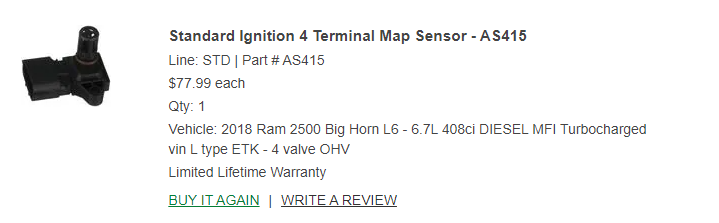
Thought I would share my experience with the P2227 error code and replacing the Barometric Pressure sensor on my 2018 RAM 2500 with the 6.7L Cummins.
tl;dr: with new(er) vehicles, though seemingly contrary to logical thought, you end up saving money by spending a little more up front for OEM parts.
Like most DIY/home mechanics, I figure most things can be resolved with some research and a few parts or tools from the local auto parts store. So when my RAM popped the P2227 code for the Baro Sensor, I figured it couldn't be that hard to replace. And it wasn't. The problem came in when I decided to try and save myself some money and get the new sensor from a local auto parts store, instead of paying three times as much for the OEM part. I was assured by multiple folks at the store that it would be a functional equivalent to the original sensor. Which, in theory it was. it fit in the same slot, used the same connector, everything looked great. Until it wasn't. After replacing the baro sensor, my truck started throwing multiple codes (baro sensor, MAF sensor, cam position sensor, turbo speed sensor, and others). At this point, I wasn't sure if it was still related to the baro sensor, or if there were other issues going on. I had plugged in the block heater a couple nights before this for the first time in a while, and I thought perhaps a power surge might have affected the circuits or ECM or something.
I had my buddy, who's worked on a lot more vehicles than I have, come take a look with me and we both came to the conclusion that all of those sensors couldn't reasonably go bad all at the same time, so we looked at what the common denominator was. We concluded either the TIPM (fuse box and associated computer chip that is sensitive to voltage changes) ECM were having problems.
So, I then disconnected everything starting with the batteries, removed the TIPM, checked every connection for damage/wear and blown fuses, checked resistance with a multimeter, and traced the wiring harness through to the ECM and pulled those connections and inspected to ensure there was no damage or unusual wear, etc. Reconnected everything, started it up and it was still throwing codes and going in/out of limp mode. Right about then, I got a postcard from Stellantis/RAM about a recall for emissions programming on the ECM. So I took it in to have that reprogramming done, thinking that if the ECM was being finicky that perhaps that might fix it. Long story made longer, it didn't. I had them keep the truck and do some additional maintenance, but also see if they could trace down what the heck the problem was with the intake/emissions and what was throwing the error. The mechanic who worked on it did all he/she could to track it down, and ultimately concluded that perhaps that baro sensor was the culprit. All credit to the Service Manager at the dealership, they called me and asked if it was okay if they put an OEM replacement sensor in to see if it would resolve the issues, to which I agreed provided that if it didn't fix it I wouldn't be charged for the part. Well, it turns out that did fix it, and I should have just done that to begin with.
Live and learn, I guess.
tl;dr: with new(er) vehicles, though seemingly contrary to logical thought, you end up saving money by spending a little more up front for OEM parts.
Like most DIY/home mechanics, I figure most things can be resolved with some research and a few parts or tools from the local auto parts store. So when my RAM popped the P2227 code for the Baro Sensor, I figured it couldn't be that hard to replace. And it wasn't. The problem came in when I decided to try and save myself some money and get the new sensor from a local auto parts store, instead of paying three times as much for the OEM part. I was assured by multiple folks at the store that it would be a functional equivalent to the original sensor. Which, in theory it was. it fit in the same slot, used the same connector, everything looked great. Until it wasn't. After replacing the baro sensor, my truck started throwing multiple codes (baro sensor, MAF sensor, cam position sensor, turbo speed sensor, and others). At this point, I wasn't sure if it was still related to the baro sensor, or if there were other issues going on. I had plugged in the block heater a couple nights before this for the first time in a while, and I thought perhaps a power surge might have affected the circuits or ECM or something.
I had my buddy, who's worked on a lot more vehicles than I have, come take a look with me and we both came to the conclusion that all of those sensors couldn't reasonably go bad all at the same time, so we looked at what the common denominator was. We concluded either the TIPM (fuse box and associated computer chip that is sensitive to voltage changes) ECM were having problems.
So, I then disconnected everything starting with the batteries, removed the TIPM, checked every connection for damage/wear and blown fuses, checked resistance with a multimeter, and traced the wiring harness through to the ECM and pulled those connections and inspected to ensure there was no damage or unusual wear, etc. Reconnected everything, started it up and it was still throwing codes and going in/out of limp mode. Right about then, I got a postcard from Stellantis/RAM about a recall for emissions programming on the ECM. So I took it in to have that reprogramming done, thinking that if the ECM was being finicky that perhaps that might fix it. Long story made longer, it didn't. I had them keep the truck and do some additional maintenance, but also see if they could trace down what the heck the problem was with the intake/emissions and what was throwing the error. The mechanic who worked on it did all he/she could to track it down, and ultimately concluded that perhaps that baro sensor was the culprit. All credit to the Service Manager at the dealership, they called me and asked if it was okay if they put an OEM replacement sensor in to see if it would resolve the issues, to which I agreed provided that if it didn't fix it I wouldn't be charged for the part. Well, it turns out that did fix it, and I should have just done that to begin with.
Live and learn, I guess.