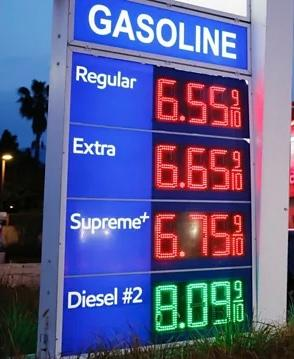
Anyone who’s ever had to live paycheck-to-paycheck will appreciate the difference. BTDT
Later, in a more successful life…. maybe it ‘s irrelevant.
Re:
@malquid I agree w/most comments. I have a diversified fuel situation: A number of small engines that sit for long periods between use, a couple gasoline-powered vehicles, and a few diesel utility machines as well as two Rams….one gas and one diesel.
For the ranch machines I have a diesel storage tank and at-present, the diesel in it is ordinary No2 from WalMart…(injected with BioborJF). But in a former life I was responsible for maintenance on jet aircraft and we used Biobor JF in them to prevent microbes and the accompanying corrosion-risks associated.
Just for everyone’s benefit: diesel (and jet fuel/kerosene) can have water condense on tank side-walls and run down and settle at the bottom of the tank. As fuel is consumed, atmosphere (with yeast & fungal spores…ever make sourdough bread-starter..?? ) enter the tank to replace the consumed fuel. (air in the tank above the fuel is called “ullage”.)
The spores mix with condensed water on the tank-walls…and run down to settle at the bottom of the tank. The microbes
live in the water….and consume the fuel for food….and the body-wastes are corrosive and form “masses” of gelatinous mats which can clog pumps, plumbing, foul sensors, and cause quantity-gauge reading errors. (Since airplane wings are also used for fuel tanks, the corrosive wastes damages lower wing-skins and reduces wing strength….so prevention is important.)
Biobor JF is a preferred anti-microbial….BUT…. it must not be “dumped” into a tank or it will quickly form a huge “gel” mass. (Dumping a “barrel” of it into a ships fuel-bunker is Not the way to do this.)
It must be “metered” at the correct proportion and “injected” into the fuel-stream as the tank is re-filled with fuel….to properly mix, distribute and inter-mix with the fuel.
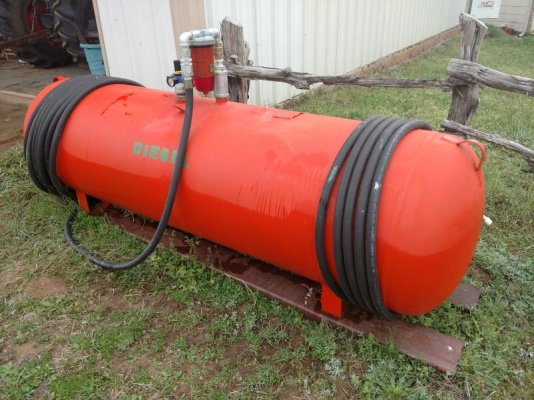
My own “home-made” diesel fuel storage system is made from an old propane tank. A “dip tube” picks up fuel from just above the bottom of the tank, and leaves the tank thru a water-separator/filter and a common hose and nozzle. There is NO PUMP. Compressed-Air from my shop air-compressor is regulated at 10-psi to pressurize the tank which forces the diesel up the dip tube. (a dryer is installed at the compressor-exit to reduce/prevent moisture from entering the tank)
@malquid : As you noted, diesel fuel does not “age” like gasoline will. The WalMart road-diesel in my tank is 2 yrs old…but it’s almost empty now and about to need re-filling (now that we have a war …oops… “excursion” … going-on, dammit!)
I use my tractor front-end-loader to pick up the propane tank and place it on my trailer to haul into town to refill it. (the delivery fees and cost of off-road dyed-diesel makes this method more economical. Last time (2023) they quoted $4/gal plus $12 delivery…. while WM was selling road-tax diesel for only $3.09…. there must be idiots around that think they’re saving money buying dyed-diesel around here. Either that, or they don’t have the ability to transport their storage tanks.)
Anyway, I don’t worry about diesel fuel getting some age on it. As for my gasoline engines….I keep 100 octane aviation gasoline (AvGas, which is still Real Gasoline…not the paint-thinner they sell on the street these days) handy for long-term storage and for little-used engines …such as lawn equipment, generators, log-splitters, tillers, etc… and, oh yeah, my airplanes….which may not fly for an entire year, but when they DO… I want reliability and no engine-harm from old fuel issues. AvGas does not suffer from the degredation of mogas….(the Confederate…Ooops… I mean the Commemorative Air Force was Begun by some South Texas crop-dusters who bought 20-yr old WW2 airplanes stored in AZ for 20-years…for the 20-yr-old AVGAS sitting in them. The military had stored them Full of Fuel to preserve the rubber-bladder fuel tanks in the wings. They could buy the airplanes for aluminum-scrap prices….the fuel was virtually Free! They had planned to SCRAP the airplanes! …but, when they flew them home to Texas to drain the fuel out of them……. discovered how much FUN they were to fly…so …. Now you know the REST of the Story!)*….the only problem with it is that it still contains old-tyme TetraEthyl-Lead ….which would kill modern vehicle emissions controls….so I don’t use it in those.
Hope this post is informative if not short.
PS: the fuel filter canister is tinted…..that’s not red-dyed-diesel….it’s clear fuel.
* PPS: Don’t believe everything you read on the “‘net “. Wikipedia has a “politically-correct” B.S. story about the beginnings of the CAF. The CAF’s own website tells a very different “for the public’ version which differs almost entirely from the Wikipedia. The version I tell here was related to me in-person by CAF-Founder “Lefty” Gardner IN his own home, with “Pappy” Boyington standing next to him with a drink in his hand. Why was this happening?
Because, for several years, in late ‘70s/early ‘80s, I was the chief pilot for a large corporation which had loaned myself and the company jet to “Tennesee” Ernie Ford and had flown Mr. Ford from San Francisco into several early “AirSho” gatherings in Harlengen, TX where he assisted “Emcee” the shows…and I had the pleasure of attending cocktail parties with them after the days activities.