- Joined
- Jan 1, 2018
- Posts
- 1,786
- Reaction score
- 2,248
- Location
- Westminster, MD
- Ram Year
- 2018 Power Wagon
- Engine
- 6.4L Hemi
It all came from amazonWhere did you purchase your light bar?


Disclaimer: Links on this page pointing to Amazon, eBay and other sites may include affiliate code. If you click them and make a purchase, we may earn a small commission.
It all came from amazonWhere did you purchase your light bar?
My wife works at the hospital here in Fredericksburg. I call it the big city population like 13k. Our farms town pop is 350Must be nice being out there. My office job (and my wife working in a hospital system) has us in the suburbs/city for now, but in a few years hopefully we can move out a ways and get rid of this parking garage issue!

My wife works at the hospital here in Fredericksburg. I call it the big city population like 13k. Our farms town pop is 350
Heavier components help when you hit potholes, doesn't matter if you use it as a "truck" or a "car", potholes will damage components.Beefier- yes, but not everybody needs beefier. Heavier components do last longer but that’s really only if you use your truck for an actual truck. That’s why the halftons have migrated away from the Heavy Duty and why the 3/4-tons and one tons have gotten more towards it. All three weights of trucks are better suited for what they were designed to be used for.
A heavier truck is not always safer. Heavier trucks take longer to stop. They’re taller which contributes to higher center of gravity which affects handling and cornering. All of those “heavier and beefier” components probably aids in much less crumple zones which will hopefully keep you alive in a serious accident. Not saying the 2500’s are less safe, just saying that it’s general dynamics.
My vote is for choosing a specific duty of truck for which it will be used- unless you just want something heavier built for whatever reason.
Sent from my iPhone using Tapatalk Pro
Your heavier components might protect a little better against potholes but it’s not the difference between night and day. Again, not everybody needs beefier, heavier components to have a good, long-lasting truck so this part of the argument is in fact invalid.Heavier components help when you hit potholes, doesn't matter if you use it as a "truck" or a "car", potholes will damage components.
Maybe if you’re pulling a heavy trailer(which is where the 3/4-especially with the CTD shines) you’ll stop quicker than me. Just because you got heavier brakes, that only means so that big ole heavy truck can stop in a timely manner like it’s supposed to. Heavier truck should have heavier brakes. Especially one that is designed as yours with that big ole Cummins under the hood. It should have bigger brakes to not only stop itself, and whatever’s behind it so again, your counter-argument here- is invalid.My Ram is heavier, as are my brakes. Add in the exhaust brake and I bet my 3/4 ton diesel slows quicker than your half ton.
Depends on which models you’re comparing. The Ram 1500 varies from 77 inches to almost 78 inches and the Ram 2500 varies from 76 inches clear up to 81 inches.The 2500 Ram is 79.8 inches tall. The 1500 Ram is 77.7 inches tall. Yes, they are slightly taller, but my Ram has a stiffer suspension and stronger sway bar than a half ton, so it is less effected by cornering.
And feel every bump, too. But again, based on what your truck was made to do and what mine was made to do, my pickup was pretty solid even with those car-rated Goodyear’s they stuck on there from the factory. They didn’t feel spongy at all. Actually rode really nice. Now if I towed something heavy, that’s where your truck would shine. But see, not everybody tows as much as what that big ole, beefier, heavier duty 2500 is capable of towing.Add in the E rated tires on the 2500 as opposed to the spongy car rated tires on the 1500 and the 2500 should feel even more solid going through turns.
Ram 2500 and Ram 1500 are both 4 star rated in crash tests, so your theory about crumple zones is wrong too. Also, crash testing is done against similar size and weight vehicles. If your 1500 crashed into my 2500 I would expect the heavier vehicle to carry more force through the collision, leading to less G force on my body. It is a proven fact that the heavier car wins wrecks. Crumple zones and air bags help protect the occupants, but physics always wins.

I agree, buy the right tool for the job but I’m starting to wonder if your logic also means trying to convince someone to always have a sledge hammer on hand even when you need to drive a brad nail home.Yes, buy the right tool for the job, but understand what makes it the right tool.
Um, no they weren’t . If you’re not using your big ole 2500 to do what it’s designed to do, it’s really just overkill; unless that’s just the kind/type of truck you want.All 4 of your points were dead wrong and inaccurate, so don't decide what to buy based upon those.
That’s what it’s all about, irregardless of what you or I both say.Buy what you want.
See, this right here is primarily what it’s all about. This is really the only truly accurate argument you’ve made that actually pertains to the whole discussion that is valid. You state here that for a long time, you only had 1/2-tons because that’s all you needed. Now that your needs have changed, you’re trying to argue points for points with a 1/2-ton owner just because you’re now a HD owner.I had half ton trucks for a long time, because that 's all I needed. Now that I need a heavier truck, I have one.
Having had an F150, a Tundra and now a Ram 2500, I can tell you that there is ZERO reason why a 3/4 ton truck can't be a daily driver. It costs a little more, but gives you much more options.
Actually no, I’m not. My argument is still generally the same. It’s always been about safety and comfort.Cornelious... now you are changing the argument. You took it from SAFETY, to COMFORT. Its hard to have an education disagreement if you keep changing the parameters of the discussion.
I know you didn’t, and contrary to popular belief, I didn’t say you did but the way you present your argument is a blatant discredit to half-tons. But it’s fine. As it’s been said already, it’s kind of to be expected since the topic was generated in the Heavy Duty section of the forum.I never once said a half ton is inferior.
This entire thread is about the capabilities of a heavy duty pickup truck. I am discussing what makes a HD truck a worthwhile investment.
You even admit that you upgraded your car tires and put D rated tires... so its not just about comfort for you.
I respectfully disagree. Unless you’re using that big 3/4-ton for what it was intended, your truck ain’t gonna stop quicker than mine, it ain’t gonna corner better than mine and it ain’t gonna ride smoother than mine. If someone abuses a truck quite much then your heavier components will counter that but if you’re someone that takes care of your truck and doesn’t hammer on it, beefier components ain’t gonna make a truck last longer than a truck with less-heavier stuff.All of my comments are 100% correct.
Heavier truck, heavier brakes, stronger and larger piston clamping larger and thicker pad.
Heavier components last longer. I'm not going to apologize for that fact. It is what it is.
You yourself admit that there are HD trucks with lower profiles than half tons. You yourself invalidate your own opinion.
Um, I don’t know where you got that from but I didn’t say that I agree with you that heavier vehicles fare better.Glad we can both agree that heavier vehicles fare better. If we had to argue the principles of physics... we'd be here a while.
Really? The OP was asking advice about payload and bed length. Now the conversation tangants off into "My truck is better than your truck".
To the OP, if you need the additional payload and bed length, a 2500 is a great vehicle to provide just that. The 1500's have a place in this world too, which is why there are are so many more of them on the road. Which ever you decide, RAM has plenty of options for you. Good luck.
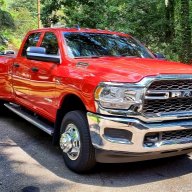
Nah nobody has really given me any reason not to. Lol. My main concern would be that I park in a parking garage at work and the clearance is 6’8. I’d be pretty limited with being able to level or put on larger tires, if that would fit at all. We have a f350 dually that parks in here, but no lift and I believe the rams are a little taller than the fords. I really just need to go drive a few and measure them to see.
Yeah my 1500 has been a great truck for me, just see my needs potentially changing over the life of my next one. I wouldn’t say I NEED the extra bed length and payload but in a lot of ways it would give me peace of mind when I need to get something done. I’m very much a “would rather have it and not need it than need it and not have it” kind of person but it’s good to see both sides of the argument. As long as I can park it at work, I’m definitely leaning towards it when I decide to pull the trigger. Very appreciative of all the responses.


