Random Car Picture Thread

Disclaimer: Links on this page pointing to Amazon, eBay and other sites may include affiliate code. If you click them and make a purchase, we may earn a small commission.

HemiLonestar

Senior Member
Navy Badge Coast Guard
Joined
Jun 1, 2012
Posts
6,783
Reaction score
4,650
Location
MD
Ram Year
2016
Engine
5.7 hemi

Wild one

Senior Member
Joined
Jan 17, 2016
Posts
23,670
Reaction score
54,354
Ram Year
14 Sport
Engine
5.7

Wild one

Senior Member
Joined
Jan 17, 2016
Posts
23,670
Reaction score
54,354
Ram Year
14 Sport
Engine
5.7
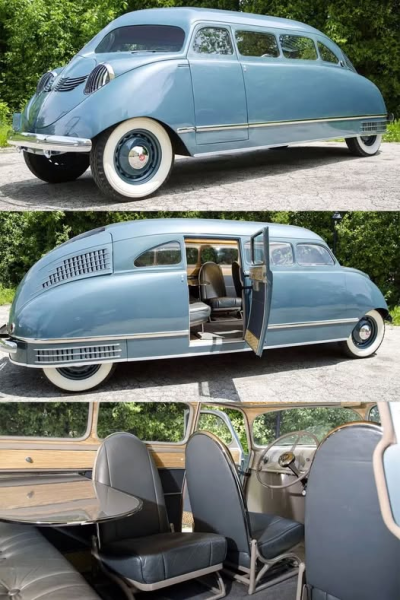
1936 Stout Scarab (world's first minivan?)
An Art Deco beetle on wheels, this aerodynamic vehicle turned heads with its bulbous aluminum body riveted to an aluminum space frame much like an airplane. Engineer William B. Stout placed the engine in the rear, creating unprecedented interior space within the 135-inch wheelbase and just-over-16-foot length.
Integrated fenders, rear-wheel skirts, hidden door hinges, and flush glass all contributed to its streamlined aerodynamics. All-wheel independent suspension provided a comfortable ride, while hydraulically operated cast-iron drum brakes handled stopping duties.
The revolutionary interior featured rotating seats that could turn 180 degrees to face each other, with a fold-down table for meals or games. Passengers entered through a central push-button door. Lacewood covered the ceiling from front to back.
A 90-horsepower Ford flathead V8 paired with a three-speed manual transmission provided performance adequate for the era, with a top speed of around 80 mph. At about $5,000 (nearly $100,000 today), the Scarab was priced far beyond most family cars. Fewer than a dozen were built before World War II, and only about five are known to survive today.
Compared to the upright sedans and coupes of the 1930s, the Scarab’s one-box profile, flat floor, and flexible seating arrangement were decades ahead of their time. While buses offered space, no passenger car of the era combined comfort, practicality, and interior versatility in this way. These qualities are why the Scarab is often credited as the world’s first minivan.

1776822839269.png
 

Wild one

Senior Member
Joined
Jan 17, 2016
Posts
23,670
Reaction score
54,354
Ram Year
14 Sport
Engine
5.7
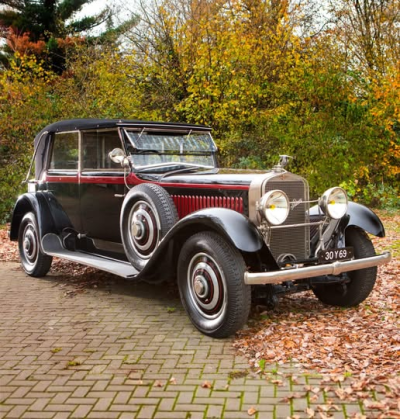
1925 Hispano-Suiza H6B Convertible Sedan
The seven-bearing crankshaft of the H6's 6,597 cc engine was machined from a massive steel billet to a dramatically reduced finished weight (period accounts often cite figures around 35 pounds), an approach that spoke directly to Marc Birkigt's background in aircraft engineering.
The all-aluminum straight-six was derived in concept from Birkigt's wartime aviation engines, carried over with its overhead camshaft and screwed-in steel cylinder liners, with water passages treated internally to resist corrosion. The engine displaced 403 cubic inches (6,597 cc).
The H6's servo-assisted four-wheel brakes were the first production power-assisted system of their type, the servo driven mechanically from the transmission. Rolls-Royce subsequently licensed the patent, though their implementation differed in detail.
The H6B, introduced for 1922, brought a modest power increase over the original H6, with output commonly cited around 135 horsepower at approximately 2,500 rpm through a three-speed gearbox (the flexibility of the engine making a closer-ratio box unnecessary).
Hispano supplied rolling chassis to coachbuilders across Europe, and the low, rigid platform attracted some of the finest houses in Paris.
The Belvallette concern, working under license from Gustave Baehr, offered a fully convertible body design of notable mechanical ingenuity, allowing the car to function equally as an enclosed sedan or open touring car.
Between 1919 and 1933, approximately 2,350 examples of the H6 series were produced across all variants.

1776823450376.png
 

Wild one

Senior Member
Joined
Jan 17, 2016
Posts
23,670
Reaction score
54,354
Ram Year
14 Sport
Engine
5.7
1964 Shelby 289 Cobra "Snake Charmer" (CSX2227)
Carroll Shelby's vision of combining American V8 power with lightweight European chassis engineering created one of motorsport's most legendary partnerships.
This particular example carries extraordinary provenance through its longtime owner Henry "Hank" Williams, a WWII veteran and jazz musician who earned the celebrated nickname "Snake Charmer" after literally talking Carroll Shelby into giving him the Le Mans team shirt off his back at a California race.
About 528 Mark II examples were produced from early 1963 through summer 1965, representing the refined second generation of the Cobra program.
The Mark II featured significant improvements over earlier models, including rack-and-pinion steering borrowed from the MGB and a new steering column from the VW Beetle. Design changes included slightly flared wheel arches, side vents, and a wider grille opening to improve cooling.
This specific Cobra (chassis CSX2227) includes an original removable hardtop, now extremely rare, which Williams acquired so his wife could comfortably ride along. The Snake Charmer campaigned this car in nearly 400 races over six decades, accumulating over 140,000 miles while maintaining single ownership until his passing at age 99.
The 289-cubic-inch Ford small-block V8 replaced the earlier 260-cubic-inch unit, providing substantially more power through a single four-barrel carburetor and a four-speed manual transmission.
Transverse leaf spring suspension front and rear, with inboard disc brakes, kept weight minimal (about 2,100 lb / 953 kg) while delivering the performance that dominated road courses against European competition.

1776823733147.png
 

Wild one

Senior Member
Joined
Jan 17, 2016
Posts
23,670
Reaction score
54,354
Ram Year
14 Sport
Engine
5.7
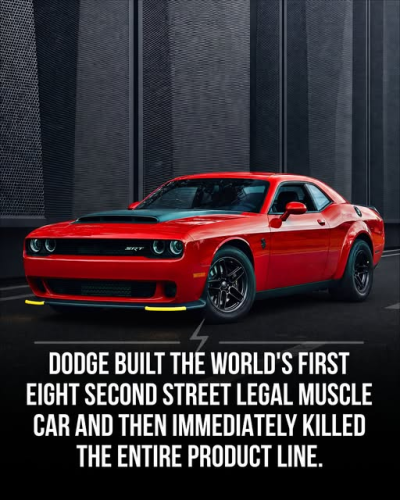
2023 Dodge Challenger SRT Demon 170
Dodge CEO Tim Kuniskis said it plainly at the reveal: "In 2015, Dodge shocked the world with the 707-horsepower Hellcat. Then in 2018 we did it with the 840-horsepower Demon, and now we are doing it again with the 1,025-horsepower Demon 170, the world's first sustainable-energy, eight-second factory-production, street-legal muscle car." That sentence alone deserves a moment of silence.
Running an eight-second quarter-mile was once the exclusive domain of million-dollar specials or heavily modified racers. The Demon 170 did it straight from the factory, a feat that earned it an NHRA violation letter because it ran faster than allowed without a roll cage or a parachute. A production car. Banned before it even hit showrooms.
The supercharged 6.2-liter HEMI produces 1,025 horsepower on E85 ethanol fuel, covering the quarter-mile in a certified 8.91 seconds at 151.17 mph, with a 0-60 time of 1.66 seconds and a peak G-force of 2.004 Gs, the highest of any production car ever built. The fueling system alone can supply 164 gallons of fuel per hour, more than a typical US shower head delivers in the same time.
Production was capped at 3,300 units, with 3,000 reserved for the United States, starting at $96,666 MSRP. This was the seventh and final Last Call special edition, a series Dodge created specifically to celebrate the end of the Challenger and Charger in their V8 forms after the 2023 model year. They did not go quietly. They went with 1,025 horsepower, a parachute port in the bumper, and a quarter-mile time that would embarrass most dedicated race cars. History will not forget this one.

1777262543496.png
 

Latest posts

Members online

Forum statistics

Threads
210,912
Posts
3,059,552
Members
170,842
Latest member
stevenmicheal
Back
Top