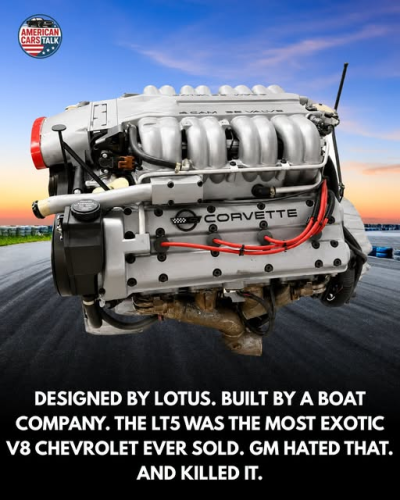
In 1986, GM bought Lotus. Not the car company people think of. Lotus Engineering, the consultancy in Hethel, England, that designed suspensions, engines, and chassis for other manufacturers. GM bought them because Chevrolet had a problem: the C4 Corvette needed more power to compete with Ferrari and Porsche, and GM's own powertrain division couldn't build a competitive overhead-cam engine. They considered a turbo V6. Nobody wanted a six-cylinder Corvette. They considered twin-turbo small-blocks. Emissions wouldn't pass. Tony Rudd at Lotus suggested building an entirely new engine from scratch. Lloyd Reuss, head of Chevrolet-Pontiac-Canada, approved it. The result was the LT5: a 5.7-liter all-aluminum DOHC 32-valve V8 designed by Lotus in England that shared exactly one dimension with the existing Corvette small-block (4.40-inch bore spacing) and zero parts.
The LT5 was a clean-sheet design that happened to physically fit in a Corvette engine bay. Aluminum block with Nikasil-coated cylinder liners. Aluminum Rotocast DOHC heads with four valves per cylinder. 11.0:1 compression. Bore: 3.90 inches. Stroke: 3.66 inches. 350 CID. Forged steel crankshaft, forged steel connecting rods, forged aluminum pistons. Three throttle bodies controlled by the ECM based on throttle pedal pressure (one, two, or all three opening progressively). A dual-plenum intake manifold with two-stage runners and sixteen fuel injectors (eight primary, eight secondary). At part throttle, eight injectors and half the intake runners were shut off, limiting output to approximately 200 HP for fuel economy and drivability. At wide-open throttle, all sixteen runners and all sixteen injectors opened: 375 HP at 5,800 RPM and 370 lb-ft at 4,800 RPM.
GM couldn't build it. Their own factories weren't set up for hand-assembled, low-volume, all-aluminum DOHC engines. So they contracted Mercury Marine's MerCruiser division in Stillwater, Oklahoma, a company that built boat engines, to machine and assemble every LT5 by hand. Each engine was individually assembled by a single technician, dynoed, and documented before shipping to the Corvette assembly plant in Bowling Green, Kentucky. The ZR-1 debuted in 1990 and was immediately nicknamed "King of the Hill." At Fort Stockton, Texas on March 1, 1990, a stock ZR-1 set seven international and world speed records verified by the FIA. In 1993, GM upgraded the LT5 to 405 HP with four-bolt main caps, improved heads, revised cam timing, redesigned pistons, and new exhaust manifolds. The target had always been 400 HP. They got there three years late.
Then GM killed it. Internal resentment had been building since the beginning: the most impressive Corvette engine was designed in England by a company GM had to buy and built in Oklahoma by a company that made boat engines. GM's own powertrain engineers had no role. Sales of the ZR-1 collapsed after 1990 (3,032 units in 1990, 502 by 1992, 448 per year through 1995). The LT5 was expensive to produce and limited in volume. Mercury Marine stopped manufacturing LT5s in late 1993, with pre-built engines supplying ZR-1 production through the 1995 model year. Total production: 6,939 ZR-1s. The LT5 was replaced by nothing. The next Corvette returned to pushrod V8s. The next DOHC Corvette engine wouldn't arrive until the LT6 flat-plane-crank V8 in the C8 Z06, twenty-seven years later. Lotus designed it. A boat company built it. GM killed it. The LT5 was the most exotic production Corvette V8 ever made. And GM couldn't wait to forget it.
View attachment 586944