
TheBlueFalcon
Junior Member
- Joined
- Feb 12, 2019
- Posts
- 5
- Reaction score
- 6
- Location
- Yakima, WA
- Ram Year
- 2013.5
- Engine
- 6.7L Cummins Turbodiesel
Thanks to COVID-19, I've been working on my truck to keep myself sane and save some money. This is a DIY repair tutorial for anyone that may have a stripped nutsert housing for the CCV (crankcase vent) cover bolts. It will be long and detailed!
Cost of repair the "right way" = $500.
Cost of repair this way = <$20
Quick history of how we got here:
This was a problem that began a couple years ago with a terrible mechanic. It only recently got bad enough to require attention.
Long story short, his shop had my 2013 Ram 3500 6.7 and the required repair parts for 3 months after I did something to the engine but they still hadn't touched it, so I put some pressure on him to get it done ASAP. Bad idea it turns out, because he did a lot of crap wrong, electing to not route wires appropriately or use some of the non-critical bolts, screws, etc. Some days, I wish I'd sent BBB or FCA after him, it was awful... Still finding things wrong to this day.
Well, he also used a drill for every nut and bolt he could, including the CCV cover bolts.
Why Cummins opted to make that out of plastic, I will never understand...
Being plastic, if you get on those bolts with too much torque and the cover isn't properly seated, the brass hex nuts in the cylinder head cover will pull out slightly and start spinning, gouging out the plastic surrounding them as they go. I suspect this gets worse if the engine is warm at all, since the plastic seems to go from brittle to somewhat softer as it gets hot.
To make matters worse, the plastic can end up getting reworked so that it fills the bottom of each corner of the hex cutout so that your hex can't reseat completely, rendering it useless...
Well, ever since dummy worked on the truck, it had a steady and annoying oil leak from the rear of the CCV cover where he had royally screwed up one of those hex cutouts. Not enough to drip from the truck or risk running out of oil, but enough to cake things somewhat with grime amd baked oil residue. Recently, it worsened significantly to the point my transmission had enough oil on it coming from the top of the engine, I thought I had an issue with the trans.
The Fix
I asked the local Cummins shop and they see this a lot apparently, but the typical fix is to replace the cylinder head cover and be more careful. For the record, the guy said those bolts only require something like 5 INCH-pounds of torque, so be careful.
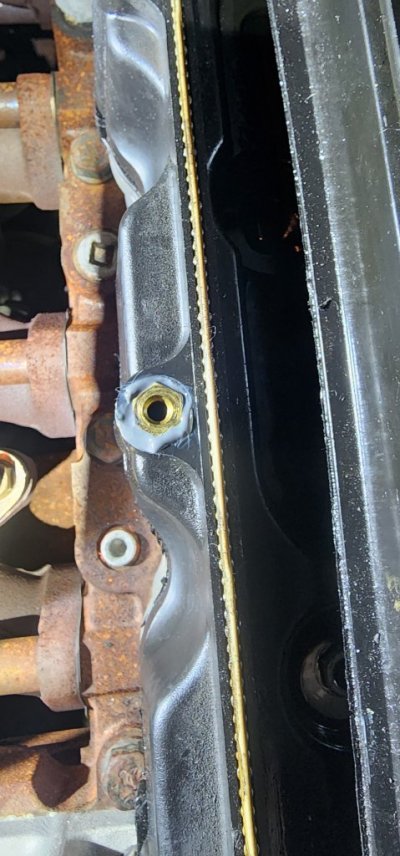
Rather than buy another POS cover, I decided to try using some high-heat epoxy to recreate the molding around the hex nuts. It has worked so far and required no fancy tools.
Required supplies:
Remaking the Holes

Cost of repair the "right way" = $500.
Cost of repair this way = <$20
Quick history of how we got here:
This was a problem that began a couple years ago with a terrible mechanic. It only recently got bad enough to require attention.
Long story short, his shop had my 2013 Ram 3500 6.7 and the required repair parts for 3 months after I did something to the engine but they still hadn't touched it, so I put some pressure on him to get it done ASAP. Bad idea it turns out, because he did a lot of crap wrong, electing to not route wires appropriately or use some of the non-critical bolts, screws, etc. Some days, I wish I'd sent BBB or FCA after him, it was awful... Still finding things wrong to this day.
Well, he also used a drill for every nut and bolt he could, including the CCV cover bolts.
Why Cummins opted to make that out of plastic, I will never understand...
Being plastic, if you get on those bolts with too much torque and the cover isn't properly seated, the brass hex nuts in the cylinder head cover will pull out slightly and start spinning, gouging out the plastic surrounding them as they go. I suspect this gets worse if the engine is warm at all, since the plastic seems to go from brittle to somewhat softer as it gets hot.
To make matters worse, the plastic can end up getting reworked so that it fills the bottom of each corner of the hex cutout so that your hex can't reseat completely, rendering it useless...
Well, ever since dummy worked on the truck, it had a steady and annoying oil leak from the rear of the CCV cover where he had royally screwed up one of those hex cutouts. Not enough to drip from the truck or risk running out of oil, but enough to cake things somewhat with grime amd baked oil residue. Recently, it worsened significantly to the point my transmission had enough oil on it coming from the top of the engine, I thought I had an issue with the trans.
The Fix
I asked the local Cummins shop and they see this a lot apparently, but the typical fix is to replace the cylinder head cover and be more careful. For the record, the guy said those bolts only require something like 5 INCH-pounds of torque, so be careful.
Rather than buy another POS cover, I decided to try using some high-heat epoxy to recreate the molding around the hex nuts. It has worked so far and required no fancy tools.
Required supplies:
- 1/2" and 1/4" drillbits and drill
- JB Weld Steel Reinforced Epoxy (syringe)
- JB Weld Static Mixer tip
- Shop rag
- Tape to mark depth on drillbit
- Tarp or blanket (Depending on your climate/time of year/availability of a garage)
- Air compressor or canned air
- Block heater or constant heat source
- CCV filter since yours may be swamped as a result of the gasket not seating completely.
- Replacement gasket just to cover your bases.
Remaking the Holes
- I didn't bother waiting for my engine to completely cool, but it was probably around 135° when I started. I started by removing the CCV cover and I left the filter in place to keep debris out.
- Now, the hole I needed to work with had become shallower as well as having the hex cutout deform, so I presume the plastic effectively pooled in the bottom somehow or got compacted down there after the initial spinout. I marked a 1/4" drillbit to match the required depth for the brass hex nut to seat fully.
- At low speed, I carefully drilled out the material in the bottom to accommodate the OEM nutsert. I figured if I only drill that far down, it can't damage anything since it apparently used to be that depth for the nutsert to fit.
- Once depth was adequate, at the lowest speed setting and just barely fast enough to do work, I used a 1/2" drillbit to scrape/round out the top of the hex nut cutout a few revolutions at a time.
- Every 3-4 revolutions, I would used compressed air to blow debris out and insert the brass nutsert upside down to see if it was seating completely yet.
- Once the depth was right and the nutsert was flush, I cleaned everything real good with compressed air and used a wire brush to clean up the brass nutsert.
- I used JB Weld Steel Reinforced Epoxy (syringe) with the JB Weld Static Mixer tip for precise placement of the epoxy - much easier to control. If you apply too much, you'll have it get inside the nut's threads and ruin it. You need to barely coat each side of the nutsert without getting any in the slots on the sides.
- You also need to generously coat beneath the hex nut's shoulders. Your goal with this is to have enough epoxy to have it fill the gaps between the housing and the nut as you push the nutsert flush with the housing.
- Once applied, push the nutsert down with steady pressure as far as you can manage with your thumb.
- Now get a hammer, wrench, or whatever and very lightly tap the nutsert down until it is flush.
- Immediately take a rag and wipe away any excess epoxy, moving away from the center of the brass nutsert with each stroke. Keep wiping until you're sure you have all excess removed. You must not have any epoxy where it doesn't belong!
- I went ahead and carefully removed my CCV filter now and wiped away any plastic shavings that fell in the hole on the top. I then set my new filter/gasket in place.
- Since the epoxy was cleaned up well, I also gently seated the CCV cover but left the bolts out for the curing process.
- Being in AK, it's still dropping to below 20°F at night, so I put a large, flattened trash bag over the top of the engine to trap heat, and draped a tarp over the entire engine compartment before shutting the hood and plugging in the block heater. This maintained 70°F in the top of the engine compartment for the night. I waited 12 hours.
- After waiting, I put in each bolt and carefully tightened them down in a star pattern like you do with lug nuts until the cover was flush (or close enough and I didn't want to over-torque the plastic).
- I wiped down the top of the engine so I could determine if it was still leaking.