Ponder it a little more. Keep in mine the effect the moving road surface has on these parts, via the tires/wheels.
If the transmission powers the transfer case, and inputs torque into the rear ramp plate of the ballramp actuator, and the front ramp plate is 'powered by' the torque -from- the rear ramp plate, then
The more traction (resistance to rotation) the front tires have, the more force is requirrd be input into the rear ramp plate. More force into the rear ramp plate, puts more compressive forces into the clutch pack.
Less traction in the rear tires, while still having good front tire traction, (ie, front ramp plate puts force to the road, rear ramp plate spins tires ), means i higher percentage of the total force is put into the rear ramp plate and converted into axial (compressive) force via the balls being force up the shallow side of the ramps.
Once the rear and front tires have equal taction, then the 4 tires will be rotating over the road surface, or spinning in the snow, with equal speed. Then, the front and rear ramp plates will be rotating in sync and no more compressive force will occor in the ball ramp.
Im trying to be articulate, but sometimes the description isn't as clear as the idea.
Does this make sense?
Your transfer case may not be working this way, but its supposed to. The condition of your individual transfer case will necessarily determine how close, or not, it works with respect to how its supposed to work.
In order for it to work right, the roughly machined friction producing surfaces of the rotor/stator must be in good shape, and the clutch plates themselves must have good friction producing surface finished.
Pics in a few minutes.
Clutch plates in decent condition. Notice how small and narrow the friction producing material is. These plate cannot take alot of slipping/friction/heat. They must engage and disengage without alot of slipping, or theyll burn up quickly.
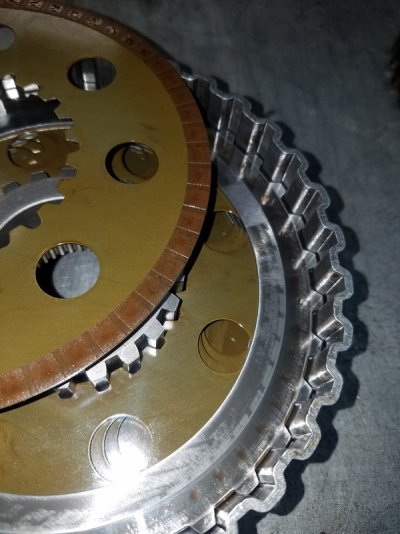
Friction surfaces of stator/rotor in good condition. The crosshatch pattern in the rotor plate MUST be in good condition for fast engagement of the front wheels. This friction producing surface creates the drag that starts the process of engaging the ballramp actuator. If this surface wears smooth, the clutch plates will engage more slowly and generate alot of heat:

Notice the shiny circular portion of the rotor plate face. The upper part, wear area is around the outside of the front face. This is the area that contacts the stator face and starts the ballramp actuator. Once it wears smoothe or glazes, the clutch plates wont last much longer.
My truck now has a 44-45 installed, and programmed via alphaobd. It works perfectly. If your 44-44 is smoked and working poorly, consider swapping in a 44-45, it took me 1-1/2 hours to do.
It was a direct, drop in replacement. Very easy. The AlphaOBD programming took 10 seconds.
My 44-44 is now a science experiment, which i've studied to the n'th degree. Someday, i may rebuild it shimmed to perfection, and with upgraded Rockland clutch plates.
I have a degree in mechanical engineering technology, and my specialized electives which differentiate the various engineering technology disciplines, were in mechanical design, CAD and mechanical power transmission systems (gearboxes). My final project for Mechanical Design III, was to design a complete manual transmission for a large tractor using AutoCAD and submit a complete design package, with drawings, a bill of materials and stress analysis with a finite element analysis run using Autodesk software. Designing involute helical teeth on a conical hypoid geat is pretty tough.
I also own a machine shop, fully equipped with CNC and manual VMCs and turning centers. I'll manufacture the parts and shims needed.
If i ever motivate myself enough to start, given the lack of need, ill swap it back in and see how it works.
One of the weakest links in the system, in my opinion, is the clutch pressure plate (bottom pic, bottom part). The pressure face (shiny circular face around the outer portion of the plate), is the part that forces the clutch plates into compression (forced by the ballramp).
The ballramp applies force to the center of the pressure plate, and the pressure plate applies force to the clutch pack at the perimeter. Flexure between the center and perimeter reduces the magnitude of this axial force and refuces the effectiveness of the overall system. This pressure plate should be made of 4140 steel rather than aluminum, should be thicker, and should have radial ridges to add support and rigidity.
These weak points are what convinced me to put in a bw44-45!