Hagar1
Senior Member
- Joined
- Aug 9, 2023
- Posts
- 1,090
- Reaction score
- 2,268
- Location
- Ontario Canada
- Ram Year
- 2012 Ram 1500
- Engine
- Hemi 5.7
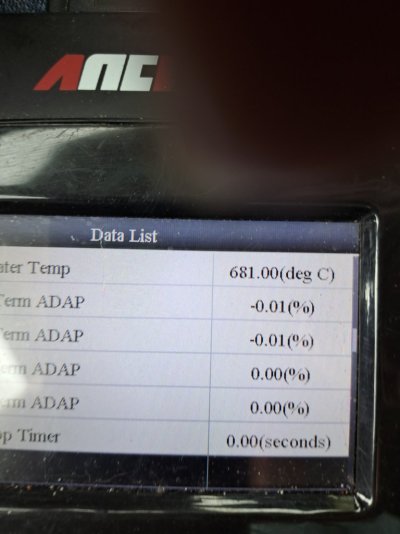
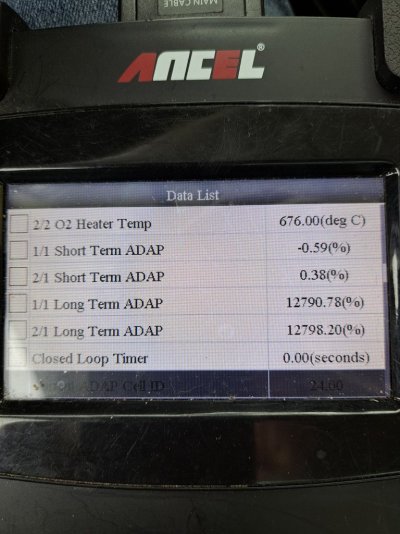
Take a look at the short term and long terms o this scanner. Open for discussion.



Disclaimer: Links on this page pointing to Amazon, eBay and other sites may include affiliate code. If you click them and make a purchase, we may earn a small commission.
O2 heaters get pretty warm, I was looking at the short term and long term readings. 12790 and 12798 percent? Then, a few seconds later I saw readings that are posted above and below that wonky reading in the center. The long term and short term should only range to +33% to minus 33%. Something ain't right.Well no way did your truck produce 681 degrees of or for anything the sensor is wacky

Almost like there is loss of comms for a milisec, or some bad grounding issue. Maybe the CPU is getting tired. Only way to know is check the sensor supply voltage and signal out voltage and check with an o-scope to see if the signal is clean.O2 heaters get pretty warm, I was looking at the short term and long term readings. 12790 and 12798 percent? Then, a few seconds later I saw readings that are posted above and below that wonky reading in the center. The long term and short term should only range to +33% to minus 33%. Something ain't right.
When it comes back to idle it goes to the wonky long term reading and stays there. I've been scratching my head for quite a while on this. I changed out the PCM with a re-paint from Flagship one. No change. By the way, I found Flagship one to be very good both to deal with and for their product. Only downside is their shipping costs to Canada.Almost like there is loss of comms for a milisec, or some bad grounding issue. Maybe the CPU is getting tired. Only way to know is check the sensor supply voltage and signal out voltage and check with an o-scope to see if the signal is clean.
The O2 heater is heated in order to properly function within seconds of starting the engine. Those temps are indeed correct or at least reasonable.Well no way did your truck produce 681 degrees of or for anything the sensor is wacky
Try a different scanner tool. Since you didn't comment on how it's running, I assume there's no obvious performance issue, so I'd suspect the tool. I never seen long terms that high. Then again, the values in the last photo could be normal if the short terms are steady at those numbers.So .... no further ideas???
[delete]
Thank you for the reply. The truck is running like crap, fuel economy fell off a cliff and 2 different boxes say the same thing. I'm going to try a different tool tomorrow. This thing is really driving me around the bend.Try a different scanner tool. Since you didn't comment on how it's running, I assume there's no obvious performance issue, so I'd suspect the tool. I never seen long terms that high. Then again, the values in the last photo could be normal if the short terms are steady at those numbers.
Regards,
Dusty
2019 Ram 1500 Billet Silver Laramie Quad Cab 2WD, 5.7 Hemi, 8HP75, 3.21 axle, 33-gallon fuel tank, 18” wheels. Build Date: 3 June 2018. Now at 139303 miles.
I should've asked before, but are there any codes?Thank you for the reply. The truck is running like crap, fuel economy fell off a cliff and 2 different boxes say the same thing. I'm going to try a different tool tomorrow. This thing is really driving me around the bend.
No, and that is the puzzling part. It runs horribly, no codes, no engine light, nothing. I've checked the cam phaser and it is responding as it should, I even considered weak valve springs but they passed the test.I should've asked before, but are there any codes?
Regards,
Dusty
2019 Ram 1500 Billet Silver Laramie Quad Cab 2WD, 5.7 Hemi, 8HP75, 3.21 axle, 33-gallon fuel tank, 18” wheels. Build Date: 3 June 2018. Now at 139303 miles.
So, if I read your commentary correctly, the values in photo 3 are within a couple of minutes of photo 2. Correct? If so that is likely normal to get a feedback long term trim value. Now how long did you run the engine after photo 3 and did the short term values remain steady during that time? If so, the long term values should remain relatively low.No, and that is the puzzling part. It runs horribly, no codes, no engine light, nothing. I've checked the cam phaser and it is responding as it should, I even considered weak valve springs but they passed the test.
Now, when I start out "cold" around 45 F I notice a very slight pop back in the engine which goes away upon hard acceleration or when it warms up. There are new intake seals and a new short runner valve controller. (which improved it slightly) recent cam and crank sensors. Recent spark plugs from a reputable part store. New air filter. No miss, compression is pretty even.
Those 3 photos were taken over about one mile of driving. The readings in the middle photo just don't make sense. The truck is running so rich that the exhaust is blackening the bumper. I tried a different test unit this evening and got some unusual results. I kept seeing the message in the downstream O2 sensor section that said, "waiting for reply." the upstream sensors were switching normally.So, if I read your commentary correctly, the values in photo 3 are within a couple of minutes of photo 2. Correct? If so that is likely normal to get a feedback long term trim value. Now how long did you run the engine after photo 3 and did the short term values remain steady during that time? If so, the long term values should remain relatively low.
I've never seen short term values so low in actual practice. Do these vary at all your a multi-minute runtime?
Also, I'm not sure what this means, but between the various screens the ADAP Cell number changes.
Regards,
Dusty
2019 Ram 1500 Billet Silver Laramie Quad Cab 2WD, 5.7 Hemi, 8HP75, 3.21 axle, 33-gallon fuel tank, 18” wheels. Build Date: 3 June 2018. Now at 139355 miles.
Right. Which makes me suspicious of a tool relationship problem or a bad connection at the OBD port. the fact that it's running that rich yet not reporting any DTCs helps make me suspicious.Those 3 photos were taken over about one mile of driving. The readings in the middle photo just don't make sense. The truck is running so rich that the exhaust is blackening the bumper. I tried a different test unit this evening and got some unusual results. I kept seeing the message in the downstream O2 sensor section that said, "waiting for reply." the upstream sensors were switching normally.
I've got the hemi tick but no miss or indication of a low cylinder. I recently changed oil and filter. There is no metal accumulation in the filter and no metal on the magnetic oil drain plug.
I'm going to take it out tomorrow and see if I can capture more readings. I'll try to document them better.
Actually, that tool allows for a lot of access. I can watch what is essentially "real time" functions as I drive. I tried a Launch 123 and it was less than satisfactory, to say the least.Right. Which makes me suspicious of a tool relationship problem or a bad connection at the OBD port. the fact that it's running that rich yet not reporting any DTCs helps make me suspicious.
I'm not familiar with the tool you're using, but can you go into the data stream mode and select and watch different signals?
Regards,
Dusty
2019 Ram 1500 Billet Silver Laramie Quad Cab 2WD, 5.7 Hemi, 8HP75, 3.21 axle, 33-gallon fuel tank, 18” wheels. Build Date: 3 June 2018. Now at 139355 miles.
How's it idle? Does it idle rich?Actually, that tool allows for a lot of access. I can watch what is essentially "real time" functions as I drive. I tried a Launch 123 and it was less than satisfactory, to say the least.
I am puzzled by the fact that even on the slightest grade, the engine vacuum will drop to zero. driving on flat ground at 55 mph, the vacuum is virtually none existent ...... just like you were driving at wide open throttle. Yet, when I look at throttle opening, maybe 11 - 12% ..... not all that big of number. Therein lies the crux of the problem, I think. But, I just can't think of why. The vacuum at idle is 20"HG and steady. There are new manifold to cylinder head seals, and new short runner valve control. The over-fueling is, in my humble opinion, a direct result of the vacuum issue. I've observed the MAP reading on the diagnostic box and it tracks properly. I had a Snap on, mechanical vacuum guage "T'd" into the brake booster line to cross check that what I was seeing on the diagnostic box. They both were telling me the same thing.
There is clearly something that I'm missing but in my old age, I just can't put a finger on it.
I truly appreciate your conversations about this.
The idle is OK, with 20 "hg and steady. The MAP reading at idle is where it should be ... less than 1 volt. When cold, just after start it is totally gutless at pretty much anything other than wide open throttle. This resolves as it warms. The other thing I noticed recently is that I think I hear a pop, pop like we would hear in a carbureted engine that was running lean. This only has happened while cold.How's it idle? Does it idle rich?
Acceleration? Any stumble or bog?
Can you see irregularity when looking at cylinder balance?
Have you checked for a vacuum leak?
Somewhere there's got to be an incorrect value that can lead to a diagnostic path.
There are a number of things to check with the scanner: ambient temp, MAP sensor output, fuel regulator pressure, camshaft position sensor, crankshaft position sensor (especially under load).
Regards,
Dusty
2019 Ram 1500 Billet Silver Laramie Quad Cab 2WD, 5.7 Hemi, 8HP75, 3.21 axle, 33-gallon fuel tank, 18” wheels. Build Date: 3 June 2018. Now at 139419 miles.
For $h!ts and giggles why don't you try another throttle body.Did you try the old spray bomb starting fluid trick to see if you have any vacumm leaksThe idle is OK, with 20 "hg and steady. The MAP reading at idle is where it should be ... less than 1 volt. When cold, just after start it is totally gutless at pretty much anything other than wide open throttle. This resolves as it warms. The other thing I noticed recently is that I think I hear a pop, pop like we would hear in a carbureted engine that was running lean. This only has happened while cold.
I'm sort of leaning to some yet to be discovered mechanical problem. The other interesting thing is that the change from good to bad literally happened over night.
One
Compression last spring was all around 135.
I used the old propane enrichment tool to look for vacuum leaks, none showed up.
MAP, CAM and Crank were all recently replaced. I verified that the cam phased was working (my diagnostic tool can check it)
I'm heading out to do more testing.
Thanks!


