
Wild one
Senior Member
- Joined
- Jan 17, 2016
- Posts
- 23,853
- Reaction score
- 54,906
- Ram Year
- 14 Sport
- Engine
- 5.7
8 Reasons Why the 1990s Ford Old Body Style Truck Is a Hit With Collectors and Enthusiasts
The 1992–1996 Ford F-150 and its heavy-duty pickup siblings are modern classics.Benjamin HuntingWriterMecum AuctionsPhotographerMotorTrend StaffPhotographerRyan LugoIllustratorOct 22, 2024

See All 14 Photos
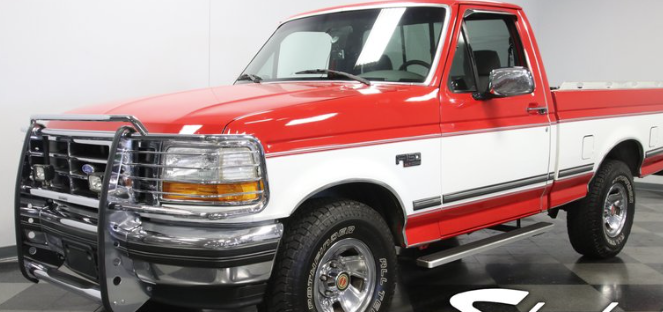
In the world of Ford pickup trucks, 1997 represents the great dividing line between the earlier squared-off designs and the later, curvier, and much larger pickups that came after. Leading up to the switchover was the Ford OBS, or “Old Body Style,” pickup, a truck that is becoming more popular with each passing year among truck enthusiasts enamored with its classic looks and surprisingly modern character.
Here are eight reasons why the 1992–1996 Ford OBS is fast becoming the most collectible Rad-era pickup among Ford fans.

See All 14 Photos
What Is a Ford OBS (Old Body Style) Truck?
By the mid-1990s, the F-Series was moving almost as many units as the two bestselling family sedans, the Ford Taurus and the Honda Accord, combined. In 1997, Ford F-Series pickups underwent a major stylistic change, introducing swooping, curvy sheetmetal to go with the first all-new platform since the previous-generation truck had been introduced in 1980.Shaking up America’s most popular vehicle—which until that point had been notoriously conservative in terms of design—was a move that was almost immediately controversial. It was a bold decision from Ford that broke with decades of tradition, and it served as the template for the next 20 or so years of the F-Series.

See All 14 Photos
It also served as a demarcation line that separated those willing to embrace the new-look Ford from those who preferred the traditional, squared-off proportions of the trucks that had come before it. As the years passed, those pickups were increasingly referred to as “Old Body Style” or OBS trucks to differentiate them from the modern Fords.
Although some extend the term all the way back to encompass the 1980–1996 and 1987–1991 F-Series generations, most enthusiasts agree that the OBS term specifically describes the 1992–1996 model years of the Ford F-Series, which was the final iteration of the truck’s ninth generation. You can also include the 1997 F-250 and F-350 models, which didn’t receive their own unique retooling until the 1999 model year.


See All 14 Photos
Unmistakable Looks, With Just a Hint of Aero
Seen in silhouette, the ’90s OBS Fords share a lot with the trucks that came before them, featuring very similar sheetmetal on the fenders, box, and doors. In fact, many of these pieces are interchangeable at a basic level, though trim and details on each are unique to each generation.The primary update made to the 1992–1996 F-150 (and continuing through 1997 for heavy-duty trucks) is at the front. It’s here that Ford installed an updated grille, shaped headlights, and a new curbed bumper. The overall effect was intended to provide a better aerodynamic profile for the truck, or at least as much of an improvement as could be made given the vehicle’s right-angle proportions. Regular, extended (SuperCab) and four-door crew-cab versions of the truck were on offer, though the latter was reserved for F-250 and F-350 models.

See All 14 Photos
Inside the truck, ’90s editions of the OBS F-Series stayed simple but still provided all of the gauges and features most truck owners needed. A bench seat was common, with a split bench or captain’s chairs with a console also available (primarily in SuperCab and crew cab). This was the era just before luxury trucks entered the market, so most upholstery was cloth, complemented by abundant vinyl and plastic.
Overall, the Ford OBS was modern enough in terms of features and equipment without sacrificing the classic proportions that had defined the F-Series trucks for the past several decades. That combination served to draw thousands of fans as the pickups transitioned to classic status.

See All 14 Photos
The Last of the Ford Pushrod V-8s
A major part of the Ford OBS appeal can be found under the hood. The 1992–1996 Old Body Style trucks are the last ones to offer the Blue Oval’s pushrod V-8 engines.Starting with the 1997 redesign, the F-150 moved entirely to the overhead-camshaft Modular V-8 engines, with the 4.6-liter and the 5.4-liter units leading the way. Although the new engines were competitive in terms of output, old-school pickup fans were wary of the move away from pushrods. During the introductory period, there was also little aftermarket support for the modular engines, and few mechanics, professional or otherwise, had experience with them. This gave them the reputation of being more complicated to maintain and difficult to modify for extra performance.
Despite the ensuing years having wiped out these concerns, classic truck fans are still drawn to the simplicity and the ubiquity of Ford’s OBS engines. The F-150 was offered with the following common V-8 options: