

You are using an out of date browser. It may not display this or other websites correctly.
You should upgrade or use an alternative browser.
You should upgrade or use an alternative browser.
Need opinions on towing 8300lbs-9000lbs
- Thread starter Blkhammer
- Start date
Disclaimer: Links on this page pointing to Amazon, eBay and other sites may include affiliate code. If you click them and make a purchase, we may earn a small commission.
Blkhammer
Member
Sounds like, out of all the information I gathered here from people feedback/experience The truck will do fine with my toy hauler (6400lbs dry) and a good weight distribution hitch+brake controller+air bags.
But once I throw in a razor 4 seater (which weighs about 1700lbs) that’s when everything becomes sketchy and unsafe.
But once I throw in a razor 4 seater (which weighs about 1700lbs) that’s when everything becomes sketchy and unsafe.
spoon059
Senior Member
- Joined
- Jun 30, 2015
- Posts
- 501
- Reaction score
- 344
- Location
- Just north of Washington DC
- Ram Year
- 2015
- Engine
- 6.7 CTD
Your truck is rated to tow "up to 10,000 lbs", depending upon configuration.so I’m curious on your guys opinion on towing something this heavy. Basically it’s a toy hauler (dry weight 6400lbs) + razor (1500lbs) + food/Necessities/etc. I’m guessing weight would be around 8300-9000lbs. I plan on towing this with my 2012 ram 1500 4x4 (3.92gears). I know it says can tow up to 10,000lbs. Just wanted to get some feedback from people who have already done this.
How did the truck handle?
Was the motor screaming the whole time?
Any type of issues?
Any pointers to make tow/haul easier( besides the obvious ,bigger truck, or lighter load)
And of course I know you need a good distribution hitch to make things a little easier
Thanks for your input/feedback.
A travel trailer needs 12-15% tongue weight to pull correctly. At 10,000 lbs, that would be up to 1500 lbs of tongue weight. That leaves no room for a hitch, passengers, or any gear in a truck. A boat, on the other hand, doesn't require nearly as much tongue weight, so you could potentially pull a 10,000 lbs boat. A flat trailer with steel plate doesn't require the high tongue weight either.
For the weights you want to pull you need a 3/4 ton Ram, or a heavy payload GM/Ford half ton. A Ram 1500 simply doesn't have enough payload to pull such a large front wall trailer.
Your truck will handle poorly.
Your motor will scream the entire time.
It will cause excessive wear and tear on your truck, leading to shorter life of your truck.
The only pointer that you will allow is DON'T TRY IT.
MasonD21
Senior Member
- Joined
- Mar 6, 2018
- Posts
- 118
- Reaction score
- 60
- Location
- Eastern WA
- Ram Year
- 2017
- Engine
- 6.4L HemiWagon
People all have differing opinions regarding which tool to use for the job.
Better to have a tow vehicle rated higher than what you are asking it to do, rather than fretting and being "on the line" regarding weights and ratings.
Tongue weight of trailer + Toy = 3/4-ton or 1-ton territory, based on the info provided...
Better to have a tow vehicle rated higher than what you are asking it to do, rather than fretting and being "on the line" regarding weights and ratings.
Tongue weight of trailer + Toy = 3/4-ton or 1-ton territory, based on the info provided...
Blkhammer
Member
People all have differing opinions regarding which tool to use for the job.
Better to have a tow vehicle rated higher than what you are asking it to do, rather than fretting and being "on the line" regarding weights and ratings.
Tongue weight of trailer + Toy = 3/4-ton or 1-ton territory, based on the info provided...
So what about just toy hauler? Truck should be able to handle something like this correct (6400lbs dry). So after everything is loaded I say around 7000-7250lbs.
MasonD21
Senior Member
- Joined
- Mar 6, 2018
- Posts
- 118
- Reaction score
- 60
- Location
- Eastern WA
- Ram Year
- 2017
- Engine
- 6.4L HemiWagon
It would depend on how the weight is loaded across the vehicle's payload and axles.So what about just toy hauler? Truck should be able to handle something like this correct (6400lbs dry). So after everything is loaded I say around 7000-7250lbs.
For example, a travel trailer with a toy hauler and the bay in the rear vs. a travel trailer with a toy hauler up front.
Ex: Rockwood sells an A-frame style pop-up with a toy hauler cage. Tongue weight of the trailer is only 300lbs, but if you load an 800lb farm ATV on the toy hauler, it brings your tongue weight closer to 1200lbs. And that would be before anything else is put in that particular camper. So before fuel or driver, you are already at or near payload, depending on other gear or equipment...
The above example was my personal struggle a few years ago with my 1500 Sierra.
On the other hand, a 30' bumper pull style or 5th wheel trailer will usually have the ATV bay rearward of the axles, and they design the weight of the RV trailer to have more weight on the tongue (or plate in terms of 5th wheel).
The concern the OP is having, aside from just general payload, will be *where* the weight is.
This is a perfect example of how a CAT Scale would be super beneficial idea once everything is loaded and ready to hit the road.
VernDiesel is much better at explaining the specifics as I've seen his posts be much more articulate and descriptive than others.
Blkhammer
Member
It would depend on how the weight is loaded across the vehicle's payload and axles.
For example, a travel trailer with a toy hauler and the bay in the rear vs. a travel trailer with a toy hauler up front.
Ex: Rockwood sells an A-frame style pop-up with a toy hauler cage. Tongue weight of the trailer is only 300lbs, but if you load an 800lb farm ATV on the toy hauler, it brings your tongue weight closer to 1200lbs. And that would be before anything else is put in that particular camper. So before fuel or driver, you are already at or near payload, depending on other gear or equipment...
The above example was my personal struggle a few years ago with my 1500 Sierra.
On the other hand, a 30' bumper pull style or 5th wheel trailer will usually have the ATV bay rearward of the axles, and they design the weight of the RV trailer to have more weight on the tongue (or plate in terms of 5th wheel).
The concern the OP is having, aside from just general payload, will be *where* the weight is.
This is a perfect example of how a CAT Scale would be super beneficial idea once everything is loaded and ready to hit the road.
VernDiesel is much better at explaining the specifics as I've seen his posts be much more articulate and descriptive than others.
Wow this is good information thx.
So what about just toy hauler? Truck should be able to handle something like this correct (6400lbs dry). So after everything is loaded I say around 7000-7250lbs.
Your truck can handle around 7500# IMHO. But you need some experience and common sense.
You could do more but you are pressing your luck to be honest.
I’m usaully the guy that says yes your 1/2 ton will be fine. But you are at the edge with what you want to do.
Blkhammer
Member
Your truck can handle around 7500# IMHO. But you need some experience and common sense.
You could do more but you are pressing your luck to be honest.
I’m usaully the guy that says yes your 1/2 ton will be fine. But you are at the edge with what you want to do.
thank you for your feedback. yea i see that with a razor i will be over the limit. but im still going to go to a scale just to see what it says. i mean if worse comes to worse i will just pull my razor with my work truck. but the whole purpose of this was to get feedback/information from you guys. and yes i have learned a lot just from your guys response. so i would like to say thank you and keep them coming.
VernDiesel
Senior Member
Especially with Razor loaded an HD is a better tool for the job if you have access to one. That does not mean even with a HD you should forego the scales. It’s often only $12 & $2 per additional weigh. But some guys don’t understand its value, how to use it, are afraid they will look stupid whatever. And now days they are near every major city. CAT even has a free app with locations & gps directions.
TW isn’t a fixed thing it’s sort of a sliding scale so to speak with a WDH and WD in both your TV & TH. That is why the same TV & TT/TH can go from sketchy to stable with good setup as proven on a cat scale. The three scale setup sees what your eyes can’t.
I don’t care what the brochure TW is or what it would be without a WDH. Because much over 5k with a TT I am going to utilize a WDH per Ram’s long standing recommendation.
At 10 percent your 6,400 pound trailer will put 640 pounds on your truck axles as seen by the scales. At 15 percent 960. Lots of variables weigh into what you get down to. Without WDH and hitch tilt & spring bar load most of that weight will be put on the drive axle. In fact enough weight can use your drive axle as a fulcrum to lift some weight off the steer axle and additionally transfer it to your drive axle. This causes sketchy handling & reduces braking ability. I recently had an old timer argue that point on here but whatever.
A box front end TT towed at speed by a light truck especially with a regular hitch may need 12 to 15 percent TW so that it doesn’t sway. But I’ve also towed many TT/TH at 10 & 11 percent TW with a built in sway control WDH at 65 mph for 1,000s of miles with good stability even when passed by semi.
I’ve linked before & after threads on here but I don’t think most of you need more proof you just need to take your wet rig to a scale & work with it. If your loaded steer was lighter than the unloaded steer weight after restoring it you will quickly feel the difference; when on slick roads, during a mock emergency swerve around, when a semi passes, when trying to stop quickly. Your family, your $12, your decision. Some guys see that as cheaper and easier than trading for a new truck.. some don’t.
TW isn’t a fixed thing it’s sort of a sliding scale so to speak with a WDH and WD in both your TV & TH. That is why the same TV & TT/TH can go from sketchy to stable with good setup as proven on a cat scale. The three scale setup sees what your eyes can’t.
I don’t care what the brochure TW is or what it would be without a WDH. Because much over 5k with a TT I am going to utilize a WDH per Ram’s long standing recommendation.
At 10 percent your 6,400 pound trailer will put 640 pounds on your truck axles as seen by the scales. At 15 percent 960. Lots of variables weigh into what you get down to. Without WDH and hitch tilt & spring bar load most of that weight will be put on the drive axle. In fact enough weight can use your drive axle as a fulcrum to lift some weight off the steer axle and additionally transfer it to your drive axle. This causes sketchy handling & reduces braking ability. I recently had an old timer argue that point on here but whatever.
A box front end TT towed at speed by a light truck especially with a regular hitch may need 12 to 15 percent TW so that it doesn’t sway. But I’ve also towed many TT/TH at 10 & 11 percent TW with a built in sway control WDH at 65 mph for 1,000s of miles with good stability even when passed by semi.
I’ve linked before & after threads on here but I don’t think most of you need more proof you just need to take your wet rig to a scale & work with it. If your loaded steer was lighter than the unloaded steer weight after restoring it you will quickly feel the difference; when on slick roads, during a mock emergency swerve around, when a semi passes, when trying to stop quickly. Your family, your $12, your decision. Some guys see that as cheaper and easier than trading for a new truck.. some don’t.
Blkhammer
Member
Especially with Razor loaded an HD is a better tool for the job if you have access to one. That does not mean even with a HD you should forego the scales. It’s often only $12 & $2 per additional weigh. But some guys don’t understand its value, how to use it, are afraid they will look stupid whatever. And now days they are near every major city. CAT even has a free app with locations & gps directions.
TW isn’t a fixed thing it’s sort of a sliding scale so to speak with a WDH and WD in both your TV & TH. That is why the same TV & TT/TH can go from sketchy to stable with good setup as proven on a cat scale. The three scale setup sees what your eyes can’t.
I don’t care what the brochure TW is or what it would be without a WDH. Because much over 5k with a TT I am going to utilize a WDH per Ram’s long standing recommendation.
At 10 percent your 6,400 pound trailer will put 640 pounds on your truck axles as seen by the scales. At 15 percent 960. Lots of variables weigh into what you get down to. Without WDH and hitch tilt & spring bar load most of that weight will be put on the drive axle. In fact enough weight can use your drive axle as a fulcrum to lift some weight off the steer axle and additionally transfer it to your drive axle. This causes sketchy handling & reduces braking ability. I recently had an old timer argue that point on here but whatever.
A box front end TT towed at speed by a light truck especially with a regular hitch may need 12 to 15 percent TW so that it doesn’t sway. But I’ve also towed many TT/TH at 10 & 11 percent TW with a built in sway control WDH at 65 mph for 1,000s of miles with good stability even when passed by semi.
I’ve linked before & after threads on here but I don’t think most of you need more proof you just need to take your wet rig to a scale & work with it. If your loaded steer was lighter than the unloaded steer weight after restoring it you will quickly feel the difference; when on slick roads, during a mock emergency swerve around, when a semi passes, when trying to stop quickly. Your family, your $12, your decision. Some guys see that as cheaper and easier than trading for a new truck.. some don’t.
Wowwww now that’s a response. And a good one to. Thank u. Pointed me in the right direction.
VernDiesel
Senior Member
Canuckfe
Junior Member
- Joined
- Jan 30, 2014
- Posts
- 23
- Reaction score
- 4
- Ram Year
- 2014
- Engine
- Hemi 5.7
I have towed my boat over the Rockies from Alberta to BC coast. I didnt scale it until after i got home. 9200lbs. I was surprized it was that muxh because the truck handled it really well despite the stupid surge brakes.
Averaged 20l/100km and I wasnt doddling.
I have '14 CC 4x4 with 6'4" box, 3.92 and hemi. Air suspension.
I locked trans out of 8th while towing.
Boat are pretty tow friendly though. Aerodynamic and axles are set back.
I also rented a 29' rv trailer. Didnt have sway or equilizer control. Did about 1000km. Truck would get squirrelly over 100km/h.


Sent from my SM-G955W using Tapatalk
Averaged 20l/100km and I wasnt doddling.
I have '14 CC 4x4 with 6'4" box, 3.92 and hemi. Air suspension.
I locked trans out of 8th while towing.
Boat are pretty tow friendly though. Aerodynamic and axles are set back.
I also rented a 29' rv trailer. Didnt have sway or equilizer control. Did about 1000km. Truck would get squirrelly over 100km/h.
Sent from my SM-G955W using Tapatalk
Before getting my HD truck I towed my 30' TT with my 13' Ram 1500 4x4 with 3.92 gears and the 8 speed. My TT weighed 8400 loaded. I bought the Equalizer 14,000/1400# unit to handle the sway. To stay within my payload of just under 1500 I tried 1000#(12%) on the hitch. It was okay until I saw it wandering going down a steep hill and ended up hitting the brake controller to straighten it out! I ended up increasing the hitch weight to 1200# (15%)and with me and the wife in the tuck we were just starting to violate our payload capacity. The next couple of times I towed down some steep hills I had no sway, even when being passed by semi trucks going down those hills!
The equalizer hitch has some good info on setting up their hitch and they talk about trailer attitude which is having the trailer close to level to about a 1 1/4" down in the front verses the back. One would have to have a level pad to do all the measuring. I went to the truck stop and weighed everything cause I wanted to know what my weights were. They were very patient with me, and I had to unhook it at one point to get all the axle weights.
I had went with the red airlift bags to level my truck and over time found that 15#s (all the time) worked to reduce my truck squat. There is definitely some debate on when to air up your load leveling bags, either before, or after you hook up your weight distribution hitch. I redid my hitch setup on a level pad with the 15# to get the correct trailer attitude. I wanted my TT to be slightly down in the front.
One thing I did notice is the front end of the truck would feel very light when I set up the weight distribution hitch first and then aired up the rear bags. That is why I went with airing the bags up 1st, cause it felt like the front of the truck was floating!
Other than that, I aired my cheap Wranglers up to the limit on the sidewall to reduce sway, but ended up going to some LT tires which significantly reduced sway. You would want to do the same by keeping you trailer tires well inflated too! With the 8 speed it had plenty of power to maintain speed except on steeper hills where I would tap the brake pedal to kick off the cruise cause it was reving up the engine trying to maintain cruising speed. That helped conserve gas mileage too! You can do like the truckers do is to speed up on the downhill part of the road to help maintain speed going up the oncoming hill, but it can be dangerous to go too fast in certain conditions when dealing with hills.
Gas mileage was about 10 on average at 62mph and would go down fast by 65 or 70. Most TT tires are rated for 65mph. One could probably put LT tires with a higher speed rating on the TT and go faster than 65 without worrying about overheating your tires.
Good luck with your towing, I went to the HD and after setting up the hitch for my HD I no longer worry about sway on hills. I still keep an eye out, probably from the time I saw the TT swaying when I had the 1500. If you get stuck in the wind you would definitely feel better having the heavier HD Truck!
The equalizer hitch has some good info on setting up their hitch and they talk about trailer attitude which is having the trailer close to level to about a 1 1/4" down in the front verses the back. One would have to have a level pad to do all the measuring. I went to the truck stop and weighed everything cause I wanted to know what my weights were. They were very patient with me, and I had to unhook it at one point to get all the axle weights.
I had went with the red airlift bags to level my truck and over time found that 15#s (all the time) worked to reduce my truck squat. There is definitely some debate on when to air up your load leveling bags, either before, or after you hook up your weight distribution hitch. I redid my hitch setup on a level pad with the 15# to get the correct trailer attitude. I wanted my TT to be slightly down in the front.
One thing I did notice is the front end of the truck would feel very light when I set up the weight distribution hitch first and then aired up the rear bags. That is why I went with airing the bags up 1st, cause it felt like the front of the truck was floating!
Other than that, I aired my cheap Wranglers up to the limit on the sidewall to reduce sway, but ended up going to some LT tires which significantly reduced sway. You would want to do the same by keeping you trailer tires well inflated too! With the 8 speed it had plenty of power to maintain speed except on steeper hills where I would tap the brake pedal to kick off the cruise cause it was reving up the engine trying to maintain cruising speed. That helped conserve gas mileage too! You can do like the truckers do is to speed up on the downhill part of the road to help maintain speed going up the oncoming hill, but it can be dangerous to go too fast in certain conditions when dealing with hills.
Gas mileage was about 10 on average at 62mph and would go down fast by 65 or 70. Most TT tires are rated for 65mph. One could probably put LT tires with a higher speed rating on the TT and go faster than 65 without worrying about overheating your tires.
Good luck with your towing, I went to the HD and after setting up the hitch for my HD I no longer worry about sway on hills. I still keep an eye out, probably from the time I saw the TT swaying when I had the 1500. If you get stuck in the wind you would definitely feel better having the heavier HD Truck!
Blkhammer
Member
Before getting my HD truck I towed my 30' TT with my 13' Ram 1500 4x4 with 3.92 gears and the 8 speed. My TT weighed 8400 loaded. I bought the Equalizer 14,000/1400# unit to handle the sway. To stay within my payload of just under 1500 I tried 1000#(12%) on the hitch. It was okay until I saw it wandering going down a steep hill and ended up hitting the brake controller to straighten it out! I ended up increasing the hitch weight to 1200# (15%)and with me and the wife in the tuck we were just starting to violate our payload capacity. The next couple of times I towed down some steep hills I had no sway, even when being passed by semi trucks going down those hills!
The equalizer hitch has some good info on setting up their hitch and they talk about trailer attitude which is having the trailer close to level to about a 1 1/4" down in the front verses the back. One would have to have a level pad to do all the measuring. I went to the truck stop and weighed everything cause I wanted to know what my weights were. They were very patient with me, and I had to unhook it at one point to get all the axle weights.
I had went with the red airlift bags to level my truck and over time found that 15#s (all the time) worked to reduce my truck squat. There is definitely some debate on when to air up your load leveling bags, either before, or after you hook up your weight distribution hitch. I redid my hitch setup on a level pad with the 15# to get the correct trailer attitude. I wanted my TT to be slightly down in the front.
One thing I did notice is the front end of the truck would feel very light when I set up the weight distribution hitch first and then aired up the rear bags. That is why I went with airing the bags up 1st, cause it felt like the front of the truck was floating!
Other than that, I aired my cheap Wranglers up to the limit on the sidewall to reduce sway, but ended up going to some LT tires which significantly reduced sway. You would want to do the same by keeping you trailer tires well inflated too! With the 8 speed it had plenty of power to maintain speed except on steeper hills where I would tap the brake pedal to kick off the cruise cause it was reving up the engine trying to maintain cruising speed. That helped conserve gas mileage too! You can do like the truckers do is to speed up on the downhill part of the road to help maintain speed going up the oncoming hill, but it can be dangerous to go too fast in certain conditions when dealing with hills.
Gas mileage was about 10 on average at 62mph and would go down fast by 65 or 70. Most TT tires are rated for 65mph. One could probably put LT tires with a higher speed rating on the TT and go faster than 65 without worrying about overheating your tires.
Good luck with your towing, I went to the HD and after setting up the hitch for my HD I no longer worry about sway on hills. I still keep an eye out, probably from the time I saw the TT swaying when I had the 1500. If you get stuck in the wind you would definitely feel better having the heavier HD Truck!
Wow great information thx
VernDiesel
Senior Member
Pttrader, Interesting read. I have a 14 8 speed 3.92 with Ecodiesel. I tow 30’ floorplan TTs frequently even some 33s. Have used Andersen, Husky with 1400 pound spring bar, (very similar design to Equalizer) and the high dollar 3P. Husky Tech guy says frame level for balance to 1” low in front for aerodynamics is ideal. His opinion. Which I also have gotten good results from.
I use the convoluted rubber axle to frame airbags to compliment the WDH. I get best results leaving my normal 5 psi before setting the hitch to the best I can get per scales then add air to bring the truck to a slight forward rake. Usually 14 to 17 psi.
If I do it the other way around and air up first bringing the truck to a slight rake 15ish psi and then set the hitch it seems as the airbags resist the hitch. I don’t get & or seem to hold the WT and I get the floaty steer.
Oh airbags mounted in place of the factory bump stops. I have TLC’s Goodyear bags very similar to Timbergroves or Airlift 5,000s.
BTW for readers don’t do this with the thin plastic-rubber in coil bags they can balloon out between the coils and are not to lift a load per mfg. They are to be aired up first to hold a bedload.
I use the convoluted rubber axle to frame airbags to compliment the WDH. I get best results leaving my normal 5 psi before setting the hitch to the best I can get per scales then add air to bring the truck to a slight forward rake. Usually 14 to 17 psi.
If I do it the other way around and air up first bringing the truck to a slight rake 15ish psi and then set the hitch it seems as the airbags resist the hitch. I don’t get & or seem to hold the WT and I get the floaty steer.
Oh airbags mounted in place of the factory bump stops. I have TLC’s Goodyear bags very similar to Timbergroves or Airlift 5,000s.
BTW for readers don’t do this with the thin plastic-rubber in coil bags they can balloon out between the coils and are not to lift a load per mfg. They are to be aired up first to hold a bedload.
Last edited:
pullin
Junior Member
- Joined
- Dec 27, 2017
- Posts
- 18
- Reaction score
- 12
- Location
- DFW, Texas
- Ram Year
- 2017
- Engine
- 6.7L Cummins
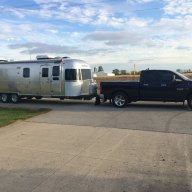
I towed some pretty large loads with my 2011 1500 Quadcab. The pic below is the largest and it handled very well.
However, I found out there are unexpected problems when pulling a single large trailer. It's actually worse than double-towing with my earlier rig. There are two type of "sway". Most here are talking about the side-to-side axis -- there's also a back and forth axis (camper rocking up and down on rough roads). You can handle the side sway with the hitch, but a large camper can move the hitch and truck bed up and down so much your springs bottom out.
I pulled a 35ft Rockwood travel trailer and I had to use a Hensley hitch to finally get the side sway under control. This hitch works as advertised and it did the job perfectly. I installed airbags to try and control the up/down movement when traveling rough roads (you know, the type that start a rhythm with your truck). It seemed we could never get everything dialed in, and I eventually decided I might end up with a broken axle so I said enough.
If it matters, here are CAT numbers and specs with the old truck and new trailer:
-1500 Quadcab, 3.92, 5.7L, tow package, 5000lb airbag (onboard pump, auto). CAT weight: 5800 lbs w full tank, hitch and me.
-2014 Rockwood Windjammer 35 ft, CAT weight 7980 full load.
The numbers for the combo in the pictures are:
-same truck, of course
-2003 Prowler 25ft fifth wheel, CAT weight 6300 loaded, ~600 pin weight
-2001 Moomba 21 ft boat, CAT weight 3300, 550 tongue.
Total rig weight 15,400. Total length 67 ft. (I know, 65 is max length, but I could remove the rear swim step from the boat if I got stopped. I never did.)
I think the fiver/boat combo I had earlier actually "flowed" on those humpback roads and the lighter trailer never moved the truck rear up and down like the single rigid trailer.
I just thought I'd throw my experience in as a data point for you. At the upper limit of the weight/tow/GCWR capacity, you might find unexpected problems and the exact combo, size etc. matters more than with lower weights.
Best of luck -- and if you look at my sig, you can see I finally accepted my fate and bought a new 2500 Crewcab Longbed CTD (it was awful I tell ya, having to get a new truck ).
).

However, I found out there are unexpected problems when pulling a single large trailer. It's actually worse than double-towing with my earlier rig. There are two type of "sway". Most here are talking about the side-to-side axis -- there's also a back and forth axis (camper rocking up and down on rough roads). You can handle the side sway with the hitch, but a large camper can move the hitch and truck bed up and down so much your springs bottom out.
I pulled a 35ft Rockwood travel trailer and I had to use a Hensley hitch to finally get the side sway under control. This hitch works as advertised and it did the job perfectly. I installed airbags to try and control the up/down movement when traveling rough roads (you know, the type that start a rhythm with your truck). It seemed we could never get everything dialed in, and I eventually decided I might end up with a broken axle so I said enough.
If it matters, here are CAT numbers and specs with the old truck and new trailer:
-1500 Quadcab, 3.92, 5.7L, tow package, 5000lb airbag (onboard pump, auto). CAT weight: 5800 lbs w full tank, hitch and me.
-2014 Rockwood Windjammer 35 ft, CAT weight 7980 full load.
The numbers for the combo in the pictures are:
-same truck, of course
-2003 Prowler 25ft fifth wheel, CAT weight 6300 loaded, ~600 pin weight
-2001 Moomba 21 ft boat, CAT weight 3300, 550 tongue.
Total rig weight 15,400. Total length 67 ft. (I know, 65 is max length, but I could remove the rear swim step from the boat if I got stopped. I never did.)
I think the fiver/boat combo I had earlier actually "flowed" on those humpback roads and the lighter trailer never moved the truck rear up and down like the single rigid trailer.
I just thought I'd throw my experience in as a data point for you. At the upper limit of the weight/tow/GCWR capacity, you might find unexpected problems and the exact combo, size etc. matters more than with lower weights.
Best of luck -- and if you look at my sig, you can see I finally accepted my fate and bought a new 2500 Crewcab Longbed CTD (it was awful I tell ya, having to get a new truck
).
Last edited:
OC455
Member
- Joined
- Apr 20, 2018
- Posts
- 3,326
- Reaction score
- 3,018
- Location
- Central NY
- Ram Year
- 2018, 2019
- Engine
- 5.7 Hemi Big Horn, 6.4L Hemi 3500 Longhorn Mega cab
Glad I read this info.....I bought a 2018 Big Horn crew cab Hemi, and the wife and I were checking out tow behind campers. There was a nice used one we looked at. I checked the GVWR and it was 7600lbs. It's dry weight is 5158 and tongue weight is 645lbs. Probably a bit much to tow behind the Big Horn then?
https://www.pryortec.com/2015_Keystone_Hideout 260LHS_Clinton_NY_14822015.veh
https://www.pryortec.com/2015_Keystone_Hideout 260LHS_Clinton_NY_14822015.veh
Synolimit
Senior Member
All this info and numbers and weight distribution etc, we talking long highway trips? What about just moving stuff around town? I know nothing really of towing except I've got 35x12.5x17 tires. So I see the load ratings of the tires is a lot larger than OEM, like 2600lbs vs 3200lbs. But I thought someone said here larger tires will hurt since it's a larger diameter rotation adding stress? To the motor and tranny right? As for the load I've got 50% stronger springs coming vs the sagging OEM. Trailers I'm viewing are around 8000-10000lbs dry but I'll only need for normal roads around town. Rears 3.92.
Last edited:
Similar threads

- Replies
- 59
- Views
- 3K


- Replies
- 1
- Views
- 569


Members online
- smoothee
- plowking
- Repairhobbyist
- ibike
- RamDiver
- txtwista
- SWAMP RAT VII
- U&A
- seems fishy
- avhatley
- Slow57
- Spanishyeti13
- KalboKalbs
- Ndutchin
- Grams
- maxx442
- SniperDroid
- hunterdan
- fastruk
- MTRamFan
- Namelama
- Manump95
- Mojo88
- RichieW13
- Magfan2
- Flip-er
- Mrbutt
- kt4hx
- butterscotch71
- WildcatHemi
- Daw14
- MarshRam
- Heathen-19
- tiffytiff25
- MY52Ram
- Motoman501
- HuskerRam
- mdc1990zr1
- PeteSzRam1500
- gremlintruck
- Hagar1
- Loranrs
- johnts
- BGW656
- hoyter
- MikeG
Total: 6,428 (members: 54, guests: 6,374)
Robots: 1,717
Robots: 1,717