
Wild one
Senior Member
- Joined
- Jan 17, 2016
- Posts
- 23,999
- Reaction score
- 55,420
- Ram Year
- 14 Sport
- Engine
- 5.7
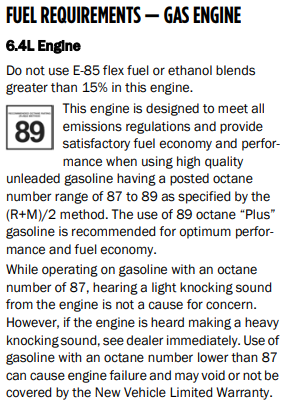
Well you're wrong.Higher altitude has less barometric pressure,so the engine doesn't have the same amount of air pressure it can access to fill the cylinders,so consequently it doesn't create the same running cylinder pressure,and it doesn't require the same amount of octane to prevent detonation. The engine sucks in air ,and the more outside air pressure aka barometric pressure it has to work with,the more oxygen it can suck in. Ask any athlete,and altitude affects their preformance big time,an engine is no differant,it has less oxygen and air pressure to with work at altitude,and consequently needs less octane.Cylinder pressure affects octane requirements,and i don't think you're grasping that fact. You can actually tell it by doing a compression test,an engine at sealevel,creates more cylinder pressure on a compression test,then it does at say 5,000ft altitudeYou are nuts. Nowhere in your manual does it state that you can use lower octane at higher altitudes. Since the days of electronic ignition, altitude does not matter! Many stations in my state of NM use 66 for regular and 88 for
midgrade. No delta in price with the few stations that use 87 and 89. Amazing how many people pay the same for a lesser product, also like you, thinking altitude matters. And make sure you use Top Tier.
You paid too much for a truck to try to save a few dollars.
By the way, I have won many bets with people claiming altitude matters.
That's why a nitrous car doesn't fall off as much at altitude as a blown car or naturally aspirated car does,as nitrous creates it's own oxygen
Last edited: