
I can only imagine how many axles run their entire life and never have the fluid changed or more likely ever even checked.Rear differential temp worries tell me you need to find a new hobby. In other words….this is one thing you should forget about. Completely.
Also, forget about Designer gear oils. Use what Mopar suggests.
(Retired rear differential tech)


You are using an out of date browser. It may not display this or other websites correctly.
You should upgrade or use an alternative browser.
You should upgrade or use an alternative browser.
Rear Differential Temperatures
- Thread starter heefageLA
- Start date
Disclaimer: Links on this page pointing to Amazon, eBay and other sites may include affiliate code. If you click them and make a purchase, we may earn a small commission.
ppine
Forester
- Joined
- Jun 24, 2022
- Posts
- 535
- Reaction score
- 513
- Location
- Nevada
- Ram Year
- 2022
- Engine
- 6.7 liter diesel
Quality lubricants at the recommended viscosity. Change them on time especially when heavily used for towing.
The break in for diffs is very important. It takes some driving at 50 mph or less to warm up the gears but not get them hot. That helps heat treat them to make them harder and last longer. Follow your manual. Of course your rear differential is going to feel hot. Speed matters. Don't tow over about 65 mph.
The break in for diffs is very important. It takes some driving at 50 mph or less to warm up the gears but not get them hot. That helps heat treat them to make them harder and last longer. Follow your manual. Of course your rear differential is going to feel hot. Speed matters. Don't tow over about 65 mph.
danielmid
Senior Member
- Joined
- Mar 23, 2018
- Posts
- 1,595
- Reaction score
- 2,980
- Location
- Southeast WI
- Ram Year
- 2015 Sport 4x4
- Engine
- Hemi 5.7
Y'all do what you want with your expensive truck's axle, I'll use designer gear oil in a weight that works well and protects the axle. It's a very small investment to make sure the truck lasts as long as I want to keep it.
I changed mine in 2024 at under 80,000. I used 75/90 synthetic gear oil and the factory specs synthetic.
I do think if one was towing heavy everyday a heavier oil may be a little bit better, but I doubt anyone would ever be able to tell the difference.
I do think if one was towing heavy everyday a heavier oil may be a little bit better, but I doubt anyone would ever be able to tell the difference.
- Joined
- Apr 28, 2012
- Posts
- 27,871
- Reaction score
- 58,472
- Ram Year
- 2010 Hemi Reg Cab 4x4
- Engine
- Hemi
There is a gauge for everything.. on sale too
Wild one
Senior Member
- Joined
- Jan 17, 2016
- Posts
- 23,962
- Reaction score
- 55,299
- Ram Year
- 14 Sport
- Engine
- 5.7
My wifes Challenger had the famous ZF howl,which the cars are famous for,and swapping it out from the factories 75W-85 to a 75W-140 made a hell'va differance in the noises coming from the diff. So yes under certain circumstances a heavier weight works better. Plus the fluid only acts like a 140 when the diff is hot and needs a bit more cushion on the contact surfaces.
You guys act like a heavier weight diff fluid will blow the diff up, hate to tell you,but you're wrong.and i'm not sure where you got such a dumb idea from
You guys act like a heavier weight diff fluid will blow the diff up, hate to tell you,but you're wrong.and i'm not sure where you got such a dumb idea from
Dean2
Senior Member
- Joined
- Jun 17, 2021
- Posts
- 4,492
- Reaction score
- 9,042
- Location
- Near Edmonton
- Ram Year
- 2021 2500
- Engine
- 6.4
211 degrees is the boiling point of water. Would you put your hand in a pot of boiling water? I don't think your hands are soft, I think many fail to understand that 180 degree water or oil is actually hot enough ro scald and cause 2nd or 3rd degree burns.Ok guys. I borrowed a temp gun from our mechanic's shop. Its pretty beat up and I had to replace the 9v battery but it works. I drove home which is about a 15 minute drive with my cruise set at 65 mph.
Soon as I pulled off the highway I stopped and checked the temp and it read 154.8 degrees... Maybe im just being paranoid, but that diff felt like the surface of the sun yesterday.
I still will get my own temp gun from Harbor Freight this weekend and check with a new one. At least now I can drive without worrying my rear end is about lock up.
*Whispers* Maybe, just maybe, my hands have gone soft. I dont have the calluses, cuts, and cracks like I used to. Perks of climbing that corporate ladder, I guess.
Dean2
Senior Member
- Joined
- Jun 17, 2021
- Posts
- 4,492
- Reaction score
- 9,042
- Location
- Near Edmonton
- Ram Year
- 2021 2500
- Engine
- 6.4
You must be kidding. You aren't "heat treating" jack **** at 150 to 200 degrees. You cant even anneal brass that cold. Where did you take matallurgy?Quality lubricants at the recommended viscosity. Change them on time especially when heavily used for towing.
The break in for diffs is very important. It takes some driving at 50 mph or less to warm up the gears but not get them hot. That helps heat treat them to make them harder and last longer. Follow your manual. Of course your rear differential is going to feel hot. Speed matters. Don't tow over about 65 mph.
Wild one
Senior Member
- Joined
- Jan 17, 2016
- Posts
- 23,962
- Reaction score
- 55,299
- Ram Year
- 14 Sport
- Engine
- 5.7
Actually here in Airdrie where the base elevation is just a bit over 3600ft the boiling point is around 204.7F211 degrees is the boiling point of water. Would you put your hand in a pot of boiling water? I don't think your hands are soft, I think many fail to understand that 180 degree water or oil is actually hot enough ro scald and cause 2nd or 3rd degree burns.
In Edmonton where alot the city is around the 2200ft mark the boiling point is closer to 208F.
212F/100C is boiling point for water at sealevel
https://maniacs.info/BoilingPointWa...oint-of-water-at-an-elevation-of-3650-ft.html

Tulecreeper
Senior Member
- Joined
- May 27, 2023
- Posts
- 2,323
- Reaction score
- 2,893
- Ram Year
- 2023
- Engine
- 6.4 Hemi
If it were only 150° you would hardly be able to hold you hand against it for that long, and no way would you be able to even touch it if it were 170°. You're fine.So ive changed my rear diff fluid recently and have noticed the diff cover is pretty dang hot after a bit of driving. Its hot enough that I can only hold my hand on it for ~5 seconds before I cant stand the heat.
I used the recommended 75w85 GL-5 gear oil from Redline. I would say I got about 5 quarts in there. The internet is saying my axle should hold around 4.45 quarts, so im close on fluid levels.
The internet is showing me that normal operating temperatures will range from 170-220 degrees. I dont have a temp gun, but based on how hot my hand gets I would bet im on the upper end of this temp range.
What worries me is this temp is from driving about 30 minutes at 65 mph with NO LOAD. Im scared of hooking up a loaded gooseneck and going 100+ miles.
75w85 seems kind of light for a heavy duty truck, but im ignorant on the subject.
What temps are guys having with a 2500? What gear oil are you running? Any advice or opinions are welcome.
Tulecreeper
Senior Member
- Joined
- May 27, 2023
- Posts
- 2,323
- Reaction score
- 2,893
- Ram Year
- 2023
- Engine
- 6.4 Hemi
I ran my 2000 Chevy Silverado 1500 for 23+ years and changed the diff, transmission, and transfer case fluids once at about 100,000 miles.I can only imagine how many axles run their entire life and never have the fluid changed or more likely ever even checked.

Grams
Senior Member
- Joined
- Oct 4, 2024
- Posts
- 1,189
- Reaction score
- 1,921
- Location
- Texas
- Ram Year
- 2024 & 2015
- Engine
- 6.7 Cummins & 5.7 Hemi
As I posted previously, Early in my career I was the rear-axle/differential specialty-tech for Toyota.
As an example of what I consider good practice…. My ‘94 Jeep Cherokee got the differential oils changed at each 100K miles. I did that Three Times.
In 2012, at 320K miles the rear-end completely failed. I was driving North on I35W just south of FtWorth and stopped for a puppy that ran out on the highway. A HALF-MILE behind me a woman driving a Class-A motorhome pulling a car-hauler with her husband’s race-car on it … was closely following her race-driver husband in his pickup while SHE was texting at 70 mph, and when HE got within a hundred feet of me he suddenly Switched-Lanes to go around me…. leaving HER Texting-Buttocks facing a stopped Jeep, and she rear ended me.
Tore the rear axle completely out, Totalling the Jeep.
I woke up in the back of the Jeep covered in glass.
We were BOTH insured by State Farm…. so SF had to figure out how to lose the least amount of pay-out.
Insurance blamed ME…. for stopping for a dog….and I had to pay the $1K deductible for being rear-ended and suffered increased insurance premiums.
So-much for changing rear axle oils hoping to keep a favorite vehicle a long time.
As an example of what I consider good practice…. My ‘94 Jeep Cherokee got the differential oils changed at each 100K miles. I did that Three Times.
In 2012, at 320K miles the rear-end completely failed. I was driving North on I35W just south of FtWorth and stopped for a puppy that ran out on the highway. A HALF-MILE behind me a woman driving a Class-A motorhome pulling a car-hauler with her husband’s race-car on it … was closely following her race-driver husband in his pickup while SHE was texting at 70 mph, and when HE got within a hundred feet of me he suddenly Switched-Lanes to go around me…. leaving HER Texting-Buttocks facing a stopped Jeep, and she rear ended me.
Tore the rear axle completely out, Totalling the Jeep.
I woke up in the back of the Jeep covered in glass.
We were BOTH insured by State Farm…. so SF had to figure out how to lose the least amount of pay-out.
Insurance blamed ME…. for stopping for a dog….and I had to pay the $1K deductible for being rear-ended and suffered increased insurance premiums.
So-much for changing rear axle oils hoping to keep a favorite vehicle a long time.
Last edited:
Dean2
Senior Member
- Joined
- Jun 17, 2021
- Posts
- 4,492
- Reaction score
- 9,042
- Location
- Near Edmonton
- Ram Year
- 2021 2500
- Engine
- 6.4
This is what he owners manual says, copied and pasted directly. It says nothing about heat treating, just wear in and fit.Owner's manual lays it out.
ENGINE BREAK-IN RECOMMENDATIONS —
DIESEL ENGINE
The Cummins® Turbo Diesel engine does not
require a break-in period due to its construction.
Normal operation is allowed, providing the
following recommendations are followed:
Warm up the engine before placing it under
load.
Do not operate the engine at idle for
prolonged periods.
Use the appropriate transmission gear to
prevent engine lugging.
Observe vehicle oil pressure and temperature
indicators.
Check the coolant and oil levels frequently.
Vary throttle position at highway speeds
when carrying or towing significant weight.
NOTE:
Light duty operation such as light trailer towing
or no load operation will extend the time before
the engine is at full efficiency. Reduced fuel
economy and power may be seen at this time.
For additional vehicle break-in requirements
Ú page 241.
Because of the construction of the Cummins®
Turbo Diesel engine, engine run-in is enhanced
by loaded operating conditions which allow the
engine parts to achieve final finish and fit during
the first 6,000 miles (10,000 km).
And this is what is on page 241
TOWING REQUIREMENTS
To promote proper break-in of your new vehicle
drivetrain components, the following guidelines
are recommended.
Perform the maintenance listed in the
“Scheduled Servicing” Ú page 394. When
towing a trailer, never exceed the GAWR or
GCWR ratings.
CAUTION!
Do not tow a trailer at all during the first
500 miles (805 km) the new vehicle is
driven. The engine, axle or other parts could
be damaged.
Then, during the first 500 miles (805 km)
that a trailer is towed, do not drive over
50 mph (80 km/h) and do not make starts
at full throttle. This helps the engine and
other parts of the vehicle wear in at the
heavier loads.
WARNING!
Make certain that the load is secured in the
trailer and will not shift during travel. When
trailering cargo that is not fully secured,
dynamic load shifts can occur that may be
difficult for the driver to control. You could
lose control of your vehicle and have a collision
Rt71668
Senior Member
Rear differential temp worries tell me you need to find a new hobby. In other words….this is one thing you should forget about. Completely.
Also, forget about Designer gear oils. Use what Mopar suggests.
(Retired rear differential tech) Mind if I pick your brain, pretty sure mine is shot, any idea around how much the repair should cost me. 2017 1500 quad
murderman
Member
Industrial facility specifications that I've worked with for multiple operators specify personnel protection insulation be applied for surface temps of 140F or higher to a height of 6-8' elevation depending on the operator. When building a facility for the middle of the Sahara back in the late 1990s, we changed the spec to 160F or higher because pretty much everything made of metal was near or above 140F in the summer. You couldn't climb a steel ladder to the top of a vessel without gloves on or you would burn your hands. The point is that temps lower than some folks think are quite hot to the touch.
After I've installed new gears in one of my rigs, I'm meticulous with break-in which includes monitoring temps. You will usually find the highest temp when you shoot the outer pinion bearing, which makes sense since it's the smallest bearing, spinning at pinion speeds, and farthest from the oil bath. Anyway, just something to consider when shooting the temp on your diff.
After I've installed new gears in one of my rigs, I'm meticulous with break-in which includes monitoring temps. You will usually find the highest temp when you shoot the outer pinion bearing, which makes sense since it's the smallest bearing, spinning at pinion speeds, and farthest from the oil bath. Anyway, just something to consider when shooting the temp on your diff.
OP
OP
heefageLA
Senior Member
Industrial facility specifications that I've worked with for multiple operators specify personnel protection insulation be applied for surface temps of 140F or higher to a height of 6-8' elevation depending on the operator. When building a facility for the middle of the Sahara back in the late 1990s, we changed the spec to 160F or higher because pretty much everything made of metal was near or above 140F in the summer. You couldn't climb a steel ladder to the top of a vessel without gloves on or you would burn your hands. The point is that temps lower than some folks think are quite hot to the touch.
After I've installed new gears in one of my rigs, I'm meticulous with break-in which includes monitoring temps. You will usually find the highest temp when you shoot the outer pinion bearing, which makes sense since it's the smallest bearing, spinning at pinion speeds, and farthest from the oil bath. Anyway, just something to consider when shooting the temp on your diff.
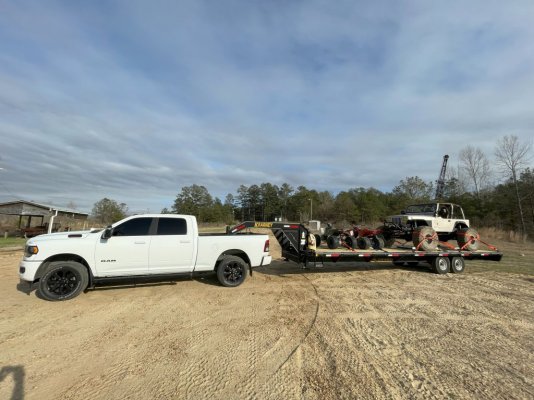
Nice setup with the Jeep! Im not too far off from you.
When an axle cools down it potentially causes condensation inside the axle.
So I also think gear oil needs to get hot enough to cause any moisture to dissipate.
So I also think gear oil needs to get hot enough to cause any moisture to dissipate.
This was a non-issue from the start. Most humans can touch a 120-130F surface for only a second or two.You need at least a 1/2 hour or more,closer to an hour is even better,before it'll be at full operating temp,15 minutes isn't near long enough to get a diff up to temp,especially a heavy duty one,that has a pile of steel to heat.Take it for a good hour long drive and run it up to 70+ mph for a bit,as that's closer to most highway speeds
OP
OP
heefageLA
Senior Member
This was a non-issue from the start. Most humans can touch a 120-130F surface for only a second or two.
You are correct, but he was also showing me what drive conditions need to be achieved for the gear to reach operating temp.
Thats the beauty of this place. I asked a pretty ignorant question based on how something 'feels', and get feedback and advice from multiple angles.
Similar threads


- Replies
- 13
- Views
- 318


