

68RFE Fluid Level

Disclaimer: Links on this page pointing to Amazon, eBay and other sites may include affiliate code. If you click them and make a purchase, we may earn a small commission.

Bramic71

Senior Member
Joined
Mar 29, 2019
Posts
260
Reaction score
104
Location
Pace, FL
Ram Year
2016
Engine
Hemi 5.7
Good evening everyone. 2022 Ram 2500 6.7 4x4. Serviced the transmission. Replaced fluid and both filters, and also installed a thermal bypass valve. I could only get the transmission to around 160° on a mile and a half run up our steep road in 2nd gear. On the highway it maxxed out between 145° and 150°. I checked it at 160° and it was still a little lower than the lowest "hot" hole on the transmission dipstick. Being that the transmission fluid temp will be running cooler now, when it's at 160°, does it still need to be in the "hot" range on the stick? Thank You All
 

HEMIMANN

Senior Member
Joined
Dec 7, 2020
Posts
9,457
Reaction score
24,953
Location
Minneapolis, MN
Ram Year
2017 2500 Laramie Crew Cab
Engine
6.4L HEMI
Good evening everyone. 2022 Ram 2500 6.7 4x4. Serviced the transmission. Replaced fluid and both filters, and also installed a thermal bypass valve. I could only get the transmission to around 160° on a mile and a half run up our steep road in 2nd gear. On the highway it maxxed out between 145° and 150°. I checked it at 160° and it was still a little lower than the lowest "hot" hole on the transmission dipstick. Being that the transmission fluid temp will be running cooler now, when it's at 160°, does it still need to be in the "hot" range on the stick? Thank You All

For transmission longevity you don't want it running any hotter than 160 degrees F.

Dealers get around the physics by stating it's "normal" to run at 190 degrees F. Uh, no it's NOT. It was designed that way to get 0.2 more miles per gallon. It's ridiculous that designers sacrificed extremely expensive machinery life for miniscule fuel use reduction. But that's the way it is.

Hence everybody here getting rid of the ridiculous thermostat and trans oil heaters. It would be OK if...IF......an oil heater system was designed right and was reliable, but it seems a bunch of junior engineers were assigned the task of designing this minute subsystem without oversight and botched it bigly. At least on the old RFE's, they restricted oil flow to the oil cooler radiator with a pencil thin, cheap thermostat that was also unreliable and failed SHUT. Couldn't design a subsystem any worse. If one of my engineers did that I would have fired them. So rather than redesign a reliable LARGE oil thermostat, we all just ditched the stat and put in a thru flow block.

The HORROR! Transmission oil being cold in winter!!! What ever did they do prior to 2010? (Hint: nothing)
 
OP
OP
Bramic71

Bramic71

Senior Member
Joined
Mar 29, 2019
Posts
260
Reaction score
104
Location
Pace, FL
Ram Year
2016
Engine
Hemi 5.7
Thank you for your reply. Should it still be in the hot range on the dipstick, or will the level now be lower on the stick since it won't be in the 160°-195° range for the most part?

You're correct. The miniscule fuel mileage gain is laughable.
 

HEMIMANN

Senior Member
Joined
Dec 7, 2020
Posts
9,457
Reaction score
24,953
Location
Minneapolis, MN
Ram Year
2017 2500 Laramie Crew Cab
Engine
6.4L HEMI
Thank you for your reply. Should it still be in the hot range on the dipstick, or will the level now be lower on the stick since it won't be in the 160°-195° range for the most part?

You're correct. The miniscule fuel mileage gain is laughable.

I don't know the calibration for the dipstick. What I do is fill to the midpoint. Plenty good enough.
 
OP
OP
Bramic71

Bramic71

Senior Member
Joined
Mar 29, 2019
Posts
260
Reaction score
104
Location
Pace, FL
Ram Year
2016
Engine
Hemi 5.7
Ok, thank you. I am in that range.
 

BossHogg

Senior Member
Navy Badge Law Enforcement
Joined
Feb 23, 2014
Posts
2,411
Reaction score
3,808
Location
Oakland Township, Michigan
Ram Year
2015
Engine
6.7L Cummins
For transmission longevity you don't want it running any hotter than 160 degrees F.
Where did the 160-degree temperature for a 68RFE come from? I've read that an operating range of 160 to 195 degrees is acceptable. I do not recall ever seeing my operating temperature at a constant 160 degrees after warming up, towing or not.
 

White six four

Senior Member
Joined
Dec 31, 2019
Posts
796
Reaction score
1,559
Location
Wisconsin
Ram Year
2016
Engine
6.4
He installed a bypass valve to get rid of the thermostat.

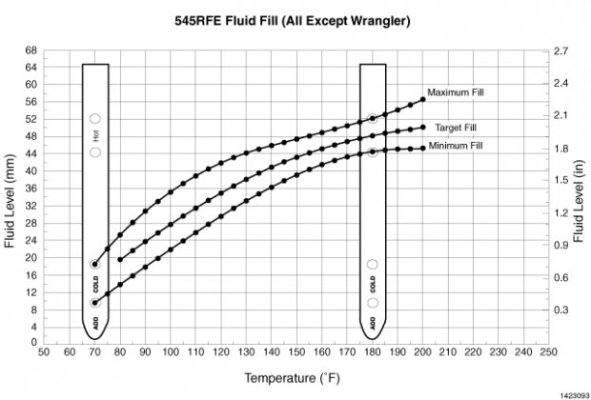
I know it says 545rfe but it uses the same atf+4 fluid so it should be pretty close as far as fluid expansion at what temp.
Trans Fluid Check.jpg

I had the same question when I installed the thermal bypass. I did a pan drop and filter change at the same time. I did my best to measure how much fluid I took out from that and the bypass install.
 

HEMIMANN

Senior Member
Joined
Dec 7, 2020
Posts
9,457
Reaction score
24,953
Location
Minneapolis, MN
Ram Year
2017 2500 Laramie Crew Cab
Engine
6.4L HEMI
Where did the 160-degree temperature for a 68RFE come from? I've read that an operating range of 160 to 195 degrees is acceptable. I do not recall ever seeing my operating temperature at a constant 160 degrees after warming up, towing or not.

Prior to EPA CAFE standards for automatic transmission oil, and per oil company recommendations. Every 18 degrees F above 140 degrees F bulk oil temperature cuts oil oxidation life in half for any oil. This is the root cause of RFE transmission heat failures. That WAS the design oil temperature target of the automatic transmission builders. Their claim the new "normal" is much higher is just that - a claim that reduces transmission longevity for the holy grail of miniscule fuel mileage increases. One of many such - just like MDS AFM, whatever. VVT, etc. Similar to how Hemi tick "is normal". No, it's not. It's a design flaw.

From my days in Mobil Lubrication Engineering.
 
OP
OP
Bramic71

Bramic71

Senior Member
Joined
Mar 29, 2019
Posts
260
Reaction score
104
Location
Pace, FL
Ram Year
2016
Engine
Hemi 5.7
He installed a bypass valve to get rid of the thermostat.

I know it says 545rfe but it uses the same atf+4 fluid so it should be pretty close as far as fluid expansion at what temp.
View attachment 580762

I had the same question when I installed the thermal bypass. I did a pan drop and filter change at the same time. I did my best to measure how much fluid I took out from that and the bypass install.
Thank you for the chart, its very helpful.
 
OP
OP
Bramic71

Bramic71

Senior Member
Joined
Mar 29, 2019
Posts
260
Reaction score
104
Location
Pace, FL
Ram Year
2016
Engine
Hemi 5.7
Prior to EPA CAFE standards for automatic transmission oil, and per oil company recommendations. Every 18 degrees F above 140 degrees F bulk oil temperature cuts oil oxidation life in half for any oil. This is the root cause of RFE transmission heat failures. That WAS the design oil temperature target of the automatic transmission builders. Their claim the new "normal" is much higher is just that - a claim that reduces transmission longevity for the holy grail of miniscule fuel mileage increases. One of many such - just like MDS AFM, whatever. VVT, etc. Similar to how Hemi tick "is normal". No, it's not. It's a design flaw.

From my days in Mobil Lubrication Engineering.
CAFE standards as well as many things the EPA does, is detrimental to the life and dependability of our vehicles.
 

HEMIMANN

Senior Member
Joined
Dec 7, 2020
Posts
9,457
Reaction score
24,953
Location
Minneapolis, MN
Ram Year
2017 2500 Laramie Crew Cab
Engine
6.4L HEMI
CAFE standards as well as many things the EPA does, is detrimental to the life and dependability of our vehicles.

They've been at this for about 25 years, or so. They've outlived their mission, so are micro-managing to keep their jobs by subtracting value from products. I dealt with them for 10 years @ Cummins.

The latest gig I'm sure you've heard about is Gasoline Direct Injection which is also greatly shortening engine life for about 5% more fuel economy. The jury is still out whether they can make a CVT transmission durable enough for all but mouse mobiles. Again, for increasing fuel economy. And while stop/start did in fact reduce fuel consumption, it was a safety hazard at heavy traffic intersections. And cost more for bigger starter motors and batteries.

It's all so stupid when design criteria is dictated by single-issue-focused bureaucrats without wholistic design consideration. As a retired product line manager it irritates me more than many.
 
OP
OP
Bramic71

Bramic71

Senior Member
Joined
Mar 29, 2019
Posts
260
Reaction score
104
Location
Pace, FL
Ram Year
2016
Engine
Hemi 5.7
They've been at this for about 25 years, or so. They've outlived their mission, so are micro-managing to keep their jobs by subtracting value from products. I dealt with them for 10 years @ Cummins.

The latest gig I'm sure you've heard about is Gasoline Direct Injection which is also greatly shortening engine life for about 5% more fuel economy. The jury is still out whether they can make a CVT transmission durable enough for all but mouse mobiles. Again, for increasing fuel economy. And while stop/start did in fact reduce fuel consumption, it was a safety hazard at heavy traffic intersections. And cost more for bigger starter motors and batteries.

It's all so stupid when design criteria is dictated by single-issue-focused bureaucrats without wholistic design consideration. As a retired product line manager it irritates me more than many.
I can definitely understand that, and agree.
 

Gr8bawana

Senior Member
Joined
Dec 7, 2015
Posts
1,391
Reaction score
1,262
Ram Year
2017
Engine
6.7 CTD
My 2017 2500 68rfe trans almost always runs at 168°-172° either empty or even towing. If I'm towing our 5er in very hot temps it might reach 180° on a steep or long climb but then returns back to normal temps right away.
Yes it still wears the stock thermal valve.
No need to fix what isn't broke.
 

olyelr

Senior Member
Joined
Nov 18, 2018
Posts
5,524
Reaction score
4,541
Location
Kewadin MI
Ram Year
2016
Engine
6.4
My 2017 2500 68rfe trans almost always runs at 168°-172° either empty or even towing. If I'm towing our 5er in very hot temps it might reach 180° on a steep or long climb but then returns back to normal temps right away.
Yes it still wears the stock thermal valve.
No need to fix what isn't broke.
Spot on for my ‘16 2500 as well.
 

cutterman

Member
Joined
Mar 22, 2020
Posts
62
Reaction score
57
Location
Chesapeake VA
Ram Year
2020
Engine
6.7L
For transmission longevity you don't want it running any hotter than 160 degrees F.

Dealers get around the physics by stating it's "normal" to run at 190 degrees F. Uh, no it's NOT. It was designed that way to get 0.2 more miles per gallon. It's ridiculous that designers sacrificed extremely expensive machinery life for miniscule fuel use reduction. But that's the way it is.

Hence everybody here getting rid of the ridiculous thermostat and trans oil heaters. It would be OK if...IF......an oil heater system was designed right and was reliable, but it seems a bunch of junior engineers were assigned the task of designing this minute subsystem without oversight and botched it bigly. At least on the old RFE's, they restricted oil flow to the oil cooler radiator with a pencil thin, cheap thermostat that was also unreliable and failed SHUT. Couldn't design a subsystem any worse. If one of my engineers did that I would have fired them. So rather than redesign a reliable LARGE oil thermostat, we all just ditched the stat and put in a thru flow block.

The HORROR! Transmission oil being cold in winter!!! What ever did they do prior to 2010? (Hint: nothing)
As a Engineering Consultant for some of these companies I will tell you this was not some junior engineer mess up. First if you seen the amount people any design has to go through it would make the Military QA process seem easy. This was all done in the standard Automotive industry requirement. When something is designed for these companies they give requirement and the design just has to meet or exceed them. Most of the time with things that create carbon points the design usually just meets the requirements. I try and tell people the modern automotive industry requirements are to achieve 5 years 140K miles. As long as the design meets this it usually meets the longevity requirements.
 

cutterman

Member
Joined
Mar 22, 2020
Posts
62
Reaction score
57
Location
Chesapeake VA
Ram Year
2020
Engine
6.7L
Prior to EPA CAFE standards for automatic transmission oil, and per oil company recommendations. Every 18 degrees F above 140 degrees F bulk oil temperature cuts oil oxidation life in half for any oil. This is the root cause of RFE transmission heat failures. That WAS the design oil temperature target of the automatic transmission builders. Their claim the new "normal" is much higher is just that - a claim that reduces transmission longevity for the holy grail of miniscule fuel mileage increases. One of many such - just like MDS AFM, whatever. VVT, etc. Similar to how Hemi tick "is normal". No, it's not. It's a design flaw.

From my days in Mobil Lubrication Engineering.
I'm sure you know but the main problem is they do put additives in ATF/Hydraulic fluids to stop the oxidation and breakdown from the higher heat and pressures. The problem mainly lies in the fact that although the fluids and equipment can handle the heat, they can only do it for a certain amount of time. Once the additives and friction modifiers burn out then the fluid starts breaking down extremely quick. This is why the change intervals have gotten shorter.

I remember a time not long ago when the industry was designing maintenance free transmissions. This was everything from Chevy to BMW. They soon realized this was a bad idea. For one they lose money through service and another vehicles started getting bad names. I don't care what petroleum product you use it will eventually break down. Transmission were going out in these vehicles but not until the second or 3rd owner which caused people to start talking about quality of certain vehicles. You can't have a high dollar German engineered car get a bad rap and cause resale value to decrease because people know they won't get XYZ out of the trans.
 

HEMIMANN

Senior Member
Joined
Dec 7, 2020
Posts
9,457
Reaction score
24,953
Location
Minneapolis, MN
Ram Year
2017 2500 Laramie Crew Cab
Engine
6.4L HEMI
I'm sure you know but the main problem is they do put additives in ATF/Hydraulic fluids to stop the oxidation and breakdown from the higher heat and pressures. The problem mainly lies in the fact that although the fluids and equipment can handle the heat, they can only do it for a certain amount of time. Once the additives and friction modifiers burn out then the fluid starts breaking down extremely quick. This is why the change intervals have gotten shorter.

I remember a time not long ago when the industry was designing maintenance free transmissions. This was everything from Chevy to BMW. They soon realized this was a bad idea. For one they lose money through service and another vehicles started getting bad names. I don't care what petroleum product you use it will eventually break down. Transmission were going out in these vehicles but not until the second or 3rd owner which caused people to start talking about quality of certain vehicles. You can't have a high dollar German engineered car get a bad rap and cause resale value to decrease because people know they won't get XYZ out of the trans.

Who are you? Dude, just....no.
 

Ritchie_Rich

Senior Member
Law Enforcement
Joined
Jun 7, 2025
Posts
444
Reaction score
454
Location
NV
I'm sure you know but the main problem is they do put additives in ATF/Hydraulic fluids to stop the oxidation and breakdown from the higher heat and pressures. The problem mainly lies in the fact that although the fluids and equipment can handle the heat, they can only do it for a certain amount of time. Once the additives and friction modifiers burn out then the fluid starts breaking down extremely quick. This is why the change intervals have gotten shorter.

I remember a time not long ago when the industry was designing maintenance free transmissions. This was everything from Chevy to BMW. They soon realized this was a bad idea. For one they lose money through service and another vehicles started getting bad names. I don't care what petroleum product you use it will eventually break down. Transmission were going out in these vehicles but not until the second or 3rd owner which caused people to start talking about quality of certain vehicles. You can't have a high dollar German engineered car get a bad rap and cause resale value to decrease because people know they won't get XYZ out of the trans.
1775153397517.jpeg
 
Back
Top