To cover the high points as best I can with my rusty physics knowledge :
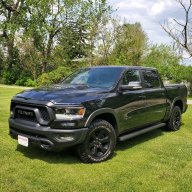
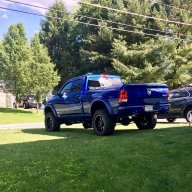
The heavier wheels and tires increase rotational inertia and as your mass increases you get less angular acceleration for a given amount of input force. This will also reduce your breaking power since inertia works both ways. MDS only operates when the truck is under light load and by removing half the cylinders from the equation you get less torque output. Since the heavier wheels and tires require more input force to get moving the truck will not see as many instances of optimal conditions in which it can enable the MDS system when acceleration changes are required. This explains part of the acceleration side of the issue and anytime minor acceleration is required where the truck could previously leave MDS engaged may now require it to disengage to get more power output.
Generally you are also going to deal with more more rolling resistance as the wheel/tire combination is heavier as well as the more aggressive tread pattern/design of an off road tire. Since they are designed, typically, for grip under adverse conditions and side wall strength they will be heavier and have a "gripper", as in more friction, optimized design. They are also going to be more likely to deform, part of the grip strategy, all of which will increase the rolling resistance. Combine this with a typically much wider tire which has a wider contact footprint with the surface and it all starts to add up. This explains part of the steady state part of the issue as it will take more constant power output in order to overcome the additional rolling resistance.
Finally you have the final drive ratio change by moving to a larger diameter tire. This will reduce the mechanical advantage available to get power to the ground via the friction (grip) between the tires and the surface. The loss of the mechanical advantage leads to less torque multiplication of the engines output which again will require more output power from the engine given the same conditions once a larger tire is in play. This is why a re-gear can help the truck significantly when larger tires are used as you regain the lost mechanical advantage restoring the lost torque multiplication. This is a factor in both the steady state part of the issue as well the acceleration part of the issue.
https://www.khanacademy.org/science...momentum/torque-tutorial/a/rotational-inertia
https://opentextbc.ca/physicstestbook2/chapter/dynamics-of-rotational-motion-rotational-inertia/
https://www.real-world-physics-problems.com/rolling-resistance.html
http://www.dynamicscience.com.au/tester/solutions1/hydraulicus/gears1mechanicalad.htm
It's been a while since I did any real Physics so I probably didn't explain something properly or otherwise screwed up, but it should be sufficient to get the idea across.