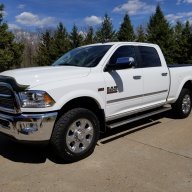
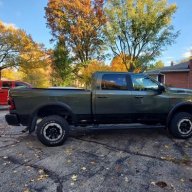
A cautionary tale.......keep up on your maintenance

Disclaimer: Links on this page pointing to Amazon, eBay and other sites may include affiliate code. If you click them and make a purchase, we may earn a small commission.

HEMIMANN

Senior Member
Joined
Dec 7, 2020
Posts
9,512
Reaction score
25,088
Location
Minneapolis, MN
Ram Year
2017 2500 Laramie Crew Cab
Engine
6.4L HEMI
I've posted this before, but this guy uses calibrated dust like the manufacturers/designers do to show filtering and airflow of various filters:


Arizona Road Dust! Quite expensive for testing. I saw a video from Donaldson Filters on this at work long ago.
 

HEMIMANN

Senior Member
Joined
Dec 7, 2020
Posts
9,512
Reaction score
25,088
Location
Minneapolis, MN
Ram Year
2017 2500 Laramie Crew Cab
Engine
6.4L HEMI
I don't know....... Starting up an engine where the oil filter is empty will, definitely introduce a small air pocket/volume reduction in upstream oil.... just at the moment the engine rod and main bearings are called upon to perform their magic in an instant.... initial start up.

On cars that have "clear flood" function, I crank until oil pressure builds up.

I'm lazy like that, too. Also shut off engine above 1,000 rpm to leave sufficient oil in the galleys. Yeah I know they drain down, but at least they haven't sat there with little oil from the Hemi's weak oil system @ only 650 rpm. I can't raise rpm from the tuner I installed. Not gonna install a hydrostatic pre-start electric oil pump either. It's not a million dollar freighter engine.
Btw, the oil pressure gauge is active during flood clear mode. Usually takes a second 20 second crank cycle for oil to reach it, and it's only just past the oil filter! What a terrible engine oiling system they put on. Anyway, you can see the gauage needle jump when oil finally gets there.
20 second crank, 20 second rest, is industrial industry standard for starter motor longevity.
 

PolarisCobra

Senior Member
Joined
Jul 16, 2018
Posts
609
Reaction score
1,033
Location
Mendon, MA
Ram Year
2025
Engine
SST SO
I was taught that it's a bad idea to rev the engine when shutting it down. I would agree that it may leave a bit more oil up top, but was taught that it also leaves some unburnt fuel in the cylinders, which washes down the cylinder walls, causing a different problem when you restart it.
 

HEMIMANN

Senior Member
Joined
Dec 7, 2020
Posts
9,512
Reaction score
25,088
Location
Minneapolis, MN
Ram Year
2017 2500 Laramie Crew Cab
Engine
6.4L HEMI
I was taught that it's a bad idea to rev the engine when shutting it down. I would agree that it may leave a bit more oil up top, but was taught that it also leaves some unburnt fuel in the cylinders, which washes down the cylinder walls, causing a different problem when you restart it.

I didn't say take it to the redline. This isn't the carbureted era, either.
 

Grams

Senior Member
Joined
Oct 4, 2024
Posts
1,060
Reaction score
1,748
Location
Texas
Ram Year
2024 & 2015
Engine
6.7 Cummins & 5.7 Hemi
I was taught that it's a bad idea to rev the engine when shutting it down. I would agree that it may leave a bit more oil up top, but was taught that it also leaves some unburnt fuel in the cylinders, which washes down the cylinder walls, causing a different problem when you restart it.
And….it’s especially hard on a turbo.

As for using the starter to crank the engine in lieu of simply starting normally…. I truly think this is completely useless and possibly more harmful.

OIl pumps are “mechanical” and rotate at the same ratio regardless of whether the engine is starter-rotated or combustion-rotated.
Hence, the oil volume pumped is (almost)* exactly the same either way.
* it seems logical to me that oil pumped slowly (as with the starter motor) will suffer greater internal “leakage” than if pumped more-quickly…. meaning that components higher-up or later-in the lube-gallery-sequence will see less oil than if the oil had been pumped speedily.

The friction and abrasion which occurs at ring/cyl-wall, bearings, etc. is probably Greater at slow rotational speads than at running speeds.
If one wishes to remove material when sanding wood, metal, or synthetics (plastics) ….the S L O W movement of the sanding-block is more-effective in most cases as it allows surface-tension to have more “dwell” time on the subject/receiving-surface.

If the object is to get lubricant onto the surfaces as quickly (time-wise) and as universally (everywhere) as possible…then faster rotation of the engine will meet the “time” more effectively….and the “sling” from a crankshaft up to piston-skirts, cylinder-walls (and therefore ring-grooves for ring, distribution, and sealing-purposes) will exist…and will Not exist at mere “cranking speeds”.

These things will be even more exacerbated when the oil is cool (such as when the initial starter-motor-cranking is utilized on new or long-inactive engines.)

In my opinion, the Best Method is to start the engine-operation as Normally as possible to reach actual combustion as rapidly as possible…both in terms of Time AND in actual rotation-count.

 

Docwagon1776

Senior Member
Joined
Mar 16, 2012
Posts
4,693
Reaction score
10,059
Location
Midwest
Ram Year
2012, 2021
Engine
5.7, 6.4
The friction and abrasion which occurs at ring/cyl-wall, bearings, etc. is probably Greater at slow rotational speads than at running speeds.
If one wishes to remove material when sanding wood, metal, or synthetics (plastics) ….the S L O W movement of the sanding-block is more-effective in most cases as it allows surface-tension to have more “dwell” time on the subject/receiving-surface.

With the understanding I think this is all a question of angels on pinheads, you're ignoring the forces of combustion and the effect of the heat on the ring's tension against the wall.

The hot exhaust gas trying to get through the rings, aka blowby, is not present with no start cranking.

To further your analogy, the sanding would be done with much more pressure and with a hammering start vs relatively constant pressure.

Again, this is just for the interest of the underlying physics of it. I think any differences in wear are so negligible as to be in magic talisman territory, trying to exert control via ritual, more than actual mechanical advantages to longevity.
 

Grams

Senior Member
Joined
Oct 4, 2024
Posts
1,060
Reaction score
1,748
Location
Texas
Ram Year
2024 & 2015
Engine
6.7 Cummins & 5.7 Hemi
With the understanding I think this is all a question of angels on pinheads, you're ignoring the forces of combustion and the effect of the heat on the ring's tension against the wall.

The hot exhaust gas trying to get through the rings, aka blowby, is not present with no start cranking.

To further your analogy, the sanding would be done with much more pressure and with a hammering start vs relatively constant pressure.

Again, this is just for the interest of the underlying physics of it. I think any differences in wear are so negligible as to be in magic talisman territory, trying to exert control via ritual, more than actual mechanical advantages to longevity.
If what you suggest is correct…then e-torque is hard on engines at each stop-light.
 

Docwagon1776

Senior Member
Joined
Mar 16, 2012
Posts
4,693
Reaction score
10,059
Location
Midwest
Ram Year
2012, 2021
Engine
5.7, 6.4
If what you suggest is correct…then e-torque is hard on engines at each stop-light.


Probably, but again the difference over the lifetime of a vehicle is likely not measurable against other variables, especially since it *should* be riding on the oil in the crosshatching on those restarts vs any metal to metal contact unless the cylinder walls are already damaged. Stop/start is a work around for idle emissions more than anything that's longevity driven, as I'm sure you know.

Similarly you could argue that MDS is better for each individual cylinders' wear when it is shut off, no exhaust gas and just the psi of the "trampoline" of air trapped, reduced temperature, no risk of cylinder wall washdown, etc. But...is it enough of a difference to matter? No.

The pressure on rings isn't really controversial, the top ring takes most of the "hammering" from combustion, then as gas slips through the ring gap to the next 'chamber' created by the ring under it the second ring gets more pressure, etc. Smarter guys than me can do the math, but the forces on the rings:
  • Radial and axial gas loading
  • Elastic ‘tension’
  • Inertia
  • Running and side face friction
  • Running and side face loading

Gas loading isn't present without the gasses from combustion. Intertia is lower at lower RPMs, of course. Tension is basically the "springiness" of the ring and it's the same in motion or static (ignoring real minor differences for heat). I *think* friction would remain the same, but honestly that's beyond my understanding of the topic to say for sure.

A real expert could figure out the pressure numbers, but I'm nowhere near informed enough to know what to plug into the formula to get decent info for the Hemi. I figure the guys who designed the pistons and rings probably did, though. :D
 

Sherman Bird

Senior Member
Joined
Jun 28, 2019
Posts
3,094
Reaction score
6,706
Location
Houston, Texas
Ram Year
1998
Engine
5.2
If what you suggest is correct…then e-torque is hard on engines at each stop-light.
Stop/Start function is for CAFE per federal mandate.... period. It is VERY hard on batteries, starters, alternators, and ESPECIALLY engines.
I encourage all of my customers to defeat that function, if longevity is at the top of their preferential list, regarding their car.
 

Sherman Bird

Senior Member
Joined
Jun 28, 2019
Posts
3,094
Reaction score
6,706
Location
Houston, Texas
Ram Year
1998
Engine
5.2
I'm lazy like that, too. Also shut off engine above 1,000 rpm to leave sufficient oil in the galleys. Yeah I know they drain down, but at least they haven't sat there with little oil from the Hemi's weak oil system @ only 650 rpm. I can't raise rpm from the tuner I installed. Not gonna install a hydrostatic pre-start electric oil pump either. It's not a million dollar freighter engine.
Btw, the oil pressure gauge is active during flood clear mode. Usually takes a second 20 second crank cycle for oil to reach it, and it's only just past the oil filter! What a terrible engine oiling system they put on. Anyway, you can see the gauage needle jump when oil finally gets there.
20 second crank, 20 second rest, is industrial industry standard for starter motor longevity.
I'm currently working on a 2008 300C with a 5.7 Hemi. It has been down for months due to the extent of repairs and the customer not needing it (it's a spare car).
As I'm nearing the time for the engine to be started, after replacing a hemorrhaging oil pan and the filter being off, and replacing the pickup tube, I'm going to hook up my electric fuel pump which I bought specifically for pre-charging newly rebuilt or heavily worked on engines. I'll fill the filter first, install it, remove the oil pressure switch, and run a couple of quarts of oil through the system that way. This really does work, too! When I start the engine, the light or gauge shows very quick indication of oil pressure!
 

HEMIMANN

Senior Member
Joined
Dec 7, 2020
Posts
9,512
Reaction score
25,088
Location
Minneapolis, MN
Ram Year
2017 2500 Laramie Crew Cab
Engine
6.4L HEMI
I'm currently working on a 2008 300C with a 5.7 Hemi. It has been down for months due to the extent of repairs and the customer not needing it (it's a spare car).
As I'm nearing the time for the engine to be started, after replacing a hemorrhaging oil pan and the filter being off, and replacing the pickup tube, I'm going to hook up my electric fuel pump which I bought specifically for pre-charging newly rebuilt or heavily worked on engines. I'll fill the filter first, install it, remove the oil pressure switch, and run a couple of quarts of oil through the system that way. This really does work, too! When I start the engine, the light or gauge shows very quick indication of oil pressure!

Oh heck yeah! Expensive machinery all have pre-lubers on them. As long as you've got the engine apart, why not? Then again, why not put in a higher flow oil pump while you're in there? And set the idle back to where they used to be too, while you're at it (750 rpm instead of 650 rpm)? THen you'll have an almost functional oiling system in a Hemi!
 

Sherman Bird

Senior Member
Joined
Jun 28, 2019
Posts
3,094
Reaction score
6,706
Location
Houston, Texas
Ram Year
1998
Engine
5.2
Oh heck yeah! Expensive machinery all have pre-lubers on them. As long as you've got the engine apart, why not? Then again, why not put in a higher flow oil pump while you're in there? And set the idle back to where they used to be too, while you're at it (750 rpm instead of 650 rpm)? THen you'll have an almost functional oiling system in a Hemi!
I didn't have the front apart. I had to remove the intake manifold in order to lift the engine high enough to get the oil pan out. The engine is a 2007 with AFM. The oil filter is the smaller threads one than the 2008 and newer engines use.
The original reason for the car coming in was because the transmission stopped pulling (722.6). I rebuilt it and have installed it, leaving off the exhaust to make the oil pan job easier.

Next, I have to remove the front fascia in order to replace the condenser, which has the trans cooler integrated.
 
Back
Top