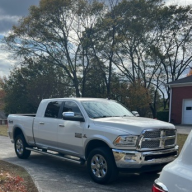
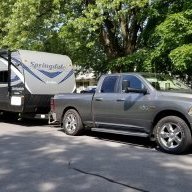
No, I don't believe you. Look up the specs for any year RAM. The tow capacity is MUCH higher for trucks with 3.92 vs 3.21. Here are some examples. You simply cannot ignore that a truck with the same body with the same engine, same transmission, and same GVWR has a better tow capacity with a 3.92 axle. There is literally no defense as this data is provided by the manufacturer of the truck! Think about it. The people that designed the truck are telling you to get the maximum tow capacity, get a truck with a 3.92 axle. Not trying to be a jerk, but the OP is planning to tow a camper that is the high end of what a half ton can tow. If he doesn't have a 3.92, then it probably didn't come with a tow package. That means suspension, brakes, and radiator could be undersized as well for that trailer. If that's the case, he shouldn't get the trailer.
Your "I" gear is an extra overdrive gear which is helpful driving on the expressway unhitched. Faster speeds at better fuel economy. Under heavy tow, the "I" gear is likely completely locked out while in Tow/Haul mode. If you don't have tow/haul mode on, you will likely just bog down and lose speed on the highway at that gear. That extra gear is repurposed on the 3.92 as another towing gear which offers additional combinations in final gear ratio. This not only provides the best ratio to keep RPMs down, but it offers better torque to ensure you can maintain that speed.
GCWR is determined by the J2807 standard. This standard/test measures 0 to 15 and 0 to 30 (among other things), it's a TIMED event. You take a little longer to complete the course, your rating goes down. Simplifying, somebody somewhere said you need to pull this trailer up a hill at a certain temperature from a dead stop with the AC running, and do it in < X seconds. If you take longer, you are rated to pull less. That's the only difference, there is no structural/safety issue if a 3.21 pulls 11,000 pounds, it just takes longer to get the load moving. That's it.
The point is, out in the real world, 0 to 15 is a useless metric. Nobody goes WOT from a dead stop with a trailer behind them, except people who are testing them. What matters in the real world is passing power on the freeway, or acceleration on an on-ramp. These "tests" will give you 100% identical results in both trucks, that's the beauty of gearing, it doesn't matter if you use a higher transmission gear or a higher rear axle gear, final gear ratio is all that matters and both trucks have very similar final gear ratios except for the extreme ends (1 and 8).
So my point is, you need to shift your perspective away from a little piece of paper which says you can tow X pounds, and instead actually judge the trucks by how they perform when used as real trucks in the real world. And that means, for all intents and purposes, your experience towing with either truck will be 100% identical except for a slightly slower dig from a dead stop. How much time does your truck spend in first gear accelerating? Mine spends < 1 minute total, over a 4 or 5 hour towing trip through the province on the freeway.
As for the tow package etc, at some point Ram just equipped all 5.7 hemi trucks with the 8 speed with the same towing gear. No difference when it comes to suspension, cooling, brakes, radiator etc. Only difference between my truck (without tow package) and one with it, is the mirrors (literally, that's the only difference). I don't know at what year they did this, but they've been doing it for a while.
Also lets dial down the drama, 7500 GROSS is completely within range of any half ton truck. Nothing bad is going to happen no matter what truck you pull that with. Even the 3.6 would do it completely safely, though it might feel underpowered. Heck that v6 is still putting out more horsepower than a 2000 era GMC with the 5.3 and nobody would think twice about pulling 7500 pounds back then.
As for your last paragraph its complete nonsense. 7 and 8 are both over drives, the truck will use both those gears if the load your pulling is small enough. There is no "repurposing" with the 3.92 I have no idea where you got that from.
What you need to understand, when both trucks are in a gear that gives them equal RPMs at the same speed, (so 6th on 3.21 vs 7th on 3.92), both trucks are putting out the same power/torque, both are putting the same torque to the wheels. That's why there is no difference in city/freeway power. Only reason the 3.92 tugs harder off the line is because it has a final gear ratio that the 3.21 doesn't have. Once the trucks are moving up through the gears, the same gear ratios are available so there is no longer any difference in performance.
Finally, I have extensive experience towing 6000 to 7000 pounds behind a 3.21. That load requires 6th gear in my truck on the freeway at 63 mph, and that will be at about 2200-ish RPMs. The 3.92 will pull that same load in 7th since that is the same final gear ratio as the 3.21 in 6th, and it will be at 2200 rpms as well. I'd much rather tow that load in 6th than in overdrive, full stop. Towing in overdrive is not good for transmissions, so with the 3.92 either you put extra strain on your tranny and tow at 2200 rpms in 7th, or you drop a gear to 6th and now you're revving needlessly at 2700 or so for no reason since the engine itself can put out enough power at 2200.
So yes, the 3.21 is a very capable tow machine. Don't fixate on the little cells on your spreadsheet because those numbers are less valid than EPA MPG numbers.


 www.ramforum.com