

- Joined
- Nov 9, 2016
- Posts
- 2,779
- Reaction score
- 5,930
- Location
- Montana, officially RETIRED
- Ram Year
- 2014
- Engine
- Hemi 5.7, supercharged
If you're not living on the edge you take up too much space


Disclaimer: Links on this page pointing to Amazon, eBay and other sites may include affiliate code. If you click them and make a purchase, we may earn a small commission.
My tubes were the older style with the o rings. Not the newer encased tubes. It’s weird because I bought my truck dec 2016. It’s a 2017 modelMight be me,but it looks like the only change that i can see is the newer one comes with the transfer tubes,which were updated.Maybe i'm missing something though.Alot of times the suffix change relates to a price change to,from what i've gathered up from my local parts department,but don't quote me on that,that's just what my local partsmen has told me,lol
My tubes were the older style with the o rings. Not the newer encased tubes. It’s weird because I bought my truck dec 2016. It’s a 2017 model
That looks about perfect. IMO

I don't want to muddy Caulks thread so I am going to put this here. Plenty of minds have been weighing in on the subject so all please feel to comment. My question is, what do you think would be the results if I did the following.
1) Place a valve in the line that runs between the 3 way diverter and the heater on the transmission. Thus allowing hot fluid from the cooling system to be shut off. Same principle as in the heater core in the cabin area. Valve off = no fluid flow and no heat, Valve open = fluid flow and heat.
2) remove the spring and thermostat that is under the plastic cap . This would eliminate the 180 degrees required to get fluid to flow to the cooler. There would be two paths for fluid to follow, one to the cooler and one to the heater. However, unlike the #2 option with RevMax the fluid going to the heater would not be heated because you can stop the hot coolant flow with the valve under the hood.
In fact if you were traveling through a very cold area you could open the valve and allow some of the fluid to be heated. When in a very hot area close the valve.
This seems kind of simple and straight forward to me. What am I overlooking?
Does that plastic cap require spring pressure to hold it against the c-clip for a seal?
And somebody please tell me why my font gets smaller as my post gets longer. What the hell causes that?
Personally i think you're over thinking this,lol. You're adding more leak points to a system that already has a few. Why are you wanting to heat the fluid,when the HD trucks and the cars don't heat the fluid. I think you'd be farther ahead adapting the HD trucks thermostat block into place.From what i've gathered up talking to a few HD owners,the 8 speeds in the HD's are running right around the 160/165 range when the trucks are running down the road unloaded.
You don't even have to cut the original hose.
By simply removing the thermostat, you'll get little too no flow through the cooler. It's a much shorter path for it to go through the heat exchanger. Likely fine in cold weather, but in warm weather you won't be able to cool it down, even with the coolant turned off from the exchanger.
I honestly don't think DD has caught onto how the system operates,as he seems to be hung up on pre-heating the fluid. The fluid is only pre-heated to meet the trucks milege numbers.I've tried to get it across to him,that if pre-heating the fluid was beneficial to the life of the tranny,the cars and the HD trucks would also be pre-heating the fluid.I'm not saying you haven't got some good ideas DD,but you have to realize only the 1500's pre-heat the fluid,while the vehicles with the most factory horsepower ahead of the 8HP70 don't pre-heat the fluid,ie: the 6.4 SRT Challenger/Chargers,and the vehicles that put the most torque stress on the tranny don't pre-heat the fluid ie: the 2500's and 3500's.That should make you question why the 1500's have to pre-heat the fluid,it's not done for the life expectancy of the transmission,it's done strictly to meet cafe/epa milege numbers.
Can anyone indicate the fluid flow direction on these ports? I'm curious on the in/out and flow direction.
View attachment 235514
No, I am not hung up on pre-heating the fluid. I do not have a desire to heat the fluid at all. I suggested cutting off the heat supply to the heat exchanger by putting a valve in the line that carries hot fluid from the radiator to the thermal unit or heater. You cannot transfer heat if you do not have a source of heat to transfer from.
I share your beliefs on all that you say in regards to comparing our 1500's to other vehicles. I do understand why the engineers heat the fluid and I do agree with your explanation on how and why the system does what it does.
Recall that I suggested that it might be plausible to use the thermostatic control block from the HD trucks on the 1500's. I would love to see the Temps. that the HD guys are posting.
I learned the hard way long ago that I should always be open to new information and willing to learn new things. In searching for Information I keep coming upon statements that put forth 175*F as the ideal transmission Temp. I know we have always felt lower is better when it comes to transmission Temps. Recall the statement I made about cooling the THM400 in my 3500 GMC.
With that transmission I would have and still will say that I can't get the Temp. low enough.
However, on the ZF transmission I just don't feel good about taking it down into the 120's.
I realize that I stand alone on that but thats what I am comfortable with.
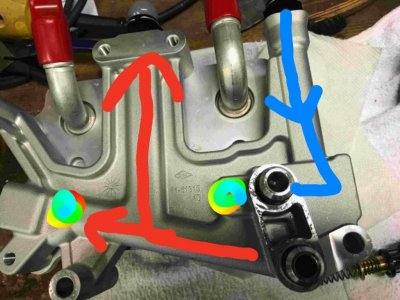
In this picture, port A is fluid into the trans, port B is fluid leaving the trans.
View attachment 237194
Red arrows are fluid leaving the trans, going towards the cooler and heat exchanger.
Blue arrow is fluid coming back from the cooler.
Multi color are the ports between the heat exchanger and manifold.
Because it's such a short path, fluid will flow through the heat exchanger much more easily than it will through all the lines to the front of the truck unless forced to do so by an open (hot) thermostat or my valve.
Fluid flows into the thermostat housing from either end, toward the middle of it where it reenters the trans.
You might be able to keep some heat from the heat exchanger,by using the Rev Max kit,and turning the block off plate into a restrictor plate instead.It'd take some trial and error to figure out the size of holes you'd need in the plate for it be used successfully as a restrictor plate though.If somebody decides to try that idea out,i'd start with no more then 1/16" holes and work up from there.Used as a restrictor plate,will keep the majority of fluid to be forced through the cooler,but still allow some fluid to run to the heat exchanger and warm up.It'd take some trial and error to find that fine line to where the restrictor plate idea would work though
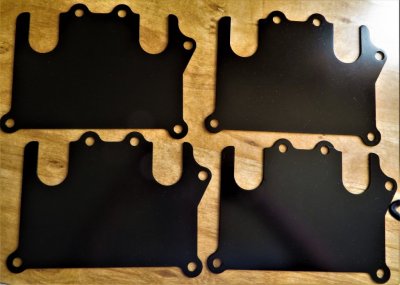
I see the thermostat in the photo. Have you placed it there to indicate its position relative to flow? Where the blue line make a 90 degree turn is where the thermostat enters the unit ?In this picture, port A is fluid into the trans, port B is fluid leaving the trans.
View attachment 237194
Red arrows are fluid leaving the trans, going towards the cooler and heat exchanger.
Blue arrow is fluid coming back from the cooler.
Multi color are the ports between the heat exchanger and manifold.
Because it's such a short path, fluid will flow through the heat exchanger much more easily than it will through all the lines to the front of the truck unless forced to do so by an open (hot) thermostat or my valve.
Fluid flows into the thermostat housing from either end, toward the middle of it where it reenters the trans.
I see the thermostat in the photo. Have you placed it there to indicate its position relative to flow? Where the blue line make a 90 degree turn is where the thermostat enters the unit ?
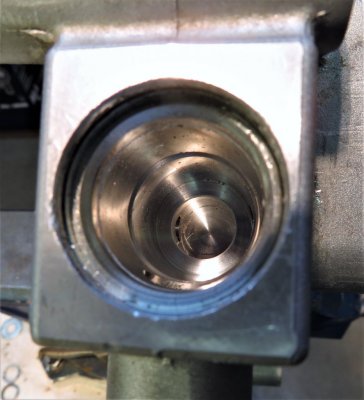
That isn't my picture, just a Google search. The 90 turn in the blue line is where the fluid returning from the cooler enters the outside of plastic plug and passes through those fluted ports to the center. If the stat is cold, it cannot go any further. Once it opens, the fluid can pass and reenter the trans.