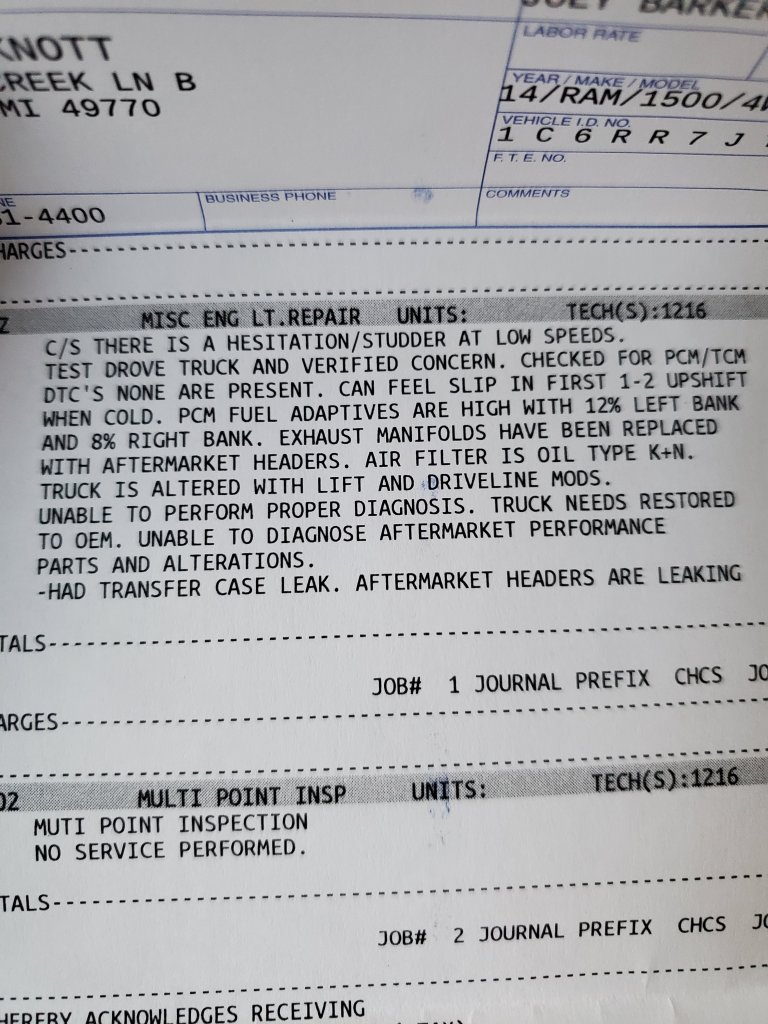
What he is experiencing is a lean condition between the 2 banks of cylinders due to the stated exhaust leaks at the headers etc. The OBD code that follows is P219a for driver side or P219b. Sounds like he asked what ask the meant and they attempted to explain. Anyway good luck with it.
That code still plagues my truck from time to time. My exhaust is sealed but I'm thinking vbands will be better than slip fit
Do you have headers ?
I found some more info regarding those DTC's
"DTC P219AFuel Trim Cylinder Balance Bank 1
DTC P219BFuel Trim Cylinder Balance Bank 2
Circuit/System Description
The Fuel Trim Cylinder Balance diagnostic detects a rich or lean cylinder to cylinder air/fuel ratio imbalance in each bank. The diagnostic monitors the pre-catalyst heated oxygen sensor (HO2S) signal's frequency and amplitude characteristics by calculating an accumulated voltage over a predetermined sample period. An imbalance is indicated when multiple samples of the accumulated voltage are consistently higher than the desired value.
Conditions for Running the DTC
•DTCs P0030, P0050, P0053, P0059, P0068, P0101, P0102, P0103, P0106, P0107, P0108, P0116, P0117, P0118, P0120, P0122, P0123, P0128, P0131–P0135, P0151– P0155, P015A-P015D, P0178, P0179, P0201–P0208, P0220, P0222, P0223, P0300, P0301–P0308, P0442, P0443, P0446, P0449, P0452, P0453, P0455, P0496, P1133, P1153, P1516, P2135, P2176, P2269 are not set.
•A scan tool device control is not active.
•The intrusive diagnostics are not active.
•The engine overspeed protection is not active.
•The power take-off is not active.
•The traction control is not active.
•The engine is in closed loop status.
•The system voltage is between 10–32 V for greater than 4 s.
•The engine run time is greater than 100 s.
•The engine coolant temperature (ECT) is warmer than −20?C (−4?F).
•The engine speed is between 425–2,500 RPM.
•The mass air flow is between 15–65 g/s.
•The fuel ethanol content is less than 87 percent.
•The DTCs run continuously when the above conditions have been met.
Conditions for Setting the DTC
Multiple samples of the pre-catalyst HO2S accumulated voltage are consistently greater than the desired value.
Action Taken When the DTC Sets
DTCs P219A and P219B are Type B DTCs.
Conditions for Clearing the MIL/DTC
DTCs P219A and P219B are Type B DTCs.
Diagnostic Aids
•The fuel trim cylinder balance diagnostic is very sensitive to heated oxygen sensor (HO2S) design. A non-OE sensor or an incorrect part number may cause a DTC to set.
•Monitoring the misfire current counters, or misfire graph, may help to isolate the cylinder that is causing the condition.
•Certain aftermarket air filters may cause a DTC to set.
•Certain aftermarket air induction systems or modifications to the air induction system may cause a DTC to set.
•Certain aftermarket exhaust system components may cause a DTC to set.
Circuit/System Verification
1. Ignition ON.
2. Verify no other DTCs are set.
⇒ If any other DTCs are set
Refer to Diagnostic Trouble Code (DTC)
⇓ If no other DTCs are set
3. Verify DTC P219A or P219B is not set.
⇒ If any of the DTCs are set
Refer to Circuit/System Testing.
⇓ If none of the DTCs are set
4. Operate the vehicle within the Conditions for Running the DTC. You may also operate the vehicle within the conditions that you observed in the Freeze Frame/Failure Records data.
5. Verify the DTC does not set.
⇒ If the DTC sets
Refer to Circuit/System Testing.
⇓ If the DTC does not set
6. All OK.
Circuit/System Testing
1. Engine idling, transmission in Park or Neutral.
2. Verify the manifold absolute pressure (MAP) sensor parameter is between 19–42 kPa (2.7–6 PSI).
⇒ If not within the specified range.
Refer to DTC P0106.
⇓ If within the specified range, inspect for the conditions listed below:
◦Modified, damaged, leaking, or restricted air induction system components.
◦Improper operation of the crankcase ventilation system. Refer to Crankcase Ventilation System Inspection/Diagnosis.
◦Split, kinked, or improperly connected vacuum hoses.
◦Restricted, damaged, leaking, or modified exhaust system from the catalytic converter forward. Refer to Symptoms - Engine Exhaust.
◦Vacuum leaks at the intake manifold, the throttle body, or the injector O-rings.
◦Improper operation of the fuel injectors. Refer to Fuel Injector Diagnosis.
◦Fuel contamination. Alcohol/Contaminants-in-Fuel.
◦Excessive fuel in the crankcase due to leaking injectors.
◦Improper operation of the ignition system. Refer to Electronic Ignition System Diagnosis.
⇒ If a condition is found
Repair as necessary.
If no condition is found
3. Test the engine for any mechanical conditions such as sticking valves, lifters, etc., which could alter the flow into the combustion chamber."



 .
.


