
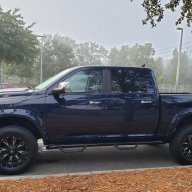
What Air Pressure for Lifted 2013 1500

Disclaimer: Links on this page pointing to Amazon, eBay and other sites may include affiliate code. If you click them and make a purchase, we may earn a small commission.

Aleckb

Junior Member
Joined
Oct 29, 2019
Posts
28
Reaction score
14
Location
Fleming Island Florida
Ram Year
2013
Engine
5.7 Hemi
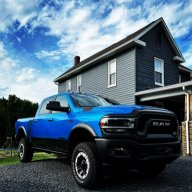
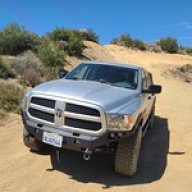
Bought 2013 1500 crew cab short bed 4WD w/ 4" lift, 20"x 11"s w/ 35x12.50 All terrains. The air pressure is 40, wondering if that is correct. I drive about 50/50 highway and streets. 40 seems ok...but wondering if that is ideal.

Thanks in advance.
 

muddy12

Senior Member
Joined
Jul 26, 2016
Posts
1,030
Reaction score
803
Location
Indiana
Ram Year
2012
Engine
5.7 Hemi
Psi too high will wear the center of the tread. Psi too low will wear the outer edges of the tread.
I’d recommend chalking the tires and adjusting the pressure accordingly.
I just put new 35x12.5’s on my stock 20” chrome clads, and after chalk testing, I’m at 36psi front, and 34 psi rear. (Crew cab with 5’ bed)

To preform the chalk test, rub chalk across the tire(I used some of my kids sidewalk chalk), and drive straight for a bit then check the chalk on the tires. You want the chalk to wear off evenly across the width of the tire. If the middle wears first, the psi is to high. If it wears off on the outside first, the psi is to low.


Sent from my iPhone using Tapatalk
 

RoadRamblerNJ

Senior Member
Joined
Aug 26, 2017
Posts
2,260
Reaction score
2,397
Location
Mountain City, TN
Ram Year
2017
Engine
392 Hemi
Bought 2013 1500 crew cab short bed 4WD w/ 4" lift, 20"x 11"s w/ 35x12.50 All terrains. The air pressure is 40, wondering if that is correct. I drive about 50/50 highway and streets. 40 seems ok...but wondering if that is ideal.

Thanks in advance.

Use the psi on the sticker in the drivers door jamb only if running stock tires.

Use the psi # on the tire if they're different than stock.

Those are my "official" answers.
Personally, I have always aired up above those numbers for street driving because...

1) I drive hard, often.
2) I pinched a tire on a pot hole causing a blowout once. Tires were at 32 psi.
3) Many cops I worked with recomended 38-40 psi just in case a pursuit comes your way.

Your driving style may be very different than mine. Just sharing what has worked for me for many years.
 

ChevySlayer69

Senior Member
Joined
Aug 1, 2018
Posts
189
Reaction score
182
Location
Maine
Ram Year
2015
Engine
hemi 5.7
Use the psi on the sticker in the drivers door jamb only if running stock tires.

Use the psi # on the tire if they're different than stock.

Those are my "official" answers.
Personally, I have always aired up above those numbers for street driving because...

1) I drive hard, often.
2) I pinched a tire on a pot hole causing a blowout once. Tires were at 32 psi.
3) Many cops I worked with recomended 38-40 psi just in case a pursuit comes your way.

Your driving style may be very different than mine. Just sharing what has worked for me for many years.

Absolutely do not use the PSI on the tire. That is max inflation and will definitely wear out the center of the tire.

40 psi is likely fine and the door jam sticker (39psi) can be used in this case.

The chalk test is a wise idea. You could start around 50psi and test in 5 psi increments downward, you will likely find an acceptable range within 30-40 psi.
 

RoadRamblerNJ

Senior Member
Joined
Aug 26, 2017
Posts
2,260
Reaction score
2,397
Location
Mountain City, TN
Ram Year
2017
Engine
392 Hemi
Absolutely do not use the PSI on the tire. That is max inflation and will definitely wear out the center of the tire.

40 psi is likely fine and the door jam sticker (39psi) can be used in this case.

The chalk test is a wise idea. You could start around 50psi and test in 5 psi increments downward, you will likely find an acceptable range within 30-40 psi.
As I said, your driving style may be very different than mine.

How I run my tires has never resulted in the middle wearing faster than the edges. Never.

I have, however, worn the edges down more than the middle of the tire numerous times on both cars and trucks, 2WD, 4WD, front & rear WD.

I ran my '09 Ram tires at 44--46 psi and they wore very evenly. Failure to rotate tires, both on schedule and correctly causes uneven wear much more than varying air pressure.

My opinion is based on my own driving experience which began about a decade before you were born. That alone does not make me any smarter than you. It does mean I'm basing my opinion on far more experience.

Good decisions come from experience.
Experience comes from bad decisions.

The OP asked for opinions. Now he has several. Not being snarky here, it's just my writing style. Too many Police reports, LOL.

Welcome to the Ram forum by the way. Truly a boatload of good info here.
 

ram1500rsm

Senior Member
Joined
Jul 24, 2018
Posts
4,891
Reaction score
5,413
Location
Trabuco Canyon, CA
Ram Year
2014
Engine
Hemi 5.7
Look at your GAWR, 3900 LBS front and 3900 LBS rear. That means each tire should be able to support 1950lbs (LT tires, if going with P rated you want to add 10% more so 2145lbs each)
then you have your door sticker, factory tires are P rated 275/60/20 at 39psi.
Should be able to hold 2600lbs

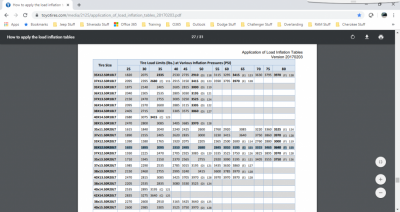
Your choice can be to pump enough air to either cover your GAWR or match the door sticker capacity. you have about 2300lbs support at 40 PSI in most 35x12x5x20 LT tires per the table, so you're above your GAWR, of you want to match the sticker you want to pump them up to 48psi for 2606lbs support each.
You could go down to a min of 36psi and still support a full load in your truck that won't exceed your GAWR of course.

upload_2019-11-14_7-48-52.png
 

corneileous

Senior Member
Joined
Sep 6, 2016
Posts
7,139
Reaction score
4,143
Location
Podunkyville, OK
Ram Year
2018 Ram 1500 Limited 4X4
Engine
Hemi 5.7
Look at your GAWR, 3900 LBS front and 3900 LBS rear. That means each tire should be able to support 1950lbs (LT tires, if going with P rated you want to add 10% more so 2145lbs each)
then you have your door sticker, factory tires are P rated 275/60/20 at 39psi.
Should be able to hold 2600lbs

Your choice can be to pump enough air to either cover your GAWR or match the door sticker capacity. you have about 2300lbs support at 40 PSI in most 35x12x5x20 LT tires per the table, so you're above your GAWR, of you want to match the sticker you want to pump them up to 48psi for 2606lbs support each.
You could go down to a min of 36psi and still support a full load in your truck that won't exceed your GAWR of course.

View attachment 186096

That 2600 pounds per tire is achieved at the max pressure of 44psi, not at 39psi.


Sent from my iPhone using Tapatalk Pro
 

ram1500rsm

Senior Member
Joined
Jul 24, 2018
Posts
4,891
Reaction score
5,413
Location
Trabuco Canyon, CA
Ram Year
2014
Engine
Hemi 5.7
That 2600 pounds per tire is achieved at the max pressure of 44psi, not at 39psi.


Sent from my iPhone using Tapatalk Pro
I think i recall the factory SRA's as SL load correct ? 114S ?
I think LL or SL loads will achieve max load at 35psi while XL do so at 41psi.?
Don't know why the factory says to inflate to 39 but P rated tires in factory size 114S load should technically offer 2600lbs at 35 psi, you won't get more than that unless you up the load with an XL tire. perhaps the 39psi comes from P downgrading the weight support when mounted on a truck by 10%? I'd think by the Tire and Rim Association specification would indicate why the 35 max psi for regular load, but i don't have access to that data.
 

corneileous

Senior Member
Joined
Sep 6, 2016
Posts
7,139
Reaction score
4,143
Location
Podunkyville, OK
Ram Year
2018 Ram 1500 Limited 4X4
Engine
Hemi 5.7
I think i recall the factory SRA's as SL load correct ? 114S ?
I think LL or SL loads achive max load at 35psi while XL do so at 41psi.?
Don't know why the factory says to inflate to 39 but P rated tires in factory size 114S load should technically offer 2600lbs at 35 psi, you won't get more than that unless you up the load with an XL tire. perhaps the 39psi comes from P downgrading the weight support when mounted on a truck by 10%? I'd think by the Tire and Rim Association specification would indicate why the 35 max psi for regular load, but i don't have access to that data.

I’m pretty sure the factory SRA’s are a standard load but if you look at the sidewall markings of one, it clearly shows little over 2600 pounds max weight AT 44psi. Not 39. As far as what the reduced rating would be taking 5 pounds of pressure away, that I don’t know but I would imagine they chose the lesser 39 for best fuel economy vs overall ride comfort for the most likely use a 1500 would more than likely be used for.

But it’s just like with those stock sized 8-ply BF goodrich all terrains I used to have; they would support 3000 pounds a piece but when you look at the sidewall on them, it says 3000 pounds AT 65 psi so, I’m not a tire specialist but I would imagine that was the reason why the BF goodrich rep that I talked to said that those tires just for normal all around driving needed to be inflated to at least 55 psi because of how much more air was needed to hold just another 400 pounds per tire over the stock SRA’s.


Sent from my iPhone using Tapatalk Pro
 

ram1500rsm

Senior Member
Joined
Jul 24, 2018
Posts
4,891
Reaction score
5,413
Location
Trabuco Canyon, CA
Ram Year
2014
Engine
Hemi 5.7
I’m pretty sure the factory SRA’s are a standard load but if you look at the sidewall markings of one, it clearly shows little over 2600 pounds max weight AT 44psi. Not 39. As far as what the reduced rating would be taking 5 pounds of pressure away, that I don’t know but I would imagine they chose the lesser 39 for best fuel economy vs overall ride comfort for the most likely use a 1500 would more than likely be used for.

But it’s just like with those stock sized 8-ply BF goodrich all terrains I used to have; they would support 3000 pounds a piece but when you look at the sidewall on them, it says 3000 pounds AT 65 psi so, I’m not a tire specialist but I would imagine that was the reason why the BF goodrich rep that I talked to said that those tires just for normal all around driving needed to be inflated to at least 55 psi because of how much more air was needed to hold just another 400 pounds per tire over the stock SRA’s.


Sent from my iPhone using Tapatalk Pro

The sidewall thing can be confusing just like the SL vs XL stuff. I have a Dodge Durango now with factory P265/60/18 tires 109H (though the factory put in the door sticker 110H, i bought the thing used with brand new Kumho tires that were 109H) and they say 2271lbs max at 51 psi on the sidewall. rear GAWR is also 3900lbs like the RAM.
When i check the TRA table it indicates 2271lbs at 35psi. The sticker on the door of the D calls for 36psi which coincidentally also matches what the TRA index will call for at 36PSI for the SL rate.

upload_2019-11-14_16-7-21.png


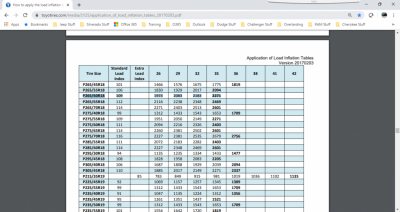
If we refer to the TRA table and LT 275/60/20 for the RAM 1500 app, you'll will need 55PSI to match the 2600lbs rating of the P rated counterparts assuming the P tire is rated at 2600 at 35psi and BFG is matching the rating with the TRA table. Which more likely they're doing to cover their butts after the Firestone Fiasco years ago.

upload_2019-11-14_15-51-57.png

Edited: After doing more research the tires i have in the durango are SL. There are XL ones same size and you'll recognize them because the XL designation will be stamped after the load index number. So this are SL and yet the sidewall says 2271lbs, max pressure 51psi. Allen tires confirmed for me max load is achieve at 35psi per the TRA specification.
 
Last edited:

corneileous

Senior Member
Joined
Sep 6, 2016
Posts
7,139
Reaction score
4,143
Location
Podunkyville, OK
Ram Year
2018 Ram 1500 Limited 4X4
Engine
Hemi 5.7
The sidewall thing can be confusing just like the SL vs XL stuff. I have a Dodge Durango now with factory P265/60/18 tires 109H (though the factory put in the door sticker 110H, i bought the thing used with brand new Kumho tires that were 109H) and they say 2271lbs max at 51 psi on the sidewall. rear GAWR is also 3900lbs like the RAM.
When i check the TRA table it indicates 2271lbs at 35psi. The sticker on the door of the D calls for 36psi which coincidentally also matches what the TRA index will call for at 36PSI for the SL rate.

View attachment 186130


If we refer to the TRA table and LT 275/60/20 for the RAM 1500 app, you'll will need 55PSI to match the 2600lbs rating of the P rated counterparts assuming the P tire is rated at 2600 at 35psi and BFG is matching the rating with the TRA table. Which more likely they're doing to cover their butts after the Firestone Fiasco years ago.

View attachment 186129

Edited: After doing more research the tires i have in the durango are SL. There are XL ones same size and you'll recognize them because the XL designation will be stamped after the load index number. So this are SL and yet the sidewall says 2271lbs, max pressure 51psi. Allen tires confirmed for me max load is achieve at 35psi per the TRA specification.

Just for ***** and giggles, I decided to call both Goodyear and Michelin for some info into that 39 psi recommendation on the tire placard sticker. Goodyear of course, couldn’t really tell me how much max weight carrying capability woulda been lost at 39 from 44 but they did confirm at least that with the stock 20” SRA’s that come on our 1500’s, if you want the max load-bearing capability for each tire, it must be inflated to 44 psi. The max load is not achieved at 39.

Now when I called Michelin- since that’s the brand of tires I have now, they were really tight-lipped on what they told me because of liability reasons when I asked them the same question about the max load weight on my tires which is a mere 78 more pounds than the original SRA’s I had.

Since all they could tell me was information based off the stock recommended pressure, they said that at 39 psi for the Michelin’s I have was good for like, between 1900 to 2100 pounds I believe, pretty much giving a basis for a pretty close assumption to the Goodyear SRA’s our trucks come with when aired to 39.

All in all, this is why I think it’s good to go with what the manufacturer says and go from there so as far as what the OP wants to know, I’d call up the manufacturer of the tires to see what they say. But then again since he’s running a 35, they may not be able to help because that’s not a factory original size.


Sent from my iPhone using Tapatalk Pro
 

ram1500rsm

Senior Member
Joined
Jul 24, 2018
Posts
4,891
Reaction score
5,413
Location
Trabuco Canyon, CA
Ram Year
2014
Engine
Hemi 5.7
Just for ***** and giggles, I decided to call both Goodyear and Michelin for some info into that 39 psi recommendation on the tire placard sticker. Goodyear of course, couldn’t really tell me how much max weight carrying capability woulda been lost at 39 from 44 but they did confirm at least that with the stock 20” SRA’s that come on our 1500’s, if you want the max load-bearing capability for each tire, it must be inflated to 44 psi. The max load is not achieved at 39.

Now when I called Michelin- since that’s the brand of tires I have now, they were really tight-lipped on what they told me because of liability reasons when I asked them the same question about the max load weight on my tires which is a mere 78 more pounds than the original SRA’s I had.

Since all they could tell me was information based off the stock recommended pressure, they said that at 39 psi for the Michelin’s I have was good for like, between 1900 to 2100 pounds I believe, pretty much giving a basis for a pretty close assumption to the Goodyear SRA’s our trucks come with when aired to 39.

All in all, this is why I think it’s good to go with what the manufacturer says and go from there so as far as what the OP wants to know, I’d call up the manufacturer of the tires to see what they say. But then again since he’s running a 35, they may not be able to help because that’s not a factory original size.


Sent from my iPhone using Tapatalk Pro

This is why it's more complicated for us end users to have a clear understanding of how this stuff works. The tires dude from Allen tires told me they all have to comply with the Tires association specs, P SL is 35 psi and all manufacturers abide by the same rule. the tire max pressure is not exactly there to indicate max load is achieve at max pressure per se (in case of the P rated ones) but to indicate max inflation.

Tirerack and other sites indicate the same stuff, for example:
https://www.tirerack.com/tires/tiretech/techpage.jsp?techid=196
 
Last edited:

ram1500rsm

Senior Member
Joined
Jul 24, 2018
Posts
4,891
Reaction score
5,413
Location
Trabuco Canyon, CA
Ram Year
2014
Engine
Hemi 5.7
We also get more confused with the 10% reduction in load rate when a P rated tire is mounted into a truck or SUV. that seems to apply only when the placard says your vehicle came equipped with LT tires and you want to mount P. so in the RAM case you might think you want to apply the 10% reduction to the 2600 lbs or 2340lbs, the truck placard already indicates the tires are P rated 275/60/20 so thecnically the 10% reduction shouldn't apply ?
 

corneileous

Senior Member
Joined
Sep 6, 2016
Posts
7,139
Reaction score
4,143
Location
Podunkyville, OK
Ram Year
2018 Ram 1500 Limited 4X4
Engine
Hemi 5.7
This is why it's more complicated for us end users to have a clear understanding of how this stuff works. The tires dude from Allen tires told me they all have to comply with the Tires association specs, P SL is 35 psi and all manufacturers abide by the same rule. the tire max pressure is not exactly there to indicate max load is achieve at max pressure per se (in case of the P rated ones) but to indicate max inflation.

Tirerack and other sites indicate the same stuff, for example:
https://www.tirerack.com/tires/tiretech/techpage.jsp?techid=196

For the most part, all that article is explaining is the importance of cold tire pressure and how the pressures fluctuate as they warm up.

But the whole part about saying a P rated tire being at its maximum weight carrying ability at 35 psi is what’s confusing me is what just flat out doesn’t make sense. The Goodyear SRA’s that comes on our trucks clearly states- 2,601 pounds max weight at 44 psi. My Michelin Defenders are 2,679 pounds max weight at 44psi. The BFG AT’s I had- 3,000 pounds max weight at 65psi which actually makes better sense now for why BFG told me to inflate those tires to 55psi just so they could support the same weight as the Michelin’s and the Goodyear’s at the same weight of the truck when not loaded or pulling a heavy trailer.


Sent from my iPhone using Tapatalk Pro
 

corneileous

Senior Member
Joined
Sep 6, 2016
Posts
7,139
Reaction score
4,143
Location
Podunkyville, OK
Ram Year
2018 Ram 1500 Limited 4X4
Engine
Hemi 5.7
We also get more confused with the 10% reduction in load rate when a P rated tire is mounted into a truck or SUV. that seems to apply only when the placard says your vehicle came equipped with LT tires and you want to mount P. so in the RAM case you might think you want to apply the 10% reduction to the 2600 lbs or 2340lbs, the truck placard already indicates the tires are P rated 275/60/20 so thecnically the 10% reduction shouldn't apply ?

Where does it say and why does it say a p rated tire loses some it’s max weight capacity just from being on a truck or SUV? I get it, if a touring tire or performance tire has a higher pressure rating for cornering, high speed and less rolling resistance then why does the higher pressure show a higher weight rating is non existent?


Sent from my iPhone using Tapatalk Pro
 

ram1500rsm

Senior Member
Joined
Jul 24, 2018
Posts
4,891
Reaction score
5,413
Location
Trabuco Canyon, CA
Ram Year
2014
Engine
Hemi 5.7
For the most part, all that article is explaining is the importance of cold tire pressure and how the pressures fluctuate as they warm up.

But the whole part about saying a P rated tire being at its maximum weight carrying ability at 35 psi is what’s confusing me is what just flat out doesn’t make sense. The Goodyear SRA’s that comes on our trucks clearly states- 2,601 pounds max weight at 44 psi. My Michelin Defenders are 2,679 pounds max weight at 44psi. The BFG AT’s I had- 3,000 pounds max weight at 65psi which actually makes better sense now for why BFG told me to inflate those tires to 55psi just so they could support the same weight as the Michelin’s and the Goodyear’s at the same weight of the truck when not loaded or pulling a heavy trailer.


Sent from my iPhone using Tapatalk Pro
How about this one
https://www.tirereview.com/determining-the-right-psi/

Part of each load curve standard is the point at which the load curve stops going up. For TRA p-metric standard load tires, it is at 35 psi. Equivalent ETRTO and JATMA tires peak at 36 psi. Interestingly, all of the standardizing organizations agree that standard load passenger car tires can (and should) use optional higher inflation pressures (44 psi or 51 psi) for certain circumstances such as high speed driving. However, these higher inflation pressures generally provide no increase in load carrying capacity and in some circumstances specify a reduction in load for high-speed use.

The Sidewall Says
Consumers are often confused because federal safety regulations also require tire sidewalls to contain information about a tire’s maximum load capacity and maximum inflation pressure. For P-metric standard load tires, the maximum pressure listed on the sidewall will be 44 psi or 51 psi, even though the pressure where the maximum load occurs is 35 psi or 36 psi. On the sidewall, this would look like “Maximum Load XXXX lbs. Maximum Pressure YY psi.”

A few manufacturers interpret the regulation to mean the maximum load and the corresponding inflation pressure (“Maximum Load XXXX lbs. at YY psi”). Either way, too often consumers see the maximum inflation pressure on the sidewall and believe that is the correct pressure for their car.

Look at some of the online forums and you will see that the arguments about relying on the placard or the tire sidewall can be animated.
 
Last edited:

Latest posts

Staff online

Forum statistics

Threads
211,314
Posts
3,065,001
Members
171,650
Latest member
Nicholas Lozano
Back
Top