Airlift 5000 Daily Driving & Tow Settings

Disclaimer: Links on this page pointing to Amazon, eBay and other sites may include affiliate code. If you click them and make a purchase, we may earn a small commission.

62Blazer

Senior Member
Joined
Dec 11, 2019
Posts
1,770
Reaction score
2,761
Location
Midwest
Ram Year
2016
Engine
6.4
It sorta does matter, the specific routine for me is back under the ball, inflate the bags to 16 psi, drop the trailer onto the ball, engage the WDH, then check the front ride height.
The airbag pressure can change depending on how heavy tongue weight is, the WDH is adjusted to compensate as the trailer weight varies and one would be surprised that having an extra 100 pounds moved into a different place can change the feel of how things tow.
As I tried to explain in my post.......yes, it matters when doing the initial setup when determining what setting you have the WDH on (ball hitch angle, tension on the bars, etc...). But once you have those settings established and hook it up the same way next time, it doesn't matter when you inflate the bags.
 

crash68

ACME product engineer
Staff member
Administrator Moderator Supporting Member
Joined
Mar 20, 2016
Posts
12,369
Reaction score
21,538
Ram Year
2015
Engine
3.0 EcoDiesel
But once you have those settings established and hook it up the same way next time, it doesn't matter when you inflate the bags.
The laws of physics state otherwise to your theory about when the airbags are inflated as the inflation pressure goes up as the load increases.
If you could fill the airbags by volume of air then it wouldn't matter what sequence you inflated them.
 

62Blazer

Senior Member
Joined
Dec 11, 2019
Posts
1,770
Reaction score
2,761
Location
Midwest
Ram Year
2016
Engine
6.4
The laws of physics state otherwise to your theory about when the airbags are inflated as the inflation pressure goes up as the load increases.
If you could fill the airbags by volume of air then it wouldn't matter what sequence you inflated them.
I understand where you are coming from but it is not being applied correctly. In order for the pressure to change significantly the volume of the airbag has to change. However it is not. While airbags are rubber and can deform, them deforming doesn't mean the volume changes unless they actually stretch and retract. The rubber actually has very little stretch. Rather the "shape" of the bag changes. When it compresses the sides bulge out and it gets wider. When it gets pulled upwards it gets skinnier but taller....which equals the same volume. If the volume doesn't change, the pressure doesn't change.
That's great on paper, but it's something you can easily trial on a truck with bags installed. Put some air pressure in the bags, or example 30 psi, with the normal weight of the truck pushing down on the bags. Now jack up the truck by the bumper or frame which takes the weight off the suspension and airbags so the tire is just hanging. Now measure the pressure in the bag and it will be right around 30 psi. You can do the same thing with your tires. Check the pressure in your tires with the weight of the truck on them, and then jack up the truck so the tires are hanging in the air and they will be the same (well, maybe 1/2 or 1 PSI difference, but nothing significant). Just like the airbags, the tires will squat and deform under weight but the volume stays the same. The rubber in the tires is not shrinking or stretching which would be required to change the volume.
Again, because there will be doubters......you can easily see this first hand in person by doing the quick and easy experiments listed above.

 

crash68

ACME product engineer
Staff member
Administrator Moderator Supporting Member
Joined
Mar 20, 2016
Posts
12,369
Reaction score
21,538
Ram Year
2015
Engine
3.0 EcoDiesel
I understand where you are coming from but it is not being applied correctly. In order for the pressure to change significantly the volume of the airbag has to change. However it is not. While airbags are rubber and can deform, them deforming doesn't mean the volume changes unless they actually stretch and retract. The rubber actually has very little stretch. Rather the "shape" of the bag changes. When it compresses the sides bulge out and it gets wider. When it gets pulled upwards it gets skinnier but taller....which equals the same volume. If the volume doesn't change, the pressure doesn't change.
That's great on paper, but it's something you can easily trial on a truck with bags installed. Put some air pressure in the bags, or example 30 psi, with the normal weight of the truck pushing down on the bags. Now jack up the truck by the bumper or frame which takes the weight off the suspension and airbags so the tire is just hanging. Now measure the pressure in the bag and it will be right around 30 psi. You can do the same thing with your tires. Check the pressure in your tires with the weight of the truck on them, and then jack up the truck so the tires are hanging in the air and they will be the same (well, maybe 1/2 or 1 PSI difference, but nothing significant). Just like the airbags, the tires will squat and deform under weight but the volume stays the same. The rubber in the tires is not shrinking or stretching which would be required to change the volume.
Again, because there will be doubters......you can easily see this first hand in person by doing the quick and easy experiments listed above.

Yet another flaw in your theory, airbag volume is designed to change vertically where as tire internal volume remains relatively unchanged. If tires are forced to deflect as much as airbags they would fail at alarming rates.
Examples of airbags pressure spiking with more load:
Screenshot_20250602-214659.png

Car tire volume:
 

62Blazer

Senior Member
Joined
Dec 11, 2019
Posts
1,770
Reaction score
2,761
Location
Midwest
Ram Year
2016
Engine
6.4
Yet another flaw in your theory, airbag volume is designed to change vertically where as tire internal volume remains relatively unchanged. If tires are forced to deflect as much as airbags they would fail at alarming rates.
Examples of airbags pressure spiking with more load:
View attachment 567531

Car tire volume:
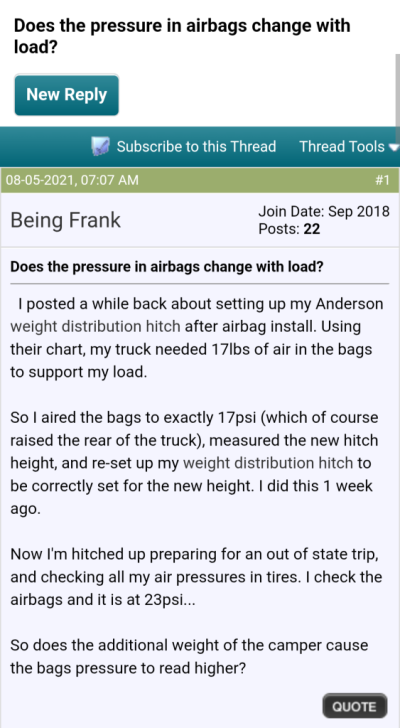
So you are somehow claiming that this post proves me wrong? Seriously? A 4 year old post by some random person on the internet saying they inflated their airbags to 17 psi, and a week later states they are now at 23 psi, and they don't know why? First of all, that is not a huge change....I mean really, going from 17 psi to 23 psi is not going to cause any noticeable difference. Second, that amount of difference could easily be contributed to the accuracy and repeatability of the tire gauge combined with a difference in ambient temperature.
Granted, I'm just a random person making a statement on the internet also. But not sure how the above post somehow has more "cred" than mine does!
 

crash68

ACME product engineer
Staff member
Administrator Moderator Supporting Member
Joined
Mar 20, 2016
Posts
12,369
Reaction score
21,538
Ram Year
2015
Engine
3.0 EcoDiesel
I'm just a random person making a statement on the internet also. But not sure how the above post somehow has more "cred" than mine does!
Probably didn't bother clicking the e-trailer or Reddit links so you, just like you ignore the facts of physics. They were several other links that I would have like to have posted but due to forum rules as they're links to other forums.
That post has more "cred" because it actually acknowledges the physics at work.
Let's try another link:
they inflated their airbags to 17 psi, and a week later states they are now at 23 psi, and they don't know why? First of all, that is not a huge change....I mean really, going from 17 psi to 23 psi is not going to cause any noticeable difference.
Sequence matters, putting 17 psi in before the load is added vs after changes the amount of volume of air in the bag.
Every time I add more pressure to airbags the rear end keeps lifting, that's called physics.
 

olyelr

Senior Member
Joined
Nov 18, 2018
Posts
5,604
Reaction score
4,625
Location
Kewadin MI
Ram Year
2016
Engine
6.4
Yes. Putting air in the bags and then putting a load on them will definitely increase air pressure in the bags. How much? I dono, never gave a **** to check.

I remember once letting the air out of my bags before i removed the trailer. Then when i removed the trailer, the bags were up off the axle (i have daystar cradles, so the bottom of bag is not connected). That is essentially the same thing but the exact opposite….when you air the bags up and then put a large load on them, pressure will definitely increase. Dosnt really mean anything, but it will.
 

62Blazer

Senior Member
Joined
Dec 11, 2019
Posts
1,770
Reaction score
2,761
Location
Midwest
Ram Year
2016
Engine
6.4
I don't claim to be the foremost expert in physics.......but I do have an engineering degree and spent years working as an automotive test engineer. I have also personally tested the theories using the methods I described. Again, this is a very simple thing to test for and I welcome anyone to spend a few minutes trying it out.

The "Reddit" article linked above talks about car tires and states the exact same thing I did. The PSI does not change dependent on the load. Airbags react very similarly.

In regards to the comment "if I put more pressure in the bags the back of the truck raises up".......well, yes. But that has nothing to do with the argument about PSI changing as the load changes. In this case the pressure is changing but the load is not. As explained the shape of the airbags changes as you put more pressure pressure....the higher the pressure the bag gets taller but skinnier. The less pressure the bag gets shorter but wider. The volume stays about the same though. The rubber material of the bags is not stretching and shrinking (if it is, very minimaly....it's not like a balloon).

I personally tried the test out last night. Inflated the bags to 50 psi with the normal truck weight on them. I then jacked it up by the trailer hitch until the bags were not touching (have cradles). Left the gauge hooked up the whole time. Granted, the pressure did drop by about 2 PSI when I jacked it up about 6". But if you think 2 PSI out of 50 really makes a difference.........

But hey, in the grand scheme of things I guess it doesn't really matter. Whatever people feel more comfortable doing.
 

18CrewDually

Senior Member
Joined
Nov 17, 2019
Posts
2,421
Reaction score
3,418
Location
U.S.- New Jersey
Ram Year
2018
Engine
Cummins 6.7 H.O.
I don't claim to be the foremost expert in physics.......but I do have an engineering degree and spent years working as an automotive test engineer. I have also personally tested the theories using the methods I described. Again, this is a very simple thing to test for and I welcome anyone to spend a few minutes trying it out.

The "Reddit" article linked above talks about car tires and states the exact same thing I did. The PSI does not change dependent on the load. Airbags react very similarly.

In regards to the comment "if I put more pressure in the bags the back of the truck raises up".......well, yes. But that has nothing to do with the argument about PSI changing as the load changes. In this case the pressure is changing but the load is not. As explained the shape of the airbags changes as you put more pressure pressure....the higher the pressure the bag gets taller but skinnier. The less pressure the bag gets shorter but wider. The volume stays about the same though. The rubber material of the bags is not stretching and shrinking (if it is, very minimaly....it's not like a balloon).

I personally tried the test out last night. Inflated the bags to 50 psi with the normal truck weight on them. I then jacked it up by the trailer hitch until the bags were not touching (have cradles). Left the gauge hooked up the whole time. Granted, the pressure did drop by about 2 PSI when I jacked it up about 6". But if you think 2 PSI out of 50 really makes a difference.........

But hey, in the grand scheme of things I guess it doesn't really matter. Whatever people feel more comfortable doing.
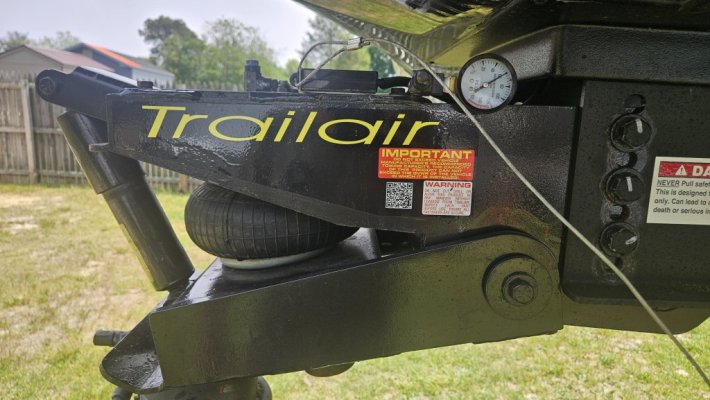
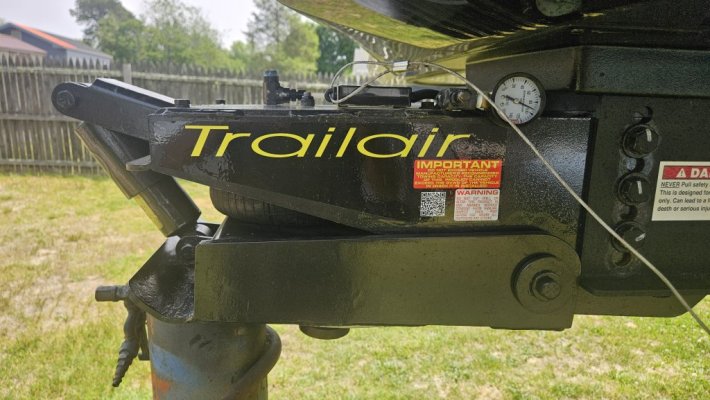
Um ok. Just did the test. Airbag on my 5er's hitch that I plumbed in a gauge.

No load set to 60 psi.
3400# load, almost 95 psi.

So PSI does rise. SEE PICS

20250605_130822.jpg

20250605_130906.jpg
 

62Blazer

Senior Member
Joined
Dec 11, 2019
Posts
1,770
Reaction score
2,761
Location
Midwest
Ram Year
2016
Engine
6.4
Um ok. Just did the test. Airbag on my 5er's hitch that I plumbed in a gauge.

No load set to 60 psi.
3400# load, almost 95 psi.

So PSI does rise. SEE PICS

View attachment 567629

View attachment 567630
Have to admit that is interesting. I did not see that type of change when doing the test at home. That looks like the same type of setup that would be on a truck.
Just to clarify, you are just manually filling those bags and there is no automatic system on it?
I would also think that airbag companies would address this in the user's manual...at least the Airlift manual does not. The reason I say that is there is a maximum amount of air you should put in the bags. For the Airlift that is 100 psi. So if you put 100 psi in the bags when the truck was empty and they saw an almost 60% increase (which the above shows) that means you now have 160 psi in the bags after loading. The instructions do state it doesn't matter when you install the air (in regards to simply putting air in them, not specifically stating the loading setup). Would think the manual would say "only inflate bags after loading so you don't exceed 100 psi" or something like that.
I'll probably wind up doing some more testing at home tonight. Unfortunately I don't have an actual loaded trailer to hook up. I have an empty flatbed but that's not much weight, and even though I'm interested in the outcome probably won't take the time to load up the trailer.
 

18CrewDually

Senior Member
Joined
Nov 17, 2019
Posts
2,421
Reaction score
3,418
Location
U.S.- New Jersey
Ram Year
2018
Engine
Cummins 6.7 H.O.
Have to admit that is interesting. I did not see that type of change when doing the test at home. That looks like the same type of setup that would be on a truck.
Just to clarify, you are just manually filling those bags and there is no automatic system on it?
I would also think that airbag companies would address this in the user's manual...at least the Airlift manual does not. The reason I say that is there is a maximum amount of air you should put in the bags. For the Airlift that is 100 psi. So if you put 100 psi in the bags when the truck was empty and they saw an almost 60% increase (which the above shows) that means you now have 160 psi in the bags after loading. The instructions do state it doesn't matter when you install the air (in regards to simply putting air in them, not specifically stating the loading setup). Would think the manual would say "only inflate bags after loading so you don't exceed 100 psi" or something like that.
I'll probably wind up doing some more testing at home tonight. Unfortunately I don't have an actual loaded trailer to hook up. I have an empty flatbed but that's not much weight, and even though I'm interested in the outcome probably won't take the time to load up the trailer.

No smoke and mirrors there. Static pressure at 60, added load, pressure goes up. No hidden auto fill or anything. Zoom in the pic and youll see the Schrader valve.
I finally jumped in on you two because you really have no argument. When you squeeze the volume of air and the bag conforms the shape squeezing on the volume of air, pressure has to go up. And the heavier the load, the more deformation of the bag, the higher the pressure.
If you need to see it in real time I can make a youtube video but I thought that wouldn't be necessary.
 

Jas34

Senior Member
Joined
Dec 2, 2023
Posts
189
Reaction score
448
Location
SC
Ram Year
2017
Engine
Hemi 5.7
While everyone's fighting the pressure fight I'll add my 2 cents. First, air bags do nothing to redistribute weight (proof can be found in one of Equalizer's videos). So, set up your weight distribution hitch first, then add just enough air to the airbags to stiffen the rear up and give you the ride you want. Some add enough air to take out any remaining sag but this shouldn't be necessary if the hitch is set up right. FWIW, I run 20-25 psi in mine. Previous trailer had a 900 lb tongue weight, current one is closer to 750. Ram 1500 with Bilstein shocks.
 

62Blazer

Senior Member
Joined
Dec 11, 2019
Posts
1,770
Reaction score
2,761
Location
Midwest
Ram Year
2016
Engine
6.4
No smoke and mirrors there. Static pressure at 60, added load, pressure goes up. No hidden auto fill or anything. Zoom in the pic and youll see the Schrader valve.
I finally jumped in on you two because you really have no argument. When you squeeze the volume of air and the bag conforms the shape squeezing on the volume of air, pressure has to go up. And the heavier the load, the more deformation of the bag, the higher the pressure.
If you need to see it in real time I can make a youtube video but I thought that wouldn't be necessary.
I don't have any explanation for your results. While it's not the exact same setup as a truck I would expect it to have similar results. I repeated the test on my truck last night and got the same results as I got previously......which is basically no pressure change based on load. Did not do it by hitching up a trailer, but inflated the bags and then jacked up the rear of the truck by the trailer hitch so the rear suspension was dangling and thus had no weight on it. I put 80 PSI in the bags and jacked up the truck so the rear tires were not touching the ground. This equates to no load on the rear suspension (I would estimate about 3,000 lbs on the rear axle, so each side would be holding around 1,500 lbs). There was maybe 1 - 2 PSI (out of 80 PSI) difference the whole time. This includes looking at the pressure when it was jacked up (no weight) and then dropping the jack to apply weight.
The argument here revolves around whether the volume of the air bag is actually changing. My position is that the volume does not significantly change, rather the bag simply changes shapes (tall and skinny vs. short and fat....different shapes but same overall volume). This is the same behavior as a tire (you will find numerous articles on the internet stating how the pressure does not change significantly on tires under load).
Again, I just don't know what to say. On paper using my theory the volume does not change and thus the pressure does not change, and personally doing the test on my truck the pressure does not significantly change.
 

olyelr

Senior Member
Joined
Nov 18, 2018
Posts
5,604
Reaction score
4,625
Location
Kewadin MI
Ram Year
2016
Engine
6.4
I don't have any explanation for your results. While it's not the exact same setup as a truck I would expect it to have similar results. I repeated the test on my truck last night and got the same results as I got previously......which is basically no pressure change based on load. Did not do it by hitching up a trailer, but inflated the bags and then jacked up the rear of the truck by the trailer hitch so the rear suspension was dangling and thus had no weight on it. I put 80 PSI in the bags and jacked up the truck so the rear tires were not touching the ground. This equates to no load on the rear suspension (I would estimate about 3,000 lbs on the rear axle, so each side would be holding around 1,500 lbs). There was maybe 1 - 2 PSI (out of 80 PSI) difference the whole time. This includes looking at the pressure when it was jacked up (no weight) and then dropping the jack to apply weight.
The argument here revolves around whether the volume of the air bag is actually changing. My position is that the volume does not significantly change, rather the bag simply changes shapes (tall and skinny vs. short and fat....different shapes but same overall volume). This is the same behavior as a tire (you will find numerous articles on the internet stating how the pressure does not change significantly on tires under load).
Again, I just don't know what to say. On paper using my theory the volume does not change and thus the pressure does not change, and personally doing the test on my truck the pressure does not significantly change.
Your way of “testing” it is no good. Put 20 pounds in the bags, then set a thousand pounds of tongue weight on them…pressure will significantly increase.

The bag volume may not change much, but who cares. If you have 20 pounds of air in them and start setting 100 pounds…2000 pounds…3000 pounds on them…the pressure will just keep increasing until they eventually blow. Period.
 

62Blazer

Senior Member
Joined
Dec 11, 2019
Posts
1,770
Reaction score
2,761
Location
Midwest
Ram Year
2016
Engine
6.4
Your way of “testing” it is no good. Put 20 pounds in the bags, then set a thousand pounds of tongue weight on them…pressure will significantly increase.

The bag volume may not change much, but who cares. If you have 20 pounds of air in them and start setting 100 pounds…2000 pounds…3000 pounds on them…the pressure will just keep increasing until they eventually blow. Period.
Why is the test method no good? It simulates the difference in an estimated 1,500 lbs. load on the bag. If you start with 1,500 lbs which is the weight of the empty truck weight and add weight so there is now 3,000 lbs of load you are adding 1,500 lbs total. If you start with 0 lbs load (tire dangling) and then drop the jack so there is now 1,500 lbs load......you are adding the same 1,500 lbs total.
Again, I'm jacking the truck up by the trailer hitch (frame) so it's unloading the weight on the tires. I'm not jacking it up underneath the axle which would never remove the vehicle weight from the suspension and tires. When you jack the truck up by the hitch or frame, you have to raise it up quite a bit before the tires come off the ground. So that's simulating the "squat" or vertical suspension movement. Same theory as the bag changing volume with squat as you are changing the upper to lower mounting distance of the bags.....that vertical distance in this method is changing quite a bit.
Maybe if I get bored I'll hitch up the trailer and load something on it this weekend.....
Honestly not trying to just argue for the sake of having an internet argument. And I willing to admit if I'm wrong.......but I'm truly interested in this. Not claiming to be an expert but I do have an engineering degree and had classes in physics that I am basing this off of. Plus have years of practical experience in building vehicles.
 

olyelr

Senior Member
Joined
Nov 18, 2018
Posts
5,604
Reaction score
4,625
Location
Kewadin MI
Ram Year
2016
Engine
6.4
Why is the test method no good? It simulates the difference in an estimated 1,500 lbs. load on the bag. If you start with 1,500 lbs which is the weight of the empty truck weight and add weight so there is now 3,000 lbs of load you are adding 1,500 lbs total. If you start with 0 lbs load (tire dangling) and then drop the jack so there is now 1,500 lbs load......you are adding the same 1,500 lbs total.
Again, I'm jacking the truck up by the trailer hitch (frame) so it's unloading the weight on the tires. I'm not jacking it up underneath the axle which would never remove the vehicle weight from the suspension and tires. When you jack the truck up by the hitch or frame, you have to raise it up quite a bit before the tires come off the ground. So that's simulating the "squat" or vertical suspension movement. Same theory as the bag changing volume with squat as you are changing the upper to lower mounting distance of the bags.....that vertical distance in this method is changing quite a bit.
Maybe if I get bored I'll hitch up the trailer and load something on it this weekend.....
Honestly not trying to just argue for the sake of having an internet argument. And I willing to admit if I'm wrong.......but I'm truly interested in this. Not claiming to be an expert but I do have an engineering degree and had classes in physics that I am basing this off of. Plus have years of practical experience in building vehicles.
Yea im not out to argue either. I understand your logic. But just saying, if you do it the other way you will see different results.

Picture it this way. Put an airbag in a hydraulic press. Start at zero psi, but the bag is sealed. Start putting pressure on it. The bag will start getting pressure in it as it compresses…regardless if the overall volume changes very much. And if you kept putting more pressure on it with the press, its eventually gonna blow from too much pressure.

I wonder how much it would take haaaaa
 

olyelr

Senior Member
Joined
Nov 18, 2018
Posts
5,604
Reaction score
4,625
Location
Kewadin MI
Ram Year
2016
Engine
6.4
Just did a little test in my driveway with the travel trailer.

Airlift 5000 bags with daystar cradles. Travel trailer is roughly 7500 pounds, so maybe 1000 pounds of tongue weight?

Started with an unloaded truck with 20psi in the bags. Set the trailer tongue on it and the bags went to about 26psi.

While it did go up, its certainly not much, at least in my case/scenario.
 

joesstripclub

Senior Member
Joined
Dec 13, 2019
Posts
787
Reaction score
1,153
Location
Kansas City, MO
Ram Year
2021 2500 PW
Engine
Hemi 6.4
I think part of the issue is you guys are "testing" this with very different setups. we have 3400 lbs onto a single airbag with what looks like a fairly small volume vs the truck test which is dividing the 1000 lb load over 2 bags which are probably a bit taller and have higher volume. If I remembered anything from school I would point you to the appropriate gas law equation that would solve this, but I can't say that I've done anything gas related since.
 

18CrewDually

Senior Member
Joined
Nov 17, 2019
Posts
2,421
Reaction score
3,418
Location
U.S.- New Jersey
Ram Year
2018
Engine
Cummins 6.7 H.O.
I think part of the issue is you guys are "testing" this with very different setups. we have 3400 lbs onto a single airbag with what looks like a fairly small volume vs the truck test which is dividing the 1000 lb load over 2 bags which are probably a bit taller and have higher volume. If I remembered anything from school I would point you to the appropriate gas law equation that would solve this, but I can't say that I've done anything gas related since.

The issue is people trying to theorize instead of accepting reality and principle. The test proved principle. Everything else is irrelevant. Bag size makes no difference and is the same bag on my truck. The test was to prove with load added, pressure goes up.
There's no argument here. When you add load to a pressurized airbag, the pressure rises as the bag deforms to support the load.
Everyone's test proves that. Whether it resulted it 2 psi or 30 psi. It will rise. Some just can't wrap their brain around it. At this point that is on them.
 
Back
Top