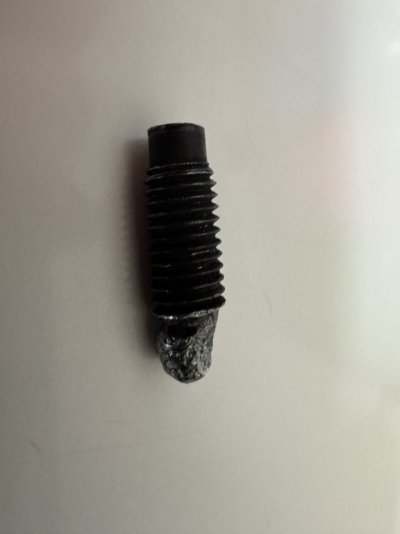
Honestly man, i have never seen or heard of a warped exhaust manifold. I have repaired broken manifold bolts a lot of times and never had that issue of warpage. Thats new to me. Usually after removing the manifold and extracting the broken studs, the manifold mounting surfaces gets cleaned and a new gasket with hardware gets installed. Also, a heads up, sometimes the studs will not extract in the vehicle so the head will have to be removed. Then if studs wont come out after trying to extract them in bench, the head will need to be replaced. I have heard from techs at other dealers that they send them to a machine shop to get extracted and repaired. But in the dealers i have worked at, they never recommended doing that. Not sure how well that would work. Hope any of that helps.
I do not know your years in the field, nor do I know the breadth of your experiences.
Cast iron manifolds
WARP. That's just physics. By how much can generally only be determined by a machine shop surface grinding the manifolds, and, as per my own experiences with Chrysler 383/440 engines and GM's HT4100 engines back "when".
Many was the time I'd replace the broken bolts and the subsequently leaky gaskets, only to see repeat failures.
Then, on a 7 ton motor home with a 440 Chrysler engine, I got tired of repeating the repairs to the exhaust. (This was way back at about year 9 of my career).
An older seasoned mechanic instructed me to have the manifolds surface ground, and to be honest, the machine shop said the warpage was only in the .003-4 range, but he surfaced them anyway, per the older seasoned mechanic.
Then as instructed by afore mentioned seasoned mechanic, the cylinder heads were meticulously cleaned off.
Thence, the manifold to cylinder head gaskets were shelved (omitted), and a can of high temp engine enamel was sprayed onto the freshly ground surface of the manifolds and, while tacky, they were installed using HIGH TENSILE strength bolts/ studs. Then, the engine was fired up and allowed to idle for about 1-2 minutes, and shut off, to allow heat to accelerate curing. Left for about 3-4 hours.
It sounded counter intuitive, but I was frustrated and willing to try it. It not only worked then (more than 40 years ago), it continues to work even now.
I've cured many engines of the problem by doing this. The problem today, is finding a machine shop willing to grind the manifolds. I recently installed new Dorman manifolds on a 2002 4.7L engine during engine replacement, emphasizing that I
DID go purchase very high tensile strength bolts at my neighborhood fastener shop. They were NOT cheap, either. For all the bolts and special hardened washers, I spent north of 30 dollars.