
Help with possible trailer purchase. Can I haul it? Wife wants to buy ASAP

Disclaimer: Links on this page pointing to Amazon, eBay and other sites may include affiliate code. If you click them and make a purchase, we may earn a small commission.

nlambert182

Senior Member
Joined
Dec 28, 2022
Posts
2,657
Reaction score
4,647
Location
Huntsville, AL
Ram Year
2018
Engine
6.7 Cummins
I’m not trying to make it be the right or wrong answer. I get that you are using “safe” numbers. But I think they may be too safe perhaps . You have the hitch weight on a 600 lb tongue dry weight trailer increasing to 1140 if I were to go to the limit of 7600 lbs. That’s a 540 lb increase on the trailer hitch if I put the full 2000 lbs in the trailer. That’s a big increase for not much weight added to the trailer.

The truck doesn’t have a trailer hitch it seems the previous owner pulled it off oddly enough. So I need to buy whatever class hitch is needed of course. The trucks build list said it was built with a class III.

I have always said I would use a WDH at a minimum.
Class III is 1k lbs.

I'm not being "too safe", but do what you want. I am telling you the same thing that almost every seasoned rv'er will tell you. There is a reason that the numbers are there.

Dry weights are a marketing gimmick and you cannot under any circumstance base anything off of those.

Tell you what.... let's try something.

Post all of your presumed numbers today based on the trailer you want.
Then go buy the trailer, load it up for camping and then scale it. Post the scale ticket here with all the numbers.
Then let's revisit this in 12 months with full transparency and post another scale ticket.

I'd be really interested to see where you land. :)

Some just need to learn lessons the hard way.
 

Black1500Ram

Senior Member
Joined
Jul 18, 2021
Posts
621
Reaction score
1,047
Location
Scottsdale, AZ
Ram Year
2015
Engine
5.7 Hemi
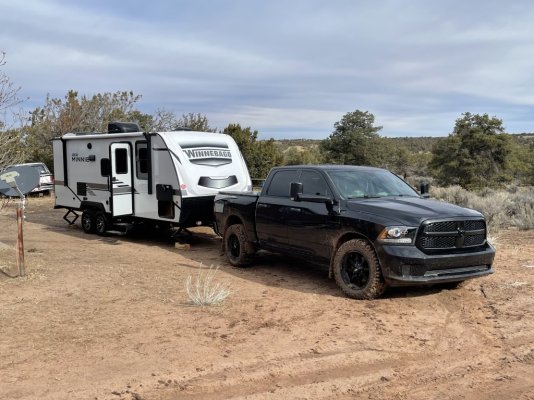
This is the trailer I pull it’s a 2306bh advertised at 46xx lbs and it’s never been under 5000 even empty.

I’ll tell you that my truck doesn’t like towing it in the hills. Oil temps get up to 250° if I don’t back off and I end up going <=50mph to keep it happy.

0 issue with power, braking or being within numbers, but I sure wouldn’t want anything heavier / longer.
 

Attachments

  • IMG_0437.jpeg
    IMG_0437.jpeg
    186.1 KB · Views: 11

runamuck

Senior Member
Air Force
Joined
Sep 4, 2018
Posts
1,893
Reaction score
2,527
Location
dfw
Ram Year
2022
Engine
6.7 dsl
We looked at another 26’ yesterday that was not stick and tin. The aluminum and fibreglass units are lighter it seems. It had a tongue weight of 600 and dry of 57xx which I thought was more encouraging. We are focusing on these types now to help with keeping the weight as low as possible.

You mentioned the first gear ratio in the 8 speed being 5.0 to 1 is that different from my 8 speed? I understand what advantages your 3.92 rear adds to towing.
some of the 8 speeds (8hp70) came with a first gear in the 4's..maybe 4.3, not sure. I dont know why there was 2, maybe just a 2019 thing. but the little bit lower first gear of the 8hp75 is good to get you moving. maybe not a big difference but every bit helps. before I bought the ram we towed our trailer with a '17 gmc sierra slt 4x4 ccsb 5.3 with 3.42 gears and it struggled bigtime so I traded for the ram and what a differance.
 
OP
OP
Q

Qcman

Member
Joined
Oct 23, 2024
Posts
53
Reaction score
32
Location
Ottawa, Canada
Ram Year
2021
Engine
5.7 liter Hemi
some of the 8 speeds (8hp70) came with a first gear in the 4's..maybe 4.3, not sure. I dont know why there was 2, maybe just a 2019 thing. but the little bit lower first gear of the 8hp75 is good to get you moving. maybe not a big difference but every bit helps. before I bought the ram we towed our trailer with a '17 gmc sierra slt 4x4 ccsb 5.3 with 3.42 gears and it struggled bigtime so I traded for the ram and what a differance.
Thx. Yeah be strong off the line. I went back to your earlier post and I saw the trailer you pull 560 tongue and 6000 pounds. The 28 foot you note is that just the trailer or does it include the tongue?

I’m looking similar weight now with 600 and 57xx so pretty close to you and 26’ without tongue. You use air bags and sways but no WDH correct?

I had the same year and model GMC as a company truck but never towed with it. But with only a 6 speed trans and lower HP it didn’t feel as strong as my Ram and much less so than the 23 F150 with a 5.0 which was my last company truck before retiring.
 

Willie Mosher

Senior Member
Joined
Mar 18, 2019
Posts
116
Reaction score
68
Location
Las Vegas Nevada
Ram Year
2018
Engine
6.4 gas
sorry I did not read eveyone posting, camping should fun, not scary or lot a work,
get Smaller Trailer, Willie 2 cent,
 

dhay13

Senior Member
Joined
Apr 12, 2015
Posts
3,443
Reaction score
3,194
Ram Year
2018
Engine
2500 6.4L Hemi 4.10's 'Off-Road'
/S Those aren’t quite the right numbers for his tongue weight. You have to use 8600 x 0.15=1290 so a lot more than 960. :) /S

Joking aside that is about 1000 lbs more gross at least than I’m looking ( when I load the trailer) at and the 960 is about 130 more on the hitch. It’s encouraging that his 1500 was able to do that and gives me hope.
Just to clarify...he towed it with his 2500. I towed it twice with my 1500. About 200 miles each way. On the way down it was brand new off the lot and empty. On the way back it was loaded up. He was living in it for work for 2 years so it was loaded pretty heavy. All the rest of the towing was done with his 2500. My 1500 towed it ok. Not sure I'd want to tow it through mountains. I towed it from Pittsburgh to Philippi, WV down I79 both ways so pretty flat.
Just a side note...I got 6.5 MPG towing with my 1500 but 8.5 towing it with his 2500. The 5.7 had to work much harder so mileage suffered.
 
OP
OP
Q

Qcman

Member
Joined
Oct 23, 2024
Posts
53
Reaction score
32
Location
Ottawa, Canada
Ram Year
2021
Engine
5.7 liter Hemi
Class III is 1k lbs.

I'm not being "too safe", but do what you want. I am telling you the same thing that almost every seasoned rv'er will tell you. There is a reason that the numbers are there.

Dry weights are a marketing gimmick and you cannot under any circumstance base anything off of those.

Tell you what.... let's try something.

Post all of your presumed numbers today based on the trailer you want.
Then go buy the trailer, load it up for camping and then scale it. Post the scale ticket here with all the numbers.
Then let's revisit this in 12 months with full transparency and post another scale ticket.

I'd be really interested to see where you land. :)

Some just need to learn lessons the hard way.
I’m not sure what the Class III hitch weight reference is. I know I would need a Class 4 and since the truck has no hitch I would be buying that?

My comment about your calculations were that they were about 300 lbs high on the tongue when compared to what someone posted when they weighed their stuff vs using gross x 0.15 as a constant.

Using that it doesn’t matter if I buy a lighter trailer or a lighter tongue weight if I just use a gross value. For example im looking at one with a payload of 3200 lbs it can carry in it. Another is about 1900 lbs. By that logic I’ll add 3200 of stuff in one and 2000 in the other. Both trailers are very close in tongue and dry weight. It wouldn’t matter which I bought except I can load the Hell out of one of them if so inclined.

At no point have I only considered dry weight I’ve only used them to compare trailer to trailer as a starting point. Otherwise I can select any trailer and use the 0.15 and promptly admit defeat.

I’ve bought nothing yet and may still consider smaller. Just for clarity in case it was missed we are no longer considering the original trailer I started with due to weight concerns since it’s dry tongue was 725 now looking at 600ish to gain a bit of room.

I guess my frustration is it seems the only way to know what it weighs is to buy everything and find out. And that is what is scaring me from buying anything right now so I haven’t. Are you saying the manufacturers report bogus dry numbers? I assumed they couldn’t do that.
 
Last edited:

nlambert182

Senior Member
Joined
Dec 28, 2022
Posts
2,657
Reaction score
4,647
Location
Huntsville, AL
Ram Year
2018
Engine
6.7 Cummins
I’m not sure what the Class III hitch weight reference is. I know I would need a Class 4 and since the truck has no hitch I would be buying that?

My comment about your calculations were that they were about 300 lbs high on the tongue when compared to what someone posted when they weighed their stuff vs using gross x 0.15 as a constant.

Using that it doesn’t matter if I buy a lighter trailer or a lighter tongue weight if I just use a gross value. For example im looking at one with a payload of 3200 lbs it can carry in it. Another is about 1900 lbs. By that logic I’ll add 3200 of stuff in one and 2000 in the other. Both trailers are very close in tongue and dry weight. It wouldn’t matter which I bought except I can load the Hell out of one of them if so inclined.

At no point have I only considered dry weight I’ve only used them to compare trailer to trailer as a starting point. Otherwise I can select any trailer and use the 0.15 and promptly admit defeat.

I’ve bought nothing yet and may still consider smaller. Just for clarity in case it was missed we are no longer considering the original trailer I started with due to weight concerns since it’s dry tongue was 725 now looking at 600ish to gain a bit of room.
If your truck was spec'd from factory with a Class III, it needs a Class III back on it. You likely can't run enough weight to justify a Class IV based on limited payload anyhow. It wouldn't gain you anything.

If you use the 15% (which is the industry "rule of thumb" for a travel trailer) you get the numbers I posted. That is preparing for worst case scenario. It's likely that someone who is not at GVWR of the trailer will have a lesser tongue weight at the time they weighed. If they add additional things after weighing, it increases. Also, you can't scale a trailer "camp ready" that you don't own so you can't get numbers until after the fact. You also can't use other people's numbers for the same reason you can't use Ram's generic payload chart. It's specific to each trailer/truck and you will never load it the same way as another owner.

My point with not using dry weights at all is that you can't really compare anything that way. You can have 2 manufacturers/models with identical dry weights, but vastly different cargo capacities, which makes the GVWR way different. The way you level the playing field is to use GVWR x 15%. That ensures that you know up front, worst case scenario, and plan accordingly. If you never plan to reach it that's fine, but you will be well armed to know that you can't exceed your truck's limits even at GVWR.

There are way too many people that fall into the category of not enough truck for the trailer. Some will admit it (been there and that's why I preach this), and some will double down and try to convince other people that they should make the same mistake. The axle hasn't fallen out yet and they haven't flipped, so it must be ok.

I, and many others, learned some of these lessons the hard and expensive way. In the end, it's up to you to decide what you want to do. My only goal here is to offer up advice and experience in hopes that it helps you make an informed decision while hopefully having a great RV experience. A lot of folks are only in it for a short period of time because it's too much of a hassle, or towing is too stressful, etc.. The reality is... if you do the work up front it's quite the enjoyable experience.
 
Last edited:
OP
OP
Q

Qcman

Member
Joined
Oct 23, 2024
Posts
53
Reaction score
32
Location
Ottawa, Canada
Ram Year
2021
Engine
5.7 liter Hemi
If your truck was spec'd from factory with a Class III, it needs a Class III back on it. You likely can't run enough weight to justify a Class IV based on limited payload anyhow. It wouldn't gain you anything.

If you use the 15% (which is the industry "rule of thumb" for a travel trailer) you get the numbers I posted. That is preparing for worst case scenario. It's likely that someone who is not at GVWR of the trailer will have a lesser tongue weight at the time they weighed. If they add additional things after weighing, it increases. Also, you can't scale a trailer "camp ready" that you don't own so you can't get numbers until after the fact. You also can't use other people's numbers for the same reason you can't use Ram's generic payload chart. It's specific to each trailer/truck and you will never load it the same way as another owner.

My point with not using dry weights at all is that you can't really compare anything that way. You can have 2 manufacturers/models with identical dry weights, but vastly different cargo capacities, which makes the GVWR way different. The way you level the playing field is to use GVWR x 15%. That ensures that you know up front, worst case scenario, and plan accordingly. If you never plan to reach it that's fine, but you will be well armed to know that you can't exceed your truck's limits even at GVWR.

There are way too many people that fall into the category of not enough truck for the trailer. Some will admit it (been there and that's why I preach this), and some will double down and try to convince other people that they should make the same mistake. The axle hasn't fallen out yet and they haven't flipped, so it must be ok.

I, and many others, learned some of these lessons the hard and expensive way. In the end, it's up to you to decide what you want to do. My only goal here is to offer up advice and experience in hopes that it helps you make an informed decision while hopefully having a great RV experience. A lot of folks are only in it for a short period of time because it's too much of a hassle, or towing is too stressful, etc.. The reality is... if you do the work up front it's quite the enjoyable experience.
Ok I understand the Class 3 reference now thx for clarifying that. Yes makes sense to me now that the reason the truck came with a class 3 is that is all it’s safe to fully function at. So realistically I should be trying to find a gvwr x0.15 that does not exceed 1000 lbs on the hitch but obviously a fair bit less than that to ensure adequate payload room for my rearend in the truck too. The Class 4 would be pointless as you say I was including us in the weight on the hitch for some reason but we wouldn’t be only the trailer.

Allowing for us 2 in the truck I would think a gvwr x 0.15 = say 800 would be a reasonable target would you agree?

800+350 for us+75 for a WDH+80 for truck tonneau and side rails=1305 payload on a 1485 truck would be ok due to using the safe 15% for calcs?
 
Last edited:

2003F350

Senior Member
Joined
Feb 23, 2013
Posts
1,713
Reaction score
1,782
Location
Michigan
Ram Year
2022
Engine
6.7 CTD
I’m not sure what the Class III hitch weight reference is. I know I would need a Class 4 and since the truck has no hitch I would be buying that?

My comment about your calculations were that they were about 300 lbs high on the tongue when compared to what someone posted when they weighed their stuff vs using gross x 0.15 as a constant.

Using that it doesn’t matter if I buy a lighter trailer or a lighter tongue weight if I just use a gross value. For example im looking at one with a payload of 3200 lbs it can carry in it. Another is about 1900 lbs. By that logic I’ll add 3200 of stuff in one and 2000 in the other. Both trailers are very close in tongue and dry weight. It wouldn’t matter which I bought except I can load the Hell out of one of them if so inclined.

At no point have I only considered dry weight I’ve only used them to compare trailer to trailer as a starting point. Otherwise I can select any trailer and use the 0.15 and promptly admit defeat.

I’ve bought nothing yet and may still consider smaller. Just for clarity in case it was missed we are no longer considering the original trailer I started with due to weight concerns since it’s dry tongue was 725 now looking at 600ish to gain a bit of room.

I guess my frustration is it seems the only way to know what it weighs is to buy everything and find out. And that is what is scaring me from buying anything right now so I haven’t. Are you saying the manufacturers report bogus dry numbers? I assumed they couldn’t do that.
@nlambert182 and I are pretty much on the same page here, him from experience, me from being in the industry years ago and watching others make mistakes and swearing not to make them myself.

Are we perhaps a bit conservative and erring on the side of safety? Possibly. But I'd rather be safe, than sorry.

What he and others have been trying to explain, is that the dry weight of an RV is basically theoretical - it's what the manufacturer EXPECTS it to weigh when it comes off the line. Unfortunately that number is almost never correct, mostly because materials don't always weigh what you expect, if the people building it need to add some wood or extra staples or whatever during assembly. They may not take into account the added weight of the welds used during the manufacturing of the frame. EVERY little bit of extra weight adds up quickly.

That's why we preach using GVWR of the trailer - it's the MAX the trailer should weigh when you fully load it with everything. If you exceed that number, then you're exceeding some part of the trailer's capabilities, whether it be the axles or the tires themselves.

You use GVWR to compare trailers not because it has anything to do with the overall size of the trailer, but rather because it gives you the worst-case scenario. If your worst-case scenario puts you over the capabilities of your truck, you're asking for trouble, ESPECIALLY as a new RVer. If your worst-case scenario keeps you inside the capabilities of your truck, then that's great - it means that even if you ARE operating with a fully-loaded trailer, your truck should still be able to keep up and you should be able to keep things under control.

It can seem confusing when you're looking at so many numbers, and many people (especially RV salesmen) will try to get you to consider only the dry weights of the camper. That's a surefire way to put yourself in the position of 'too much trailer, not enough truck.' If you simplify (maybe over-simplify) things and look at just the GVWR (max weight), you should be able to keep yourself out of that situation. In one way or another, 'too much trailer, not enough truck' is a costly situation, whether it be having to buy a new truck or ending up out of control on the highway.

We are NOT trying to come down on you or anything. We are just very safety-minded, for ourselves and for others. We have to share the road with you, we would MUCH rather you be towing safely too.
 
OP
OP
Q

Qcman

Member
Joined
Oct 23, 2024
Posts
53
Reaction score
32
Location
Ottawa, Canada
Ram Year
2021
Engine
5.7 liter Hemi
This is the trailer I pull it’s a 2306bh advertised at 46xx lbs and it’s never been under 5000 even empty.

I’ll tell you that my truck doesn’t like towing it in the hills. Oil temps get up to 250° if I don’t back off and I end up going <=50mph to keep it happy.

0 issue with power, braking or being within numbers, but I sure wouldn’t want anything heavier / longer.
I assume that’s a 23 ‘ living space based on its number? Does it have a slide out on the other side can’t tell from the pic? Truck is a Hemi with 3.21 and 8 speed as well?
 

2003F350

Senior Member
Joined
Feb 23, 2013
Posts
1,713
Reaction score
1,782
Location
Michigan
Ram Year
2022
Engine
6.7 CTD
Ok I understand the Class 3 reference now thx for clarifying that. Yes makes sense to me now that the reason the truck came with a class 3 is that is all it’s safe to fully function at. So realistically I should be trying to find a gvwr x0.15 that does not exceed 1000 lbs on the hitch but obviously a fair bit less than that to ensure adequate payload room for my rearend in the truck too. The Class 4 would be pointless as you say I was including us in the weight on the hitch for some reason but we wouldn’t be only the trailer.

Allowing for us 2 in the truck I would think a gvwr x 0.15 = say 800 would be a reasonable target would you agree?

800+350 for us+75 for a WDH+80 for truck tonneau and side rails=1305 payload on a 1485 truck would be ok due to using the safe 15% for calcs?

That's probably a pretty decent target to shoot for, if that's what your payload really is (I seem to remember you posted your sticker before but I can't recall for sure). It would keep you within your truck's rated capabilities.

That's actually a pretty decent payload for a 1500. There are some out there with an abysmal rating of 900 or so lbs.
 
OP
OP
Q

Qcman

Member
Joined
Oct 23, 2024
Posts
53
Reaction score
32
Location
Ottawa, Canada
Ram Year
2021
Engine
5.7 liter Hemi
That's probably a pretty decent target to shoot for, if that's what your payload really is (I seem to remember you posted your sticker before but I can't recall for sure). It would keep you within your truck's rated capabilities.

That's actually a pretty decent payload for a 1500. There are some out there with an abysmal rating of 900 or so lbs.
Yes it was 1485 on the sticker I posted initially.
 

2003F350

Senior Member
Joined
Feb 23, 2013
Posts
1,713
Reaction score
1,782
Location
Michigan
Ram Year
2022
Engine
6.7 CTD
I assume that’s a 23 ‘ living space based on its number? Does it have a slide out on the other side can’t tell from the pic? Truck is a Hemi with 3.21 and 8 speed as well?

That's another crux of the RV industry - the numerical numbers in the model number don't REALLY line up with anything anymore. They used to, and some manufacturers try to hold to it, but by and large they don't. For instance, we have a Shadow Cruiser 277BHS. Its interior living space is 32 feet long. The BHS portion does tell you that it's a bunkhouse (BH) with a slide (S).

The only way to get those specs on an RV are to either measure the actual trailer, or look at the manufacturer's data - dimensional data they tend to be relatively accurate with, it's the weights they aren't always very close on.
 
OP
OP
Q

Qcman

Member
Joined
Oct 23, 2024
Posts
53
Reaction score
32
Location
Ottawa, Canada
Ram Year
2021
Engine
5.7 liter Hemi
@nlambert182 and I are pretty much on the same page here, him from experience, me from being in the industry years ago and watching others make mistakes and swearing not to make them myself.

Are we perhaps a bit conservative and erring on the side of safety? Possibly. But I'd rather be safe, than sorry.

What he and others have been trying to explain, is that the dry weight of an RV is basically theoretical - it's what the manufacturer EXPECTS it to weigh when it comes off the line. Unfortunately that number is almost never correct, mostly because materials don't always weigh what you expect, if the people building it need to add some wood or extra staples or whatever during assembly. They may not take into account the added weight of the welds used during the manufacturing of the frame. EVERY little bit of extra weight adds up quickly.

That's why we preach using GVWR of the trailer - it's the MAX the trailer should weigh when you fully load it with everything. If you exceed that number, then you're exceeding some part of the trailer's capabilities, whether it be the axles or the tires themselves.

You use GVWR to compare trailers not because it has anything to do with the overall size of the trailer, but rather because it gives you the worst-case scenario. If your worst-case scenario puts you over the capabilities of your truck, you're asking for trouble, ESPECIALLY as a new RVer. If your worst-case scenario keeps you inside the capabilities of your truck, then that's great - it means that even if you ARE operating with a fully-loaded trailer, your truck should still be able to keep up and you should be able to keep things under control.

It can seem confusing when you're looking at so many numbers, and many people (especially RV salesmen) will try to get you to consider only the dry weights of the camper. That's a surefire way to put yourself in the position of 'too much trailer, not enough truck.' If you simplify (maybe over-simplify) things and look at just the GVWR (max weight), you should be able to keep yourself out of that situation. In one way or another, 'too much trailer, not enough truck' is a costly situation, whether it be having to buy a new truck or ending up out of control on the highway.

We are NOT trying to come down on you or anything. We are just very safety-minded, for ourselves and for others. We have to share the road with you, we would MUCH rather you be towing safely too.
It’s all good I’m not taking it as coming down on me. I’m here trying to not make a terrible mistake. It’s why I have not made any purchases even though I’ve gotten deals that I would have bought had I had confidence in the truck’s ability. Simply put I don’t.
 
OP
OP
Q

Qcman

Member
Joined
Oct 23, 2024
Posts
53
Reaction score
32
Location
Ottawa, Canada
Ram Year
2021
Engine
5.7 liter Hemi
That's another crux of the RV industry - the numerical numbers in the model number don't REALLY line up with anything anymore. They used to, and some manufacturers try to hold to it, but by and large they don't. For instance, we have a Shadow Cruiser 277BHS. Its interior living space is 32 feet long. The BHS portion does tell you that it's a bunkhouse (BH) with a slide (S).

The only way to get those specs on an RV are to either measure the actual trailer, or look at the manufacturer's data - dimensional data they tend to be relatively accurate with, it's the weights they aren't always very close on.
Yeah I’m learning the numbers are unreliable so that’s why I asked him specifically what it was in the pic.
 

nlambert182

Senior Member
Joined
Dec 28, 2022
Posts
2,657
Reaction score
4,647
Location
Huntsville, AL
Ram Year
2018
Engine
6.7 Cummins
Ok I understand the Class 3 reference now thx for clarifying that. Yes makes sense to me now that the reason the truck came with a class 3 is that is all it’s safe to fully function at. So realistically I should be trying to find a gvwr x0.15 that does not exceed 1000 lbs on the hitch but obviously a fair bit less than that to ensure adequate payload room for my rearend in the truck too. The Class 4 would be pointless as you say I was including us in the weight on the hitch for some reason but we wouldn’t be only the trailer.

Allowing for us 2 in the truck I would think a gvwr x 0.15 = say 800 would be a reasonable target would you agree?

800+350 for us+75 for a WDH+80 for truck tonneau and side rails=1305 payload on a 1485 truck would be ok due to using the safe 15% for calcs?
Something like that would be perfectly acceptable.

In all honesty and fairness, you could potentially look into a 6,500 lb GVWR trailer and based on the capacity numbers above, you'll still be under all of your ratings at max load. If you have to exceed your payload by a fractional margin it isn't the end of the world assuming you stay beneath the rear axle rating. I wouldn't exceed it by much but if you came in somewhere around 1400 lbs with 2 passengers and you want to take 2 more it isn't going to break the bank. It may not be the most enjoyable ride, but it should be doable with caution.

As for lengths, the old way was the model number delineated the length of the box, minus the tongue. On a fifth wheel, it was the length of the box minus the overhang. Nowadays it's strangely calculated. My 2800KBH has a 30' box and a 33' tip to tail length. On a 1500, I'd stick around the 28' or less tip to tail length. There are charts online that will kind of show you suggested NTE lengths by size. This helps prevent sway and a tail wagging the dog scenario.
 

Black1500Ram

Senior Member
Joined
Jul 18, 2021
Posts
621
Reaction score
1,047
Location
Scottsdale, AZ
Ram Year
2015
Engine
5.7 Hemi
I assume that’s a 23 ‘ living space based on its number? Does it have a slide out on the other side can’t tell from the pic? Truck is a Hemi with 3.21 and 8 speed as well?
23’ “living space” yes, closer ~30’ end to end
Does have a slide
Hemi, 3.92 8spd.
 

09SilverRam

Senior Member
Joined
May 31, 2021
Posts
197
Reaction score
191
Location
The South
Ram Year
2009
Engine
4.7
Back
Top