redline oil

Disclaimer: Links on this page pointing to Amazon, eBay and other sites may include affiliate code. If you click them and make a purchase, we may earn a small commission.

Drunken Hamster

Turncoat Ford Boi
Joined
Jul 18, 2017
Posts
1,910
Reaction score
357
Location
South Carolina
Ram Year
was 2005
Engine
was 5.7 Hemi
Good choice, I use 5w30 redline in my ram 3 plus years, prior I used the 5w20 redline. I am a fan of that oil Simply because it ended my hemi tick and I watched it end multiple ticks on this board.

Lubeguard's biotech is the same science, organic oil soluble moly in an ester base. I call it poor mans redline because you would be adding it to 6 quarts of presumably a cheaper synthetic that isn't ester base. So with redline you will be having more % of oil that is the real synthetics ester plus pao. I wouldn't add lubeguard to redline, no reason to. Lubeguard is so close to redline, the question is should you just add a qrt of redline to an oil change instead of lubeguard. But lubeguard isn't set up to run by itself, it isn't a balanced oil, just an additive.

So, in short, if I were going PUP, I'd add Lubeguard Biotech to it, and since I'm going Redline, I should add the Mos2 to it?
 

Burla

Senior Member
Joined
Apr 28, 2012
Posts
27,545
Reaction score
57,754
Ram Year
2010 Hemi Reg Cab 4x4
Engine
Hemi
no
 

Burla

Senior Member
Joined
Apr 28, 2012
Posts
27,545
Reaction score
57,754
Ram Year
2010 Hemi Reg Cab 4x4
Engine
Hemi
mos2 and lubeguard are moly additives, redline already has the highest moly you can get otc in usa along with motul. Just stick redline with no additives. But yes I think if you weren't using redline lubeguards biotech would dress up any engine oil, but I generally don't recommend additives, this one science is solid. Group 5 has nothing to do with it, and redline is a combo group 4 and 5.
 

Drunken Hamster

Turncoat Ford Boi
Joined
Jul 18, 2017
Posts
1,910
Reaction score
357
Location
South Carolina
Ram Year
was 2005
Engine
was 5.7 Hemi
mos2 and lubeguard are moly additives, redline already has the highest moly you can get otc in usa along with motul. Just stick redline with no additives. But yes I think if you weren't using redline lubeguards biotech would dress up any engine oil, but I generally don't recommend additives, this one science is solid. Group 5 has nothing to do with it, and redline is a combo group 4 and 5.
Okay. Just makes my life easier, anyway. Thanks, man. :) Two gallons of Redline 5w30 and a Royal Purple 30-8a filter (larger than the recommended 20-253 but same threads and gasket) going on order tomorrow.

Sent from my magic 5-inch
 

HammerHead

USMC 0313
Joined
Feb 18, 2015
Posts
2,284
Reaction score
2,834
Location
Georgia/Florida
Ram Year
2019 4Runner
Engine
4.0
Oil Viscosity is an important decision when choosing your oil, regardless of oil brand. Because all engines are constructed with “very specific” clearances between internal engine components. Those clearances are determined by the engine designers (engineers) and that’s why they give you the recommended oil weight. So why is this important? It’s because internal engine components are cooled by oil “Directly” and cooled by the coolant “Indirectly”. So running a thicker oil than what is recommended is a bad idea in most cases. Because oil “flow” through internal engine clearances is critical for proper lubrication and to pull heat from internal engine components. The engine oil temperature in these areas of the engine can be 50-90 degrees “Hotter” than oil sump temperatures; thinner oils flow better than thicker oils pulling more heat from internal engine components. I tested this by switching from manufacturer recommended 5w20 to 5w30 while canyon racing in the North Georgia mountains, and my oil sump temperatures were 16 degrees “Hotter” on average running the thicker oil. Why? Because the thicker oil’s flow “slower” through internal engine components and get hotter, driving up bearing temperatures, reach or exceed the oils thermal stability (more on that below), lubricate less affectively and pull less heat from your engine. Thicker oils do provide options with mechanical noise, but mechanical noise doesn’t necessarily mean there is a problem with the engine; usually just annoys the vehicle owner. Bottom line, choose your oil viscosity specific to your needs. But if you choose a thicker oil, you need to understand what is happening inside your engine.


Now that you understand the importance of oil viscosity let’s talk about the single “Most” important aspect of oil. Anti-wear performance! Your oils anti-wear performance is the most critical job of your oil of choice, and differs wildly between different brands of oil. Doesn’t matter what oil manufactures you choose they “All” say their oil is the best. So where does that leave us? Where do we go to see the difference between oil and how they perform against one another? You, I, most of us end up on the internet forums getting opinions from “Self-Proclaimed” oil experts. They talk about base oil, oil additives, post used oil analysis (UOA) and virgin oil analysis (VOA). Trying to helplessly prove that their oil of choice is better. Or prove some other pathetic point that has no relevance on the oils anti-wear performance. So where does that leave us? Were right back to the first and most important issue with oil choice, How Does It Perform against other oils???? There is only one (1) place you can this information, and the link to the oil testing site is in my signature, and at the end of this post. 216 oils tested and compared by a qualified mechanical engineer, independent, controlled, repeatable oil testing that you Cannot find anywhere else. Your only other option is to listen to some self-proclaimed oil expert pretending to be something they could never be.


Now that that you can freely scroll through the oil testing site and see how oils compare against one another, and you understand the importance of oil viscosity. Let’s talk about the next important aspect of oil. Thermal Stability! Oil thermal stability is the oils ability to maintain anti-wear characteristics while heated past design. All oils have a drop in anti-wear performance when heated, but the drop varies wildly from oil to oil. Some drop 5-10% while others have a significant drop 25-30%, this is another important thing to consider when choosing your oil. With that said, were right back to the big question; where can we find information on thermal stability? The internet? The pathetic self-proclaimed oil expert? Where? This information can be found on the oil test site along with the anti-wear performance. Before you ask why thermal stability is important, go to the test site and see for yourself. It’s too complex for me to articulate on a forum. The mechanical engineer has a questions and answer section where you can ask questions, and get a qualified answer from a qualified person.


Credit: Mechanical Engineer Rat 540

https://540ratblog.wordpress.com/2013/06/20/motor-oil-wear-test-ranking/
 

Drunken Hamster

Turncoat Ford Boi
Joined
Jul 18, 2017
Posts
1,910
Reaction score
357
Location
South Carolina
Ram Year
was 2005
Engine
was 5.7 Hemi
Oil Viscosity is an important decision when choosing your oil, regardless of oil brand. Because all engines are constructed with “very specific” clearances between internal engine components. Those clearances are determined by the engine designers (engineers) and that’s why they give you the recommended oil weight. So why is this important? It’s because internal engine components are cooled by oil “Directly” and cooled by the coolant “Indirectly”. So running a thicker oil than what is recommended is a bad idea in most cases. Because oil “flow” through internal engine clearances is critical for proper lubrication and to pull heat from internal engine components. The engine oil temperature in these areas of the engine can be 50-90 degrees “Hotter” than oil sump temperatures; thinner oils flow better than thicker oils pulling more heat from internal engine components. I tested this by switching from manufacturer recommended 5w20 to 5w30 while canyon racing in the North Georgia mountains, and my oil sump temperatures were 16 degrees “Hotter” on average running the thicker oil. Why? Because the thicker oil’s flow “slower” through internal engine components and get hotter, driving up bearing temperatures, reach or exceed the oils thermal stability (more on that below), lubricate less affectively and pull less heat from your engine. Thicker oils do provide options with mechanical noise, but mechanical noise doesn’t necessarily mean there is a problem with the engine; usually just annoys the vehicle owner. Bottom line, choose your oil viscosity specific to your needs. But if you choose a thicker oil, you need to understand what is happening inside your engine.


Now that you understand the importance of oil viscosity let’s talk about the single “Most” important aspect of oil. Anti-wear performance! Your oils anti-wear performance is the most critical job of your oil of choice, and differs wildly between different brands of oil. Doesn’t matter what oil manufactures you choose they “All” say their oil is the best. So where does that leave us? Where do we go to see the difference between oil and how they perform against one another? You, I, most of us end up on the internet forums getting opinions from “Self-Proclaimed” oil experts. They talk about base oil, oil additives, post used oil analysis (UOA) and virgin oil analysis (VOA). Trying to helplessly prove that their oil of choice is better. Or prove some other pathetic point that has no relevance on the oils anti-wear performance. So where does that leave us? Were right back to the first and most important issue with oil choice, How Does It Perform against other oils???? There is only one (1) place you can this information, and the link to the oil testing site is in my signature, and at the end of this post. 216 oils tested and compared by a qualified mechanical engineer, independent, controlled, repeatable oil testing that you Cannot find anywhere else. Your only other option is to listen to some self-proclaimed oil expert pretending to be something they could never be.


Now that that you can freely scroll through the oil testing site and see how oils compare against one another, and you understand the importance of oil viscosity. Let’s talk about the next important aspect of oil. Thermal Stability! Oil thermal stability is the oils ability to maintain anti-wear characteristics while heated past design. All oils have a drop in anti-wear performance when heated, but the drop varies wildly from oil to oil. Some drop 5-10% while others have a significant drop 25-30%, this is another important thing to consider when choosing your oil. With that said, were right back to the big question; where can we find information on thermal stability? The internet? The pathetic self-proclaimed oil expert? Where? This information can be found on the oil test site along with the anti-wear performance. Before you ask why thermal stability is important, go to the test site and see for yourself. It’s too complex for me to articulate on a forum. The mechanical engineer has a questions and answer section where you can ask questions, and get a qualified answer from a qualified person.


Credit: Mechanical Engineer Rat 540

https://540ratblog.wordpress.com/2013/06/20/motor-oil-wear-test-ranking/

The 5.7 in the 2500 (exact same motor) is asking for 5w30 and in the cars, too, iirc. 5w20 on the 1500 is only for the dodge fleet to do better against CARB. Not to mention reports of guys way down south finding 10w40, 5w40 or 0w40 stickers on their dip-sticks or whatever the exact number was.

20wt is like water from what I hear. And since 30wt is proven safe and preferable, AND listed as what should be used in other vehicles owner's manuals with the exact same motor sans intake and accessory drive in some cases, that's what I and many others will use.

Either that or 0w40 since that is used in other sized hemis to great benefit.

*GASP* I'm not running a 20wt oil, my Hemi is going to grenade!!!!!

This, lol.

Sent from my magic 5-inch
 

Buck19

Junior Member
Joined
Jan 1, 2018
Posts
14
Reaction score
5
Location
Salida Ca.
Ram Year
2017
Engine
5.7 HEMI
I live in Northern California where it maybe gets 30 degrees in the winter to 100 + in the summer. If I’m understanding all this right 5w30 is too thick for my climate. What if I use 6qts 5w20 and 1 quart 5w30 would that still give my Hemi the benefits it needs.
 

69GWC

Power Wagon
Joined
Oct 1, 2015
Posts
5,387
Reaction score
6,957
Location
Spring hill, Kansas
Ram Year
2022 Power Wagon
Engine
6.4 Hemi, 8sp
5w30 is not to thick I would do all 7 quarts of 5w30.

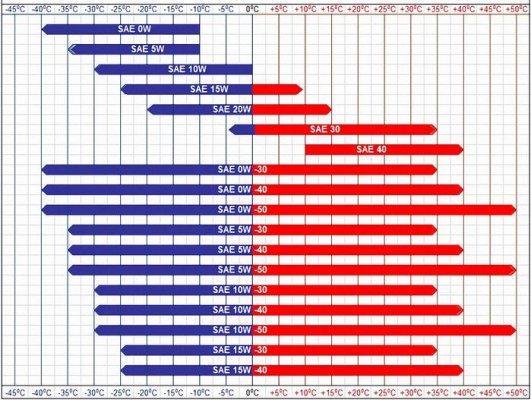
here is a chart that shows how they work . As you csn see 5w30 works to -30*

cf028082-9c32-408b-9922-6c55c0d2dc53_SAE chart.jpeg
 

Burla

Senior Member
Joined
Apr 28, 2012
Posts
27,545
Reaction score
57,754
Ram Year
2010 Hemi Reg Cab 4x4
Engine
Hemi
I live in Northern California where it maybe gets 30 degrees in the winter to 100 + in the summer. If I’m understanding all this right 5w30 is too thick for my climate. What if I use 6qts 5w20 and 1 quart 5w30 would that still give my Hemi the benefits it needs.

I live in Petaluma, I run 5w30 and I am changing to 10w30 next week. I have been using 5w30 for years, and I even put it in my wife's toyo 4 banger.
 

Buck19

Junior Member
Joined
Jan 1, 2018
Posts
14
Reaction score
5
Location
Salida Ca.
Ram Year
2017
Engine
5.7 HEMI
I have no tick and no lifter chatter. I want my engine to last so I want the protection early on.
 

Drunken Hamster

Turncoat Ford Boi
Joined
Jul 18, 2017
Posts
1,910
Reaction score
357
Location
South Carolina
Ram Year
was 2005
Engine
was 5.7 Hemi
5w30 is not to thick I would do all 7 quarts of 5w30.

here is a chart that shows how they work . As you csn see 5w30 works to -30*

View attachment 120421
There are also these charts, though idk about the accuracy of all of them since they don't all have all of the grades listed.

However, viscosity for temperature is not all you should look at. HTHS, or high temperature, high sheer resistance in addition to base oil and a good additive pack are very important from what I'm picking up.

As far as Redline goes, which is what I just got delivered and am about to put in, the 5w40 and 0w40 have very high HTHS on their website. And, given the first chart below, those two give the widest range of operating temperature. With a mix of the two being the best middle ground.

However, to simplify, the first number "xW" is how good it does in cold. 10w can go to freezing or 10 below, I believe. 5w can go 20 below, and 0w cam go 30 below or farther. I'm not 100% certain in these numbers or information, but yeah.

The second number (20, 30, 40, etc) is your viscosity once it's heated up. Hemi's are rated for 20wt mainly to meet carb fuel economy standards. 30wt (and is reportedly even what's recommended in the 3rd gen RAM 2500 manual) is just fine to run, and many also run 40wt no problem as the 6.4 recommends 0w40 PUP.

I'm currently about to put 5w30 in mine and I live in Florida. Between now and the next oil change, I want to find out more about viscosity mixing and running 40wt in the 3rd gen ram era 5.7 before I pull the trigger in my theoretical ideal oil of Redline 5w40 and 0w40 mix.

Another important thing is the filter. I'll keep it simple. Royal Purple or Fram ULTRA. It has to be the Fram ULTRA if you go Fram. The orange frams are said to be terrible.

((the fram is cheaper than the royal purple filter. By about $6 usd on Amazon.))

Also, get a bigger filter than stock. Just use Amazon to find the one recommended for your ride, then go to Summit and type in the filter name and find all the ones that have the same size threads and gasket as your recommended one and use the biggest one you think will fit.

In my case, my truck would take a royal purple 20-253, and I ordered he larger rp 30-8a. Which was actually the only other one with the same threads and gasket as the recommended one, and it's twice as long. {I looked under there. It should fit just fine. But mine's a 2wd 05, so a 4x4 or newer generation truck might be different.}

Either way, good luck, dude. This post was much longer than I anticipated. 2af10afac42e5ece9bc0660b79c87566.jpg7eb874084557b27aef3f54abf86ceb6d.jpgbb971ed1176db8c980c95b3d1524117f.jpg0dad3b0211564f128b8d2e100cd6c73b.jpg

Sent from my magic 5-inch
 

Buck19

Junior Member
Joined
Jan 1, 2018
Posts
14
Reaction score
5
Location
Salida Ca.
Ram Year
2017
Engine
5.7 HEMI
I drive a 17 1500 quad cab 5.7. Thanks for all the info. It’s a lot to mull over.
 

69GWC

Power Wagon
Joined
Oct 1, 2015
Posts
5,387
Reaction score
6,957
Location
Spring hill, Kansas
Ram Year
2022 Power Wagon
Engine
6.4 Hemi, 8sp
I am guessing those graphs are not for synthetics? Maybe thats why they are different than the one I posted.

The RP filter most buy for the Hemi that is a larger replacement for the smaller RP filter is the 20-820.
Is the 30-a even larger ?
 

Drunken Hamster

Turncoat Ford Boi
Joined
Jul 18, 2017
Posts
1,910
Reaction score
357
Location
South Carolina
Ram Year
was 2005
Engine
was 5.7 Hemi
I am guessing those graphs are not for synthetics? Maybe thats why they are different than the one I posted.

The RP filter most buy for the Hemi that is a larger replacement for the smaller RP filter is the 20-820.
Is the 30-a even larger ?

Dunno if those graphs are for Syn or not. I assume so, though, as [from what I know] there isn't and can't be a conventional 0w anything oil.

Yeah, the 20-820 is for the newer 22mm threading or whatever threading it is. Mine is the 3/4-16 threading, and so, 20-253 is the standard size and 30-8a is the only other size that has the same threading and gasket sizes.

In the pics, it seems 2x as long. I held it in my hand today, it's definitely bigger than the filter that's on there. 2x bigger? IDK, like I promised, I'll take pics during the process.
 

Buck19

Junior Member
Joined
Jan 1, 2018
Posts
14
Reaction score
5
Location
Salida Ca.
Ram Year
2017
Engine
5.7 HEMI
I’m a 1000 miles from an oil change. So I’m hoping I can get a catch can before hand and do the change at the same time.
 

Wild one

Senior Member
Joined
Jan 17, 2016
Posts
23,714
Reaction score
54,457
Ram Year
14 Sport
Engine
5.7
I am guessing those graphs are not for synthetics? Maybe thats why they are different than the one I posted.

The RP filter most buy for the Hemi that is a larger replacement for the smaller RP filter is the 20-820.
Is the 30-a even larger ?

The 30-8A filter has 3/4-16 threads and won't interchange with the stock filters threads of 22mm X 1.5. To use the the 30-8a you would need to replace the nipple that the filter screws onto to the earlier 3/4-16 nipple.Not sure if you can do it on the later trucks,as I've never tried.
 
Back
Top