RevMax 8 speed thermostat bypass

Disclaimer: Links on this page pointing to Amazon, eBay and other sites may include affiliate code. If you click them and make a purchase, we may earn a small commission.

Different Drummer

Senior Member
Joined
Oct 20, 2020
Posts
612
Reaction score
664
Location
North East
Ram Year
2017
Engine
Pentastar V6
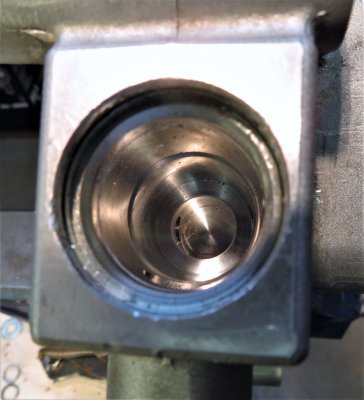
This pic might help a bit to ,you can see how the flow path is inside the thermostat housing.

View attachment 237251
I see the hole in the bottom bore at Approx. nine O-clock which goes to the heater I believe.
I see a hole just inside the upper bore at Approx. six O-clock. I believe that this is the entry point for fluid returning from the cooler. I can just barely sense a hole near the bottom of the upper bore at Apron. three O-clock. This hole I believe would lead cooled fluid to the transmission. Is this all correct?
 

caulk04

Senior Member
Supporting Vendor
Joined
Mar 24, 2013
Posts
1,099
Reaction score
2,428
Ram Year
2018
Engine
5.7 Hemi
Looking into the bore in that most recent picture:

Hole at the bottom is fluid coming into the cavity from the heater.

Hole nearest the top is fluid entering the cavity from the cooler.

The hole you can't see clearly at 3oclock is where the fluid reenters the transmission.

The stock thermostat travels down into this bore to gradually close off the lower and open the upper path as the fluid heats up. My part mimicks the thermostat in it's open position which blocks the return from the heater and opens the return from the cooler.
 
OP
OP
W

Wild one

Senior Member
Joined
Jan 17, 2016
Posts
23,817
Reaction score
54,823
Ram Year
14 Sport
Engine
5.7
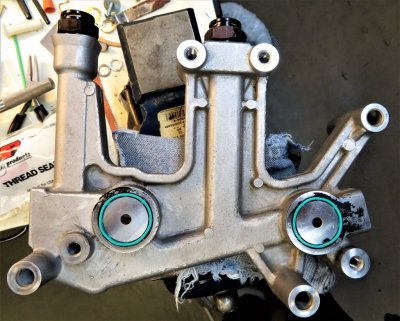
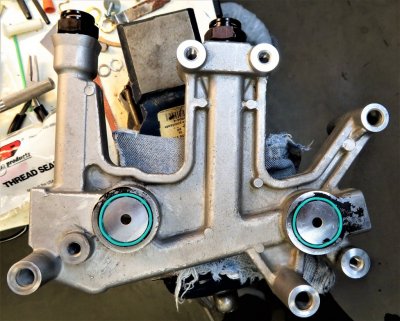
In this pic,the middle hole at 3:00 is hot pressure side fluid from transmission,bottom hole at 9:00 is hot pressure side fluid fed to heat exchanger,the upper hole at 6:00 is the hot pressure side fluid feed to the cooler in the top of the A/C condensor.Thermostat is always installed on the hot side of the liquid/fluid you're trying to regulate,never on the cold side.Everything in this photo is on the out pressure side feed from the trannies internal pump,and is in the hot side of the fluid,which is what feeds to the exchanger to either have the heat in the fluid increased by the coolant,or is fed to the cooler to have the heat in the fluid decreased,nothing in this photo is a return,it's all a pressurized "out" feed on this side

IMG_4256 (2).JPG

Left side is thermostat side

IMG_4254 (2).JPG
 
Last edited:
OP
OP
W

Wild one

Senior Member
Joined
Jan 17, 2016
Posts
23,817
Reaction score
54,823
Ram Year
14 Sport
Engine
5.7
In this picture, port A is fluid into the trans, port B is fluid leaving the trans.

View attachment 237194

Red arrows are fluid leaving the trans, going towards the cooler and heat exchanger.

Blue arrow is fluid coming back from the cooler.

Multi color are the ports between the heat exchanger and manifold.

Because it's such a short path, fluid will flow through the heat exchanger much more easily than it will through all the lines to the front of the truck unless forced to do so by an open (hot) thermostat or my valve.

Fluid flows into the thermostat housing from either end, toward the middle of it where it reenters the trans.

This pic is back asswards,the thermostat is never installed after the cooler Jesse.The red arrows in this pic are the cool side return from the cooler,where the blue arrows are,is the pressurized hot side from the tranny to the cooler.The blue arrows are actually on the pump side and should be red and facing the other way.I should of paid more attention to the photo earlier,that's what you get for just glancing over things,lol.
 

caulk04

Senior Member
Supporting Vendor
Joined
Mar 24, 2013
Posts
1,099
Reaction score
2,428
Ram Year
2018
Engine
5.7 Hemi
I totally agree that that makes more sense, but I'm basing my info on that nice computer model that wouldn't have been created by some schmo without a clue. Could entirely be wrong, but that's my thinking.

It doesn't matter which direction the fluid flow is for my part, the bottom port is for the heater and is blocked.
 
OP
OP
W

Wild one

Senior Member
Joined
Jan 17, 2016
Posts
23,817
Reaction score
54,823
Ram Year
14 Sport
Engine
5.7
I totally agree that that makes more sense, but I'm basing my info on that nice computer model that wouldn't have been created by some schmo without a clue. Could entirely be wrong, but that's my thinking.

It doesn't matter which direction the fluid flow is for my part, the bottom port is for the heater and is blocked.

Took me a minute to find the pic you're talking about,but it's wrong to,lol.Not the first time i've seen diagrams like that done wrong by a "schmo" that was probably handed a rude and crude hand drawn facsmile to create a nice computor rendering,lol
Very good chance who-ever did the putor rendering had no idea what they were drawing,and where the lines go out of sight on the other side of the bellhousing,they got the lines switched up by mistake,as there's a bit where the cooler lines disappear in the drawing.
 
Last edited:
OP
OP
W

Wild one

Senior Member
Joined
Jan 17, 2016
Posts
23,817
Reaction score
54,823
Ram Year
14 Sport
Engine
5.7
So... Doing more reading and thinking, I came across info that conflicts with what I was told here about flow direction between the trans and thermal unit. Seems it flows out the lower port on the trans which would pressurize the deepest port of the thermostat housing first. This reinforces my idea in that there is a bypass for the fluid should the heater and cooler become blocked. The plug I've made retains this function.

Note on this model which of the lines to the cooler is red (hot from trans) and where that corresponds on the assembly. View attachment 236439

At any rate it's more food for thought, I have my part made and just need to make time to fit it and test it some. My daily commute ends with trans temps between 150-160 starting at 50-55 in the morning and whatever ambient is in the evening (20-30 lately) so it'll be interesting to see the effect of full cooler flow on an otherwise stock, un molested truck.

Jesse i think this is the pic you're referring to,and if you were the person told to recreate this drawing with-out really knowing what it is,it'd be easy enough to reverse the lines where they disappear behind the bellhousing.
 

Different Drummer

Senior Member
Joined
Oct 20, 2020
Posts
612
Reaction score
664
Location
North East
Ram Year
2017
Engine
Pentastar V6
In this pic,the middle hole at 3:00 is hot pressure side fluid from transmission,bottom hole at 9:00 is hot pressure side fluid fed to heat exchanger,the upper hole at 6:00 is the hot pressure side fluid feed to the cooler in the top of the A/C condensor.Thermostat is always installed on the hot side of the liquid/fluid you're trying to regulate,never on the cold side.Everything in this photo is on the out pressure side feed from the trannies internal pump,and is in the hot side of the fluid,which is what feeds to the exchanger to either have the heat in the fluid increased by the coolant,or is fed to the cooler to have the heat in the fluid decreased,nothing in this photo is a return,it's all a pressurized "out" feed on this side

View attachment 237269

Ok, I can follow this, but just to be sure tell me if saying it a little differently agrees.
HOT fluid directly from the transmission enters the chamber through the center ( 3 O-clock ) orifice.
The position of the thermostat device obviously determines the direction that this fluid will flow. In a cool condition ( <180*F ) it will flow downward to the 9 O-clock orifice where it gets sent to the heater. If in a HOT condition ( >180*F ) it will flow upward to the 6 O-clock orifice where it gets routed to the cooler in the front of the vehicle.
I think I just described pretty much what is said above.
By blocking off the lower 9 o-clock orifice the system becomes a constant cool only device. This is why the effect is so profound in dropping the Temp below 120* F.
All of this is on the pressure side and is fluid flowing away from the transmission.
I will stop here and wait to see if I got this correct.
Thanks guys

 
OP
OP
W

Wild one

Senior Member
Joined
Jan 17, 2016
Posts
23,817
Reaction score
54,823
Ram Year
14 Sport
Engine
5.7

Yup you got it right.Basically Jesse's plug does exactly that.If you're still worried about it running to cool,a bypass thermostat would be easy enough to plumb into the cooler lines.Improved racing (link above) has a pretty good rep,and they have a couple bypass thermostats that would work good to maintain a constant temp
 

Different Drummer

Senior Member
Joined
Oct 20, 2020
Posts
612
Reaction score
664
Location
North East
Ram Year
2017
Engine
Pentastar V6
Yup you got it right.Basically Jesse's plug does exactly that.If you're still worried about it running to cool,a bypass thermostat would be easy enough to plumb into the cooler lines.Improved racing (link above) has a pretty good rep,and they have a couple bypass thermostats that would work good to maintain a constant temp
Yes, I have seen them. However, now that I am apparently seeing what happens within the Thermal control unit, please answer one more question.
Actually two questions.
1) Describe the path that transmission fluid takes AFTER it travels through the heater in its return route to the transmission. I was or am under the understanding that it flows through one of those tubes with the O-rings that connect the thermal unit to the transmission. If this is in fact the case then when fluid is not being heated ( when the lower orifice at 9 O-clock is blocked ) the fluid in that tube just sits in a static state. ( no flow in either direction ).

2) After fluid exits the cooler in front of the radiator what precisely is the route it flows to get back into the transmission. Is it simply dumped back into the transmission never seeing any part of the thermal control unit until it once again exits from the transmission into the thermal control unit via the center ( 3 O-clock ) orifice?

3) the second tube with O-ring that connects the thermal control unit to the transmission must therefore be the pathway the fluid takes ( pressure, heated side ) directly from the transmission via the 3 O-clock return orifice.
Is all above correct?
 
OP
OP
W

Wild one

Senior Member
Joined
Jan 17, 2016
Posts
23,817
Reaction score
54,823
Ram Year
14 Sport
Engine
5.7
Yes, I have seen them. However, now that I am apparently seeing what happens within the Thermal control unit, please answer one more question.
Actually two questions.
1) Describe the path that transmission fluid takes AFTER it travels through the heater in its return route to the transmission. I was or am under the understanding that it flows through one of those tubes with the O-rings that connect the thermal unit to the transmission. If this is in fact the case then when fluid is not being heated ( when the lower orifice at 9 O-clock is blocked ) the fluid in that tube just sits in a static state. ( no flow in either direction ).

2) After fluid exits the cooler in front of the radiator what precisely is the route it flows to get back into the transmission. Is it simply dumped back into the transmission never seeing any part of the thermal control unit until it once again exits from the transmission into the thermal control unit via the center ( 3 O-clock ) orifice?

3) the second tube with O-ring that connects the thermal control unit to the transmission must therefore be the pathway the fluid takes ( pressure, heated side ) directly from the transmission via the 3 O-clock return orifice.
Is all above correct?

You can see the routing path in this pic. If the thermostat is letting fluid flow to the cooler as in the hot open state,i would think nothing is going back through the heat exchanger,as there's no flow path for that to happen. Whatever is in the heat exchanger is probably static fluid when the thermostat is in the hot open state,as you've got figured out.

IMG_4254 (2).JPG
 
OP
OP
W

Wild one

Senior Member
Joined
Jan 17, 2016
Posts
23,817
Reaction score
54,823
Ram Year
14 Sport
Engine
5.7
This is the opposite side of the router plate,which has a 1/2" pipe plug installed,which i'm guessing is so they can machine the bore in the return side of the router

IMG_4255 (2).JPG
 

Different Drummer

Senior Member
Joined
Oct 20, 2020
Posts
612
Reaction score
664
Location
North East
Ram Year
2017
Engine
Pentastar V6
Yes, but please see #2 in my previous post. Make believe you have a miniature ping pong ball or a rubber Duck if you prefer. When that marker ( the ping pong ball ) leaves the cooler what is the exact path it takes to find it's way into the transmission?
If everything going on in all the orifices in the thermal control unit are "Hot pressure side" there has to be someplace where the cooled fluid enters the transmission. I have not looked under the truck but I have to guess it is someplace remote from the thermal control unit.
It does not appear to me that any cooled transmission fluid ever comes near the thermal control unit. Only hot fluid exiting the transmission and recirculated warmed fluid returning to the transmission is in contact with the thermal control unit. It is easy to see now that I have the fluid flowing in the proper direction and I have tried to erase some information and diagrams I had relied on that were not very accurate.
 

crazykid1994

Senior Member
Joined
Sep 21, 2013
Posts
5,063
Reaction score
5,064
Location
Florida
Ram Year
2017
Engine
Hemi 5.7
Yes, but please see #2 in my previous post. Make believe you have a miniature ping pong ball or a rubber Duck if you prefer. When that marker ( the ping pong ball ) leaves the cooler what is the exact path it takes to find it's way into the transmission?
If everything going on in all the orifices in the thermal control unit are "Hot pressure side" there has to be someplace where the cooled fluid enters the transmission. I have not looked under the truck but I have to guess it is someplace remote from the thermal control unit.
It does not appear to me that any cooled transmission fluid ever comes near the thermal control unit. Only hot fluid exiting the transmission and recirculated warmed fluid returning to the transmission is in contact with the thermal control unit. It is easy to see now that I have the fluid flowing in the proper direction and I have tried to erase some information and diagrams I had relied on that were not very accurate.
One o ring tube is fluid exiting the trans. The other is fluid entering the trans.
 
OP
OP
W

Wild one

Senior Member
Joined
Jan 17, 2016
Posts
23,817
Reaction score
54,823
Ram Year
14 Sport
Engine
5.7
Yes, but please see #2 in my previous post. Make believe you have a miniature ping pong ball or a rubber Duck if you prefer. When that marker ( the ping pong ball ) leaves the cooler what is the exact path it takes to find it's way into the transmission?
If everything going on in all the orifices in the thermal control unit are "Hot pressure side" there has to be someplace where the cooled fluid enters the transmission. I have not looked under the truck but I have to guess it is someplace remote from the thermal control unit.
It does not appear to me that any cooled transmission fluid ever comes near the thermal control unit. Only hot fluid exiting the transmission and recirculated warmed fluid returning to the transmission is in contact with the thermal control unit. It is easy to see now that I have the fluid flowing in the proper direction and I have tried to erase some information and diagrams I had relied on that were not very accurate.

See those 2 black looking fittings on the top ,those are the feeds to the cooler,one on the left is the hot side out to the cooler,the one on the right is the cold return side from the cooler.
These are the hot out to the cooler and cold return side from the cooler transfer tubes that are in the back side of the router.Basically if you didn't have the thermal unit,where these transfer tubes are,is where you're cooler lines would be attached if we had threaded fittings and cooler lines,like the HD trucks and cars have.These push-in transfer tubes are threaded for a screw in cooler line attachment on the cars and HD 2500's and 3500's with the 8 speed. This thread sort of migrated over to High Performance Rams on facebook,and we had a guy kind enough to crawl under his 2500 with the 8 speed and take a bunch of pics of his tranny.

IMG_4268 (2).JPG
 
OP
OP
W

Wild one

Senior Member
Joined
Jan 17, 2016
Posts
23,817
Reaction score
54,823
Ram Year
14 Sport
Engine
5.7
Not sure this'll work,but here's what the 2500's have as their cooler lines. Thanks go out to Kyle Bonk for this photo from under his 2500.

(1) Facebook
 

Different Drummer

Senior Member
Joined
Oct 20, 2020
Posts
612
Reaction score
664
Location
North East
Ram Year
2017
Engine
Pentastar V6
One o ring tube is fluid exiting the trans. The other is fluid entering the trans.
Thank you, but I am going to ask you to be VERY specific. I realize I am being a PIA asking all these questions and by slowly and methodically mapping the whole thing out. However, there has been conflicting information ( even in this thread ) on the subject as well as very confusing diagrams / drawings in regards to how the system works and the path that fluid takes. All that information is what got me off in the wrong direction rapidly advancing down the rabbit hole.

So back to the two O-ring tubes.
Yes, it is quite obvious that one has to be fluid exiting the Trans. and one has to be fluid entering the Trans. ( you end your statement there ) That's a "no brainer" There are only two tubes connecting the thermal control unit to the Transmission, one HAS to be inflow and one HAS to be outflow.
Please tell me if you can.
1) where does the fluid flowing from the Transmission ( through an O-ringed tube ) enter the Thermal control unit? I suspect it is the center orifice at the 3 O-clock position. However, I want to be very sure of that.
2) Where does the fluid originate from that flows through the O-ringed tube that carries fluid INTO the transmission. My guess is it is directly from the heating unit portion of the thermal control unit. Again, I want to be 100% positive about its origin.
Again, I know I am being "****" about this. However, I do not want to be digesting misinformation a second time around.
Thanks
 

Different Drummer

Senior Member
Joined
Oct 20, 2020
Posts
612
Reaction score
664
Location
North East
Ram Year
2017
Engine
Pentastar V6
See those 2 black looking fittings on the top ,those are the feeds to the cooler,one on the left is the hot side out to the cooler,the one on the right is the cold return side from the cooler.
These are the hot out to the cooler and cold return side from the cooler transfer tubes that are in the back side of the router.Basically if you didn't have the thermal unit,where these transfer tubes are,is where you're cooler lines would be attached if we had threaded fittings and cooler lines,like the HD trucks and cars have.These push-in transfer tubes are threaded for a screw in cooler line attachment on the cars and HD 2500's and 3500's with the 8 speed. This thread sort of migrated over to High Performance Rams on facebook,and we had a guy kind enough to crawl under his 2500 with the 8 speed and take a bunch of pics of his tranny.

View attachment 237525
I assume the two black fittings you refer to are the ones seen in post #452.
OK that means that cooled fluid does return to the manifold that sits between the transmission and the heating unit. This fluid must make it into the transmission during HOT conditions through the O-ringed "inflow" tube without being contaminated with warmed fluid from the heating side of the device. I can only guess that this happens because when the system is >180 that bottom orifice at 9 O-clock is closed off and the fluid flow to the heater is now in a static state. Somewhere down flow from the heating element there must be a convergence of fluid coming from the heater and fluid coming from the cooler. When the system is cold the cooler fluid is static because the thermostat is blocking flow to the cooler ( via upper orifice at 6 O-clock ) and allowing flow from the heater ( via lower orifice at 9 O-clock. At this point fluid flow from the heater is active. The reverse occurs when fluid is >180 degrees. That being, fluid flow from the heater is static and fluid flow from the cooler is active.
I don't think that the thermostat has an instantaneous capability so at some intermediate temperatures I suspect the transmission fluid will actually be a mix of warmed and cooled fluid.
Would all that I have said be accurate?
 

crazykid1994

Senior Member
Joined
Sep 21, 2013
Posts
5,063
Reaction score
5,064
Location
Florida
Ram Year
2017
Engine
Hemi 5.7
Thank you, but I am going to ask you to be VERY specific. I realize I am being a PIA asking all these questions and by slowly and methodically mapping the whole thing out. However, there has been conflicting information ( even in this thread ) on the subject as well as very confusing diagrams / drawings in regards to how the system works and the path that fluid takes. All that information is what got me off in the wrong direction rapidly advancing down the rabbit hole.

So back to the two O-ring tubes.
Yes, it is quite obvious that one has to be fluid exiting the Trans. and one has to be fluid entering the Trans. ( you end your statement there ) That's a "no brainer" There are only two tubes connecting the thermal control unit to the Transmission, one HAS to be inflow and one HAS to be outflow.
Please tell me if you can.
1) where does the fluid flowing from the Transmission ( through an O-ringed tube ) enter the Thermal control unit? I suspect it is the center orifice at the 3 O-clock position. However, I want to be very sure of that.
2) Where does the fluid originate from that flows through the O-ringed tube that carries fluid INTO the transmission. My guess is it is directly from the heating unit portion of the thermal control unit. Again, I want to be 100% positive about its origin.
Again, I know I am being "****" about this. However, I do not want to be digesting misinformation a second time around.
Thanks
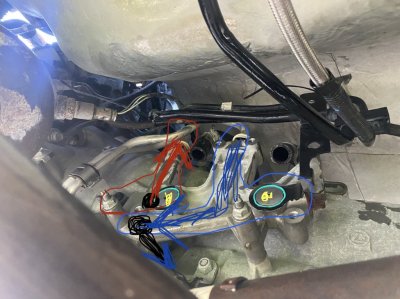
The thermostat is designed to control flow so it goes either through the heater or the radiator. The middle hole is fluid from the transmission. Then the thermostat decides heater or radiator. Then it returns to the other orifice of the unit either from the radiator or from the heater. It goes through one or the other. Caulks device blocks the path leading to the heater which forces the fluid to only go through the radiator. Rev max blockoff plate blocks the path to the heater and forces the fluid only through the radiator. Black circles are the location of the o ring tubes between the unit and the transmission. Red is hot fluid going to the radiator. Blue is fluid returning from the radiator. Yellow dots are the holes where the heater is connected. As you can see this is a picture of the unit attached to the truck so you can see the hard lines leaving the top of the unit to and from the radiator.

F23B2750-E623-4CF2-A71A-4378B90C8335.jpeg
 
Back
Top