

Dean2
Senior Member
- Joined
- Jun 17, 2021
- Posts
- 4,444
- Reaction score
- 8,898
- Location
- Near Edmonton
- Ram Year
- 2021 2500
- Engine
- 6.4
Never ceases to amaze me how much nonsense gets posted on oil threads.

 oilsadvisor.com
Click on the link above to read the whole article, this is just the intro.

Pennzoil Vs Mobil 1: which is better?
Pennzoil Ultra Platinum and Mobil 1 represent two different philosophies that both deliver excellent results.
Pennzoil Ultra Platinum uses a gas-to-liquid (GTL) synthetic base oil made from natural gas rather than crude oil. This manufacturing process gives it an edge in engine cleanliness and resistance to oxidation.
Mobil 1 prioritizes film strength, which means better protection during metal-to-metal contact under extreme loads. This is particularly important during cold starts and high-stress driving.
Let’s get right to it: Pennzoil typically wins on piston cleanliness and oxidative stability. Mobil 1 edges ahead on overall durability and fuel economy. Both oils easily handle extended drain intervals of 10,000 miles or more when used with appropriate oil filters, and both meet or exceed current API and ILSAC standards.
The decision essentially boils down to what matters most for your specific application. High-performance engines that see track time might benefit from Pennzoil’s cleaning properties. Daily drivers focused on longevity and fuel costs might lean toward Mobil 1.
This post gives you a head-to-head comparison between these oils based on engine protection, fuel economy, leak prevention, and price can help you choose the best-suited product for your need.
The main difference between these oils is how the base stock is manufactured. Pennzoil Platinum and Ultra Platinum use Gas-to-Liquid (GTL) technology. This GTL process produces a fully saturated base oil with essentially no sulfur or nitrogen. Shell, which owns Pennzoil, pioneered the large-scale use of GTL base stocks.
The key advantage is that GTL base oil doesn’t contain the Group III+ hydrocracked oils that most competitors blend with Group IV synthetics, which gives it a cleaner starting point.
Mobil 1 historically built its reputation on Group IV Polyalphaolefins (PAOs), which are chemically synthesized molecules. Modern Mobil 1 formulations blend Group III+ (hydrocracked) and Group IV (PAO) base stocks. For example, Mobil 1 Supercar 0W-40 uses a PAO-Ester blend (Group IV/V). However, newer API SP formulas like the 0W-40 European Car Formula have moved away from the traditional PAO-Ester blend entirely, with completely redesigned base oil and additive packages.
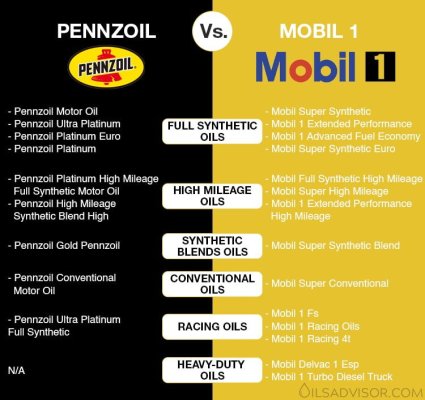 Compared to Pennzoil, Mobil 1 seems to have more diversity in the product line.
Pennzoil and Mobil 1 are two well-known motor oils that share some characteristics.
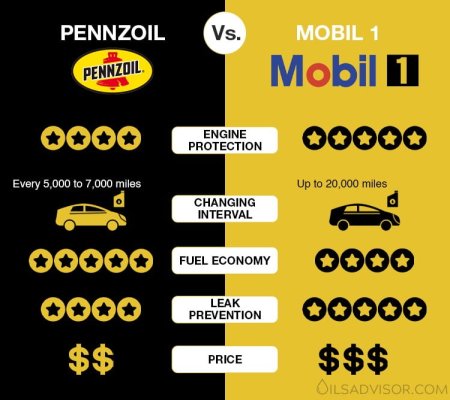 In terms of engine protection, changing intervals, and leak prevention, Mobil 1 has an advantage over the other Pennzoil. While Pennzoil oil is more cost-effective and efficient in terms of fuel efficiency.
Pennzoil Vs Mobil 1: Head-To-Head Comparison
While they are both high-quality products, one may outperform the other in some ways. Read more to understand Pennzoil vs Mobil1 differences.
oilsadvisor.com
Click on the link above to read the whole article, this is just the intro.
Pennzoil Vs Mobil 1: Head-To-Head Comparison
Best Review, Blog, Comparison, Engine Oil / By Ryan McCain / November 6, 2025Pennzoil Vs Mobil 1: which is better?
Pennzoil Ultra Platinum and Mobil 1 represent two different philosophies that both deliver excellent results.
Pennzoil Ultra Platinum uses a gas-to-liquid (GTL) synthetic base oil made from natural gas rather than crude oil. This manufacturing process gives it an edge in engine cleanliness and resistance to oxidation.
Mobil 1 prioritizes film strength, which means better protection during metal-to-metal contact under extreme loads. This is particularly important during cold starts and high-stress driving.
Let’s get right to it: Pennzoil typically wins on piston cleanliness and oxidative stability. Mobil 1 edges ahead on overall durability and fuel economy. Both oils easily handle extended drain intervals of 10,000 miles or more when used with appropriate oil filters, and both meet or exceed current API and ILSAC standards.
The decision essentially boils down to what matters most for your specific application. High-performance engines that see track time might benefit from Pennzoil’s cleaning properties. Daily drivers focused on longevity and fuel costs might lean toward Mobil 1.
This post gives you a head-to-head comparison between these oils based on engine protection, fuel economy, leak prevention, and price can help you choose the best-suited product for your need.
Pennzoil Vs Mobil 1: Product Line Comparison
The main difference between these oils is how the base stock is manufactured. Pennzoil Platinum and Ultra Platinum use Gas-to-Liquid (GTL) technology. This GTL process produces a fully saturated base oil with essentially no sulfur or nitrogen. Shell, which owns Pennzoil, pioneered the large-scale use of GTL base stocks.
The key advantage is that GTL base oil doesn’t contain the Group III+ hydrocracked oils that most competitors blend with Group IV synthetics, which gives it a cleaner starting point.
Mobil 1 historically built its reputation on Group IV Polyalphaolefins (PAOs), which are chemically synthesized molecules. Modern Mobil 1 formulations blend Group III+ (hydrocracked) and Group IV (PAO) base stocks. For example, Mobil 1 Supercar 0W-40 uses a PAO-Ester blend (Group IV/V). However, newer API SP formulas like the 0W-40 European Car Formula have moved away from the traditional PAO-Ester blend entirely, with completely redesigned base oil and additive packages.
Compared to Pennzoil, Mobil 1 seems to have more diversity in the product line.Pennzoil’s Product Range
- Pennzoil Ultra Platinum (full synthetic made with natural gas, top-tier)
- Pennzoil Platinum (full synthetic with advanced protection)
- Pennzoil Platinum High Mileage (full synthetic for vehicles over 75,000 miles)
- Pennzoil Platinum Euro (for European vehicles)
- Pennzoil Full Synthetic
- Pennzoil High Mileage Full Synthetic
- Pennzoil Gold (synthetic blend)
- Pennzoil High Mileage (conventional-based for vehicles over 75,000 miles)
- Pennzoil Motor Oil (conventional base oil)
Mobil 1’s Product Range
- Mobil 1 Extended Performance (0W-20, 5W-20, 5W-30, 10W-30)
- Mobil 1 Extended Performance High Mileage (0W-20, 5W-20, 5W-30)
- Mobil 1 Hybrid (0W-20)
- Mobil 1 Classic Car (10W-30)
- Mobil 1 C40 GT 0W-40 (for Porsche GT engines)
- Mobil 1 Turbo Diesel Truck (5W-40)
- Mobil 1 Racing 4T (10W-40 for motorcycles)
- Mobil 1 V-Twin (20W-50 for V-Twin engines)
- Mobil Super Synthetic Euro (5W-40 for European spec vehicles)
Pennzoil Vs Mobil 1: Key Differences
Pennzoil and Mobil 1 are two well-known motor oils that share some characteristics.
In terms of engine protection, changing intervals, and leak prevention, Mobil 1 has an advantage over the other Pennzoil. While Pennzoil oil is more cost-effective and efficient in terms of fuel efficiency.
Last edited: