
Hmmm ..New theory(?): Could it be the 'shields' causing warped manifolds??

Disclaimer: Links on this page pointing to Amazon, eBay and other sites may include affiliate code. If you click them and make a purchase, we may earn a small commission.

Jeepwalker

Senior Member
Joined
Sep 8, 2017
Posts
4,282
Reaction score
5,471
Location
WI
Ram Year
2012 Reg Cab, 4x4
Engine
5.7 Hemi
I'm just throwing this out there..... Could it be ...Could-it-be....I wonder, the shields being the 'root issue' causing the exhaust manifold to warp? Here's what's making me wonder, I'm just thinking out loud here:

1) The manifolds tend to warp "upwards" on the ends ...and break the bolts there.
2) Just so happens the shields are 'open' on the ends of the manifolds and rather tight at the middle. Therefore the ends cool off faster, esp the outer surface, the surface away from the engine. That would cause the cast iron to SHRINK in those areas FIRST...causing a warping "up" of the manifolds at the ends ...the exact areas where the bolt heads pop off.
3) When I was milling my exh manifolds down they got somewhat hot. Meaning they were warm on the underside (mating surface) and cooler on the outer edge. They warped 'up' a bit. I laid a machinists ruler on them and went "Hmmm". After I let them cool to ambient they were flat across the surface I was belt sanding. So...if you go to belt sand your manifolds, just alternate between them, and take breaks so they don't build up too much heat (and flex up on the ends).
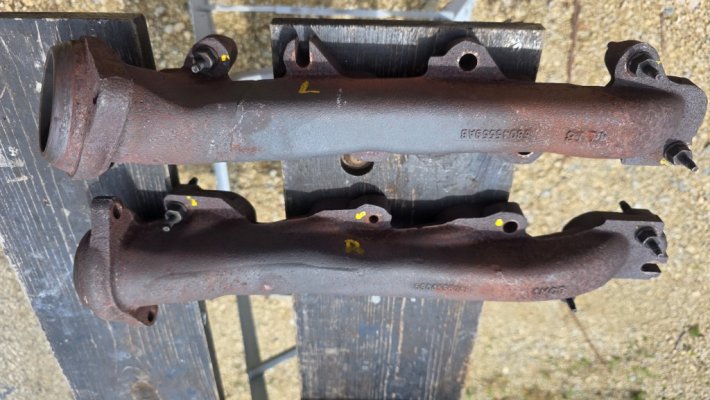
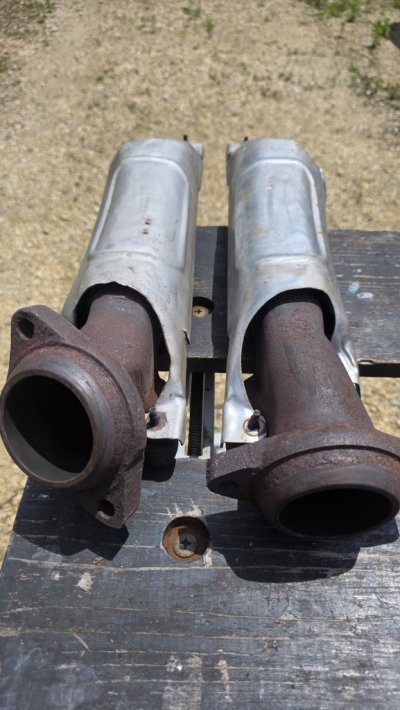
4) Look at the coloration in the picture below. You can see where they get HOT in the center, less so on the ends. It turns out the shield (on my tk ...probably others) is concave in the center ...very tight to the manifold in the very area where it is darker gray (see first pic). It obviously was impeding cooling airflow. By design? IDK. So the manifolds retain heat more in that center area I believe. See pics below. Or maybe the cooling air velocity of the airflow is greater by keeping the center section of the shield closer to the manifold in the center?? Not sure what Ram was thinking there.
5) A lot of older trucks ..and I know Chevy's for sure didn't have a shroud around the manifold...or when they did, it was the whole manifold generally, not predomenately the center section. Or the center section was sometimes 'louvered' to allow the manifolds (my theory) to cool more or less as one, not hotter in some areas and cooler in others. Classic cars usually had open exhaust manifolds and warping was rarely an issue.

Anyway, that's what I'm thinking ...wondering. What do you 'experts' think?

What I did on mine prior to assembly was hammer the concave center section of the shroud "out" more so more cool air can flow around the center section of the manifold going forward. I also hammered 'carefully' the open 'ends' of the shield further away from the manifolds (increased the gap from normal (almost no gap), for better airflow ..and so they contain less hot air (see 'gap' in 2nd picture). Now there is a good equidistant 5/16"-3/8" gap around the trailing lip of the heat shield (2nd pic), where before there was hardly any gap for air to escape the center region of the exh manifold. If there was enough material I'd rather have a wider 1/2" gap.

I wonder how new truck manifolds would last if someone right away removed and re-made different shrouds which were larger or not all the way around or perforated in the center ...in other words, didn't contain more heat in the center area of the manifold and allow the ends to cool first??

What say you??
20260625_121051.jpg20260625_122033.jpg
 
Last edited:

mdc1990zr1

Senior Member
Joined
Feb 10, 2019
Posts
551
Reaction score
1,168
Location
Conshohocken, PA
Ram Year
2016
Engine
Hemi 5.7
I'm just throwing this out there..... Could it be ...Could-it-be....I wonder, the shields being the 'root issue' causing the exhaust manifold to warp? Here's what's making me wonder, I'm just thinking out loud here:

1) The manifolds tend to warp "upwards" on the ends ...and break the bolts there.
2) Just so happens the shields are 'open' on the ends of the manifolds and rather tight at the middle. Therefore the ends cool off faster, esp the outer surface, the surface away from the engine. That would cause the cast iron to SHRINK in those areas FIRST...causing a warping "up" of the manifolds.
3) When I was milling my exh manifolds down they got somewhat hot. Meaning they were warm on the underside (mating surface) and cooler on the outer edge. They warped 'up' a bit. I laid a machinists ruler on them and went "Hmmm". After I let them cool to ambient they were flat across the surface I was belt sanding.
4) Look at the coloration in the picture below. You can see where they get HOT in the center, less so on the ends. It turns out the shield (on my tk ...probably others) is concave in the center ...very tight to the manifold. It obviously was impeding cooling airflow. So the manifolds retain heat more in that area. See pics below.
5) A lot of older trucks ..and I know Chevy's for sure didn't have a shroud around the manifold...or when they did, it was the whole manifold generally, not predomenately the center section. Or the center section was sometimes 'louvered' to allow the manifolds (my theory) to cool more or less as one, not hotter in some areas and cooler in others. Classic cars usually had open exhaust manifolds and warping was rarely an issue.

Anyway, that's what I'm thinking ...wondering. What do you 'experts' think?

What I did on mine prior to assembly was hammer the concave center section of the shroud "out" more so more cool air can flow around the center section of the manifold going forward. I also hammered 'carefully' the ends to work the ends 'out' away from the manifolds ..much more than they were, for better airflow and so they contain less hot air (2nd picture). Now there is a good equidistant 5/16"-3/8" gap around the trailing lip of the heat shield (2nd pic), where before there was hardly any gap for air to escape the center region of the exh manifold. If there was enough material I'd rather have a wider 1/2" gap.

I wonder how new truck manifolds would last if someone right away removed and re-made different shrouds which were larger or not all the way around or perforated in the center ...in other words, didn't contain more heat in the center area of the manifold and allow the ends to cool first??

What say you??
View attachment 585999View attachment 586000
I posted previously that I thought that the heat shields being removed may prevent the bolts in the rear from snapping. I think the clamping force of the outermost nut that secures the heat shield prevents the bolt from twisting as it expands and contracts with the heating of the manifold. After so many heat cycles, something has to give and that when the bolts snap. BD diesel must think something similar as they reposition the heat shield to its own bolt instead of sharing a manifold bolt.
 

hunterdan

Senior Member
Joined
May 7, 2018
Posts
1,185
Reaction score
1,564
Location
SE PA
Ram Year
2019 classic
Engine
5.7 Hemi
Me personally, I think it's lack of a flex pipe after the cats. Not so much warping, but just a lot of load on the bolts causing them to snap. When the engine loads up and starts torquing on the motor mounts, essentially the entire exhaust system has to flex with it. Seems like most of the broken bolts are on the driver side, right? Driver side would be the side that lifts up under load.
 

crackerjack1957

Senior Member
Joined
Sep 26, 2015
Posts
2,376
Reaction score
3,305
Ram Year
2014 Sport 1500 CC 4x4
Engine
Hemi 5.7...65RFE...4.56
But if you machine or grind manifold after warpage without changing anything else besides gaskets & bolts..........I don't know of anyone that has had the repeated broken bolts.

So if it doesn't happen again......all of the other theories don't apply.

Ceramic coating & thermal wraps hold heat in exhaust which has 2 advantages.
Protects & cools engine & other parts.
Speeds up exhaust pulses which pulls exhaust gasses out of combustion chamber more efficiently.
 
Last edited:

Ken226

Senior Member
Joined
Mar 12, 2017
Posts
2,304
Reaction score
5,968
Location
Washington State
Ram Year
2013
Engine
Hemi
But if you machine or grind manifold after warpage without changing anything else besides gaskets & bolts..........I don't know of anyone that has had the repeated broken bolts.

I've done 4 cars over the last 10 years.

So far in my sample size of 8 individual manifolds, time has shown you to be correct.
 

mdc1990zr1

Senior Member
Joined
Feb 10, 2019
Posts
551
Reaction score
1,168
Location
Conshohocken, PA
Ram Year
2016
Engine
Hemi 5.7
My theory is that that cats are to close to the manifolds .

Notice how it’s always the rear most bolts / studs break , right near the highest temperature differential.
The last two bolts also have the added weight of the exhaust hanging off of it combined with added expansion and contraction of all that. A lot of physics going on there. Maybe take some of the load off of that y-pipe to exhaust manifold joint with some sort of hanger or brace?
 
OP
OP
J

Jeepwalker

Senior Member
Joined
Sep 8, 2017
Posts
4,282
Reaction score
5,471
Location
WI
Ram Year
2012 Reg Cab, 4x4
Engine
5.7 Hemi
Yeah, all these ideas are possibilities. I'm just throwing out what I noticed.... run it up the flagpole. Just a thought/idea. Obviously I don't know for sure. But like you say, after planing the manifold flat again, it should be (hopefully) never an issue..

:happy160:
 

DILLIGAF

Senior Member
Canadian Forces
Joined
May 28, 2016
Posts
5,773
Reaction score
12,334
Location
Canada
Ram Year
2012
Engine
5.7
Just looking at those POS says it all. no theory needed.

Garbage flow, Garbage Material , Garbage hardware.
 

Grams

Senior Member
Joined
Oct 4, 2024
Posts
1,123
Reaction score
1,830
Location
Texas
Ram Year
2024 & 2015
Engine
6.7 Cummins & 5.7 Hemi
Long piece of cast-iron heats up and expands lengthwise…and the bolts work to keep it from lengthening…. until the end-bolts break. The attached exhaust pipe/cat weight is addt’l stress…so that’s the common breakage-point for the bolts to fail.

Machining/sanding a re-using a manifold is helpful…but the major reason re-used manifolds don’t repeat is….. they are now “annealed” due to the previous expereince… And the replacement bolts are upgraded in most cases.

IMO
 

Dusty

Senior Member
Joined
Jun 6, 2013
Posts
2,097
Reaction score
2,857
Location
Rochester, New York
Ram Year
2019
Engine
5.7 Hemi
I see the hot spot in the middle which I think is caused by the fact that the two center ports are so close to each other. However in the older design the usual symptom was broken bolts at the extreme ends of the manifold. That issue doesn't seem to be prevalent on he fifth gen versions. They just crack in half.

I think the heart of the problem is just that there's far less casting around the flange area. They're too thin. Compare the flange thickness to small block Chevies or the LA engines, and I never saw one of those break.

The shields are there for a reason. I know if they're missing from a 5.3 motor the spark plug boots will literally melt.

Regards,
Dusty
2019 Ram 1500 Billet Silver Laramie Quad Cab 2WD, 5.7 Hemi, 8HP75, 3.21 axle, 33-gallon fuel tank, 18” wheels. Build Date: 3 June 2018. Now at 155218 miles.
 

mdc1990zr1

Senior Member
Joined
Feb 10, 2019
Posts
551
Reaction score
1,168
Location
Conshohocken, PA
Ram Year
2016
Engine
Hemi 5.7
I see the hot spot in the middle which I think is caused by the fact that the two center ports are so close to each other. However in the older design the usual symptom was broken bolts at the extreme ends of the manifold. That issue doesn't seem to be prevalent on he fifth gen versions. They just crack in half.

I think the heart of the problem is just that there's far less casting around the flange area. They're too thin. Compare the flange thickness to small block Chevies or the LA engines, and I never saw one of those break.

The shields are there for a reason. I know if they're missing from a 5.3 motor the spark plug boots will literally melt.

Regards,
Dusty
2019 Ram 1500 Billet Silver Laramie Quad Cab 2WD, 5.7 Hemi, 8HP75, 3.21 axle, 33-gallon fuel tank, 18” wheels. Build Date: 3 June 2018. Now at 155218 miles.
Let’s not forget that the bolts are much thinner in diameter than in the past
 

crackerjack1957

Senior Member
Joined
Sep 26, 2015
Posts
2,376
Reaction score
3,305
Ram Year
2014 Sport 1500 CC 4x4
Engine
Hemi 5.7...65RFE...4.56
Long piece of cast-iron heats up and expands lengthwise…and the bolts work to keep it from lengthening…. until the end-bolts break. The attached exhaust pipe/cat weight is addt’l stress…so that’s the common breakage-point for the bolts to fail.

Machining/sanding a re-using a manifold is helpful…but the major reason re-used manifolds don’t repeat is….. they are now “annealed” due to the previous expereince… And the replacement bolts are upgraded in most cases.

IMO
Annealing & stress relieving are different processes
Annealing will alter the material making it less hard.
 

04fxdwgi

Senior Member
Joined
May 19, 2023
Posts
1,803
Reaction score
3,794
Location
Coastal NE North Carolina
Ram Year
2016 1500 Sport
Engine
5.7 Hemi
Ram aint the 1st for these problems. 75% of the 04 / 05 Ford 5.4's cracked the manifolds. On mine, the manifolds came out in 2 pieces each.
 

Hagar1

Senior Member
Joined
Aug 9, 2023
Posts
1,132
Reaction score
2,352
Location
Ontario Canada
Ram Year
2012 Ram 1500
Engine
Hemi 5.7
Manifold warps because it was not stress relieved before machining...... manifold breaks the bolts
THIS! They are made from what is often referred to as "green cast iron" which essentially refers to the fact that they are not stress relieved. They probably are in the machining process before they are fully cooled.
 

EdGs

Senior Member
Joined
Nov 29, 2020
Posts
5,556
Reaction score
11,785
Location
FL
Ram Year
2015
Engine
Hemi 5.7L
I'm not sure how cast iron is processed, but in our machine shop at work, when we make cylindrical arbors from aluminum, we always machine them slightly oversize and then bake them for several hours to stress-relieve them before they get machined to final size.

If they are machined without heat cycling before final sizing, they will not hold concentricity aftet the first use and will be NFG.

When we flatten copper wire, it gets work-hardened and has to be baked for several hours to anneal it for use.

The way that the exhaust manifolds warp like hell, then stay good once milled/sanded after being heat-cycled makes me think that it was never done, or never properly done at manufacture.
 
Last edited:
Back
Top