A can of worms.. Payload.. Why?

Disclaimer: Links on this page pointing to Amazon, eBay and other sites may include affiliate code. If you click them and make a purchase, we may earn a small commission.

Irishthreeper

Senior Member
Joined
Aug 15, 2021
Posts
548
Reaction score
867
Location
Florida
Ram Year
2021
Engine
Hemi 6.4
The moral of the story is to stick with the info your particular truck has listed in the door….Payload, axle weights, etc. Regardless of actual capability, that’s the only way to keep yourself safe from tickets, lawyers and insurance companies. This past year I’ve seen a number of 2500 Cummins pulling huge, tri-axle 5W’s. Not smart
 
OP
OP
Rafke77

Rafke77

Member
Joined
Aug 16, 2022
Posts
48
Reaction score
16
Location
Plymouth Indiana
Ram Year
2022
Engine
6.4
In your search you have read countless comments on this topic. In the end, the number on the sticker is what Ram has certified your truck for. Doing anything else is guessing that it won't lead to a problem down the road, and anyone's response about their exceeding specifications for their truck has no relationship to your specific situation. Numbers in online charts are for a uniquely configured vehicle, you would have to find that exact provisioned truck to get the towing presented; essentially don't refer to those charts to help figure out anything in a driver's specific vehicle. Run your rig below the door jamb stickers and you should be fine. Exceed those numbers and the risks increase.
I had no intentions on going over, what I want to tow is well within my door stickers guidelines.
I was just curious why there is such a difference on payloads from truck to truck. Why some trucks can hold much more weight in the beds as opposed to others. I am not trying to confuse towing capabilities of truck vs truck, just payload. I wondered how much it had to do with registration purposes, safety limits, or manufacturers number games. Why does it seem leaf springs have a higher payload then coil rears was just a specific question.

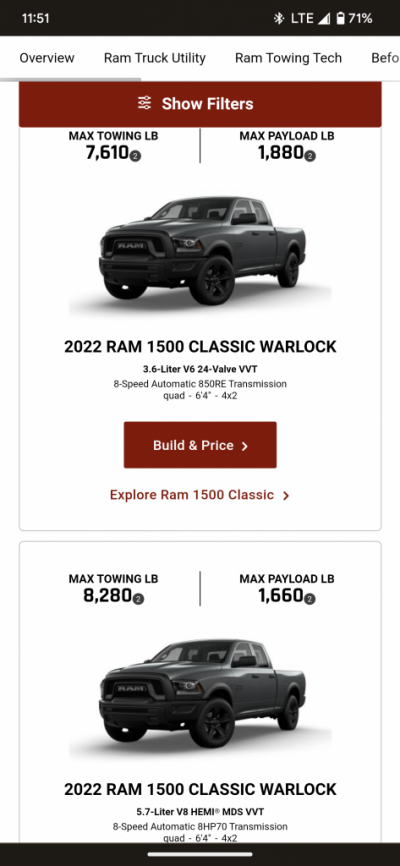
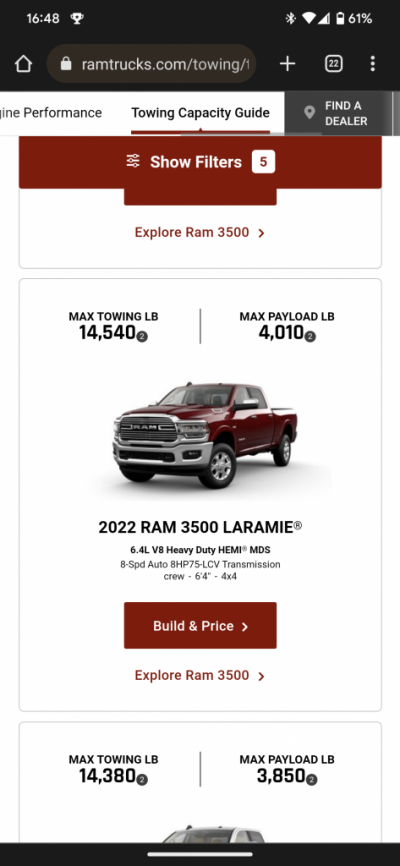
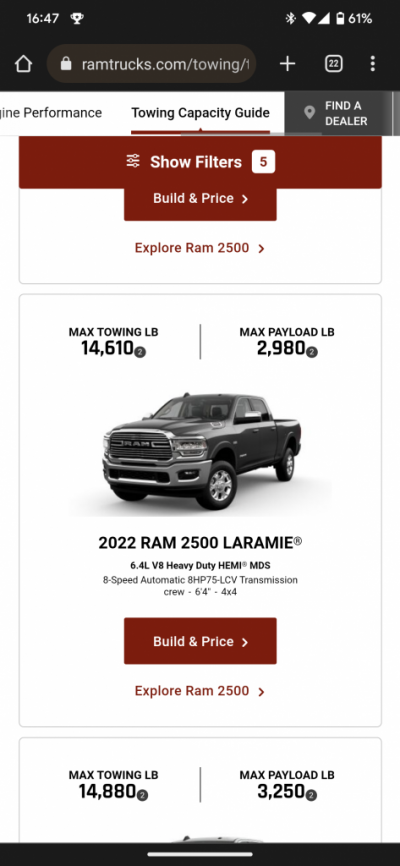
Just a quick "for instance" in the picture I attached, I'm clear on the two different engines, possible rear gear, etc. Why can the 3.6 liter have a 1,880lb payload and the 5.7 have a 1,660lb payload. Is that based off of a 10,000lb GVWR (or whatever the GVWR is for that specific truck), with the added weight of a larger engine? I know it reads "max payload". Which is why I guessed engine weight, due to those examples probably having both the least amount of options to provide those max payload numbers.


I've learned a lot from the responses here and what I've searched on the internet. I appreciate the knowledge and responses of forums like this.
 

Attachments

  • Screenshot_20221012-115101.png
    Screenshot_20221012-115101.png
    295.6 KB · Views: 8

tron67j

Senior Member
Joined
Oct 14, 2019
Posts
4,103
Reaction score
5,420
Location
Maryland
Ram Year
2018
Engine
6.4 Hemi
Ultimately it is the GVWR minus the curb weight of the vehicle, as stated above full of gas and all fluids, and the difference is the maximum payload. But there can be a number of other issues that impact all of those numbers. For example, my 2500 has almost twice the payload capacity of a 2500 with the power wagon package. You start adding bigger wheels and tires, a different suspension package, and other things and it all ultimately affects payload capacity.

But to your example, two identical GVWR trucks with the only difference being the engines, say a V6 and a V8, will result in the V6 having more payload capacity due to the lesser weight of the engine. Again, with a 2500 example, my truck with a diesel engine would have much less payload capacity and as a result, I might be able to theoretically tow more trailer, but with the diminished payload capacity, I would never reach that maximum capability.
 

Dusty

Senior Member
Joined
Jun 6, 2013
Posts
2,097
Reaction score
2,857
Location
Rochester, New York
Ram Year
2019
Engine
5.7 Hemi
Ok, let me start off by clarifying I know what the towing capacity and payload is on my 2022 Laramie 2500 is, and I know it's more than sufficient to tow my future fifth wheel.

I see such a range of payloads and towing capacity on Rams website. I know there is a difference between diesel, gas, 4x4 vs 4x2, amount of options (added weight). But even if I'm filtering the vehicles to have most of the same options, they're still 500lb + or - differences in payloads. My truck has 2830lbs payload it shows others over 3000lbs.

I've read other makes have much higher payloads and that's due to Ram having coils opposed to leaf springs and different tires could increase payload.

So, how is the max payload calculated? And if it's just leaf springs that would give the same model with the same options different payloads, would changing from coils to leaf theoretically increase payload? Given this, I read payload cannot be changed, but like I said if it can't be changed then how come there are differences?

I've read a lot of articles and unless I'm not searching the exact correct terms I can't find the answer I'm looking for.

I found this response on jaycoowners.com, from 6/28/19, credit to "spoon059"

"There are 2 schools of thought. There is one side that says the little yellow sticker is the bible and you cannot exceed those weight ratings or your truck will explode and kill a bus full of nuns. There is another side that will point out that a 3/4 ton truck is arbitrarily limited to 10,000 lbs GVWR to keep in as a class 2B vehicle for registration purposes only.

I won't tell you what to think, but I will remind you that your 2018 Ram 2500 is the EXACT SAME TRUCK as a 2018 Ram 3500, with the exception of coil springs instead of leaf springs and minor frame differences to mount the coil springs. Engine, transmission, brakes, axles, wheels/tires (assuming 18" rims on your 2500), bolts, exhaust, seats, etc are EXACTLY THE SAME. The rear coil springs are rated to carry 500 lbs less than the leaf springs. Think about this... if you bought the 6.4 gas engine, magically your rear springs could hold 800 lbs MORE than you can since you have the Cummins. That should let you know that your truck is far more capable then 10,000 lbs, but it is limited simply because it was originally meant to be a class 2B truck, limited to 10,000 lbs.

In most every state in the union, you can register your truck for higher than 10,000 lbs if you want to pay the extra fees, and you will be perfectly legal to exceed the arbitrary 10,000 lbs number. There is virtually no mechanical difference between a 2500 and a single rear wheel (SRW) 3500... other than a 500 lbs difference in rear springs and slightly different frame (because of the different spring mount)."

So, how is payload calculated and contrary to what I've read can it be changed?

Please go easy on me, I'm trying to learn. Thank you.

-Rob

I don't know about today, but years ago you could change the GVWR on a truck through the state DMV. I did this once. The state is really only interested in the revenue generated by the registration fee.

However, I think the DOT cares more about the weight rating given by the manufacturer as certified by the factory.

Regards,
Dusty
2019 Ram 1500 Billet Silver Quad Cab 2WD, 5.7 Hemi, 8HP75, 3.21 axle, 33-gallon fuel tank, factory dual exhaust, 18” wheels. Build date: 3 June 2018. Now at 78651 miles
 

Dusty

Senior Member
Joined
Jun 6, 2013
Posts
2,097
Reaction score
2,857
Location
Rochester, New York
Ram Year
2019
Engine
5.7 Hemi

My son just went through this on his 2014 Ram 2500. The standard axle for a 2500 is 10.5 inch ring & pinion, 11.5 on the 3500. He has the upgraded 11.5 which he found has completely different U-joints and prop shaft than the ones listed for a base 2500.

Regards,
Dusty
2019 Ram 1500 Billet Silver Quad Cab 2WD, 5.7 Hemi, 8HP75, 3.21 axle, 33-gallon fuel tank, factory dual exhaust, 18” wheels. Build date: 3 June 2018. Now at 78651 miles
 

Big

Junior Member
Joined
Sep 9, 2013
Posts
10
Reaction score
7
Ram Year
2014
Engine
2500 CTD
In the US the weight placard on your door frame is typically a snapshot of how the truck was rated when it rolled off the assembly line. The GVWR is determined partly by the frame, springs, axles, brakes, tires and wheels. For towing the GCWR includes the engine, transmission and gearing. Payload is the difference between the unloaded weight (includes driver and full fuel tank) and the GVWR. To complicate matters the manufacturers also factor in legal, registration and marketing considerations. So, GVWR is a somewhat fuzzy number for noncommercial owners (except in Canada) although you should try to keep it in the ballpark.

Added accessories by you or the dealer--bigger tires, running boards, bumpers, bed liner, etc.--subtract from the payload. Weight adds up surprisingly fast. Passengers count as payload too, so some trucks equipped with all the luxuries may reach their GVWR with only passengers and no gear.

You best bet in getting a handle on the numbers is to weigh your truck unloaded. That is your actual curb weight. Now weigh it again with passengers, gear and trailer. Weigh axles separately for best info as you do not want to exceed the individual axle rating even when your total weight is over GVWR.

Hope that helps.
 
OP
OP
Rafke77

Rafke77

Member
Joined
Aug 16, 2022
Posts
48
Reaction score
16
Location
Plymouth Indiana
Ram Year
2022
Engine
6.4
In the US the weight placard on your door frame is typically a snapshot of how the truck was rated when it rolled off the assembly line. The GVWR is determined partly by the frame, springs, axles, brakes, tires and wheels. For towing the GCWR includes the engine, transmission and gearing. Payload is the difference between the unloaded weight (includes driver and full fuel tank) and the GVWR. To complicate matters the manufacturers also factor in legal, registration and marketing considerations. So, GVWR is a somewhat fuzzy number for noncommercial owners (except in Canada) although you should try to keep it in the ballpark.

Added accessories by you or the dealer--bigger tires, running boards, bumpers, bed liner, etc.--subtract from the payload. Weight adds up surprisingly fast. Passengers count as payload too, so some trucks equipped with all the luxuries may reach their GVWR with only passengers and no gear.

You best bet in getting a handle on the numbers is to weigh your truck unloaded. That is your actual curb weight. Now weigh it again with passengers, gear and trailer. Weigh axles separately for best info as you do not want to exceed the individual axle rating even when your total weight is over GVWR.

Hope that helps.
Thank you, yes it helps some. I believe registration plays a bigger roll than anything. Here's just another example. I loaded the same engine, same transmission, same gears, just the 2500 versus a 3500. Towing is pretty much the same, payload is very different. And what's the major difference between the 2500 and 3500 HEMI? The suspension. It's the same exact engine, so it's not going to be able to "support" more weight in the truck. Is the frame metal thicker?? I know someone posted several posts back, the different rear suspensions. I also read that the 3500's SRW vs DRW will hold 2400lbs more payload. So that added with leaf springs imo, is the only technical reason the payload is more. Ram added the coils for a smooth ride. So if it is just a change in suspension that's creating well over a thousand pounds of extra payload. I don't see why I couldn't add airbags, helper springs to do the same. So beef up the rear suspension, hold more weight, of course within reason!! know I've dragged this on forever, I just like black and white answers.
 

Attachments

  • Screenshot_20221214-164826.png
    Screenshot_20221214-164826.png
    269.9 KB · Views: 5
  • Screenshot_20221214-164741.png
    Screenshot_20221214-164741.png
    269.2 KB · Views: 5

HEMIMANN

Senior Member
Joined
Dec 7, 2020
Posts
9,577
Reaction score
25,200
Location
Minneapolis, MN
Ram Year
2017 2500 Laramie Crew Cab
Engine
6.4L HEMI
Well yeah, if you're gonna add springs to a 2500 to make a 3500, why wouldn't you just get a 3500? Are you worried about warranty and nameplate? I don't think an owner can re-nameplate a vehicle for load upgrades, if that's what you're asking.
 

RamRigger

Member
Joined
Feb 2, 2022
Posts
77
Reaction score
59
Location
Vancouver, Washington
Ram Year
2021
Engine
6.7L
Ok, let me start off by clarifying I know what the towing capacity and payload is on my 2022 Laramie 2500 is, and I know it's more than sufficient to tow my future fifth wheel.

I see such a range of payloads and towing capacity on Rams website. I know there is a difference between diesel, gas, 4x4 vs 4x2, amount of options (added weight). But even if I'm filtering the vehicles to have most of the same options, they're still 500lb + or - differences in payloads. My truck has 2830lbs payload it shows others over 3000lbs.

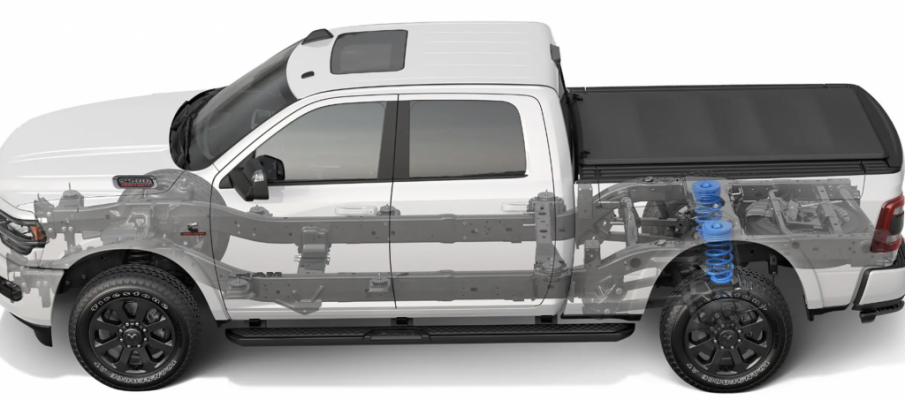
After doing a fair amount of research on the differences between the newer Rams (2019 and up), 2500 and 3500 have the same frames, but like you said, the only differences are in the mounting of the springs, coil vs leaf. Other than that the strength and rigidity are identical. Here is the clearest explanation, and it is not detailed enough, but here it goes:

The 2019 Ram Heavy Duty line has been fully redesigned for the model year. These new HD trucks include many of the upgrades featured on the 1500, including active noise cancellation, anti-vibration, and smoother-riding shock absorbers. All of which is, of course, upsized for the bigger frame and stronger design of the HD line's 2500 and 3500 pickups.

MORE STORIES
https://newatlas.com/automotive/toy...n=ocelot_e079a01&itm_content=recommendation_1
One of the key changes is in the extensive use of high-strength steel in the truck's frame. Now at 98.5 percent HS-steel, the framework improves torsional rigidity while lowering the frame's weight. To add to that lightweighting, Ram also used an aluminum hood and lighter powertrain components to reduce the HD's overall weight by up to 143 pounds (65 kg).


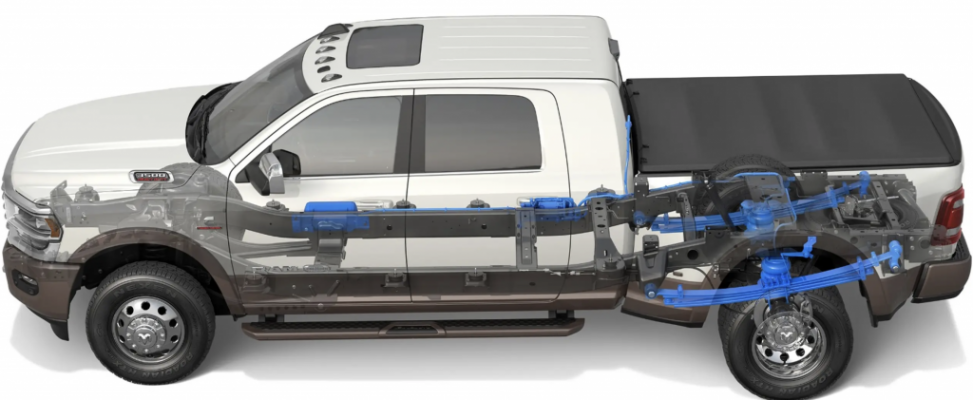
The pics are not the best representation but are the best I could find to date. Take a look and while the 2500 is much easier to view they look reasonable the same to me
 

Attachments

  • 2019:3500.png
    2019:3500.png
    420.1 KB · Views: 10
  • 2019:2500.png
    2019:2500.png
    389.5 KB · Views: 11

tron67j

Senior Member
Joined
Oct 14, 2019
Posts
4,103
Reaction score
5,420
Location
Maryland
Ram Year
2018
Engine
6.4 Hemi
I think the easier answer is each truck is engineered in a specific way and payload can vary greatly based on options, suspension package, etc. I don't see how someone can say a 2500 and 3500 are identical except for coil versus leaf springs. The connection points are different and this may result in significant variation of how weight is transferred to the frame. Assuming that the coil set up doesn't have the same weight transfer capacity as leaf one, then it is plausible that the manufacturer will save money and not over-engineer braking and other components for use that the 2500 truck is not built for.

Options and accessories may impact payload in various ways. Adding them certainly will reduce payload capacity. Also, a off-road package designed to absorb bruising trail conditions is not also going to maximize trailer towing opportunities. A choice has to be made and I remember finding out the Power Wagon package would have crushed the ability to carry weight as the dealer explained payload was hampered by the restrictions of the shocks and other suspension components.

It is important to understand the vehicle you own and that is where the research helps; by figuring out what one wants to do with a truck and then getting right truck to do it.
 
OP
OP
Rafke77

Rafke77

Member
Joined
Aug 16, 2022
Posts
48
Reaction score
16
Location
Plymouth Indiana
Ram Year
2022
Engine
6.4
Well yeah, if you're gonna add springs to a 2500 to make a 3500, why wouldn't you just get a 3500? Are you worried about warranty and nameplate? I don't think an owner can re-nameplate a vehicle for load upgrades, if that's what you're asking.
No, not looking to re-nameplate. This all started because we're interested in purchasing a 5th wheel. I found one that's within the payload and towing capacity range, roughly 1900 dry front hitch and 10,000 dry weight for the trailer. My curiosity got sparked because I always like a large margin of error, this was on the closer side for me. So I was looking at 3500's and saw the towing capacity for the 3500 with the gas engine had almost the same, while the payload was increased. So I wondered why, is it just a way for states to make money off of people having to register their trucks for a higher amount if they wanted a heavier duty truck, or is it a physical differences in the trucks. So I wanted to know more and more and more.. Here we are. Lol
 
Last edited:
OP
OP
Rafke77

Rafke77

Member
Joined
Aug 16, 2022
Posts
48
Reaction score
16
Location
Plymouth Indiana
Ram Year
2022
Engine
6.4
The pics are not the best representation but are the best I could find to date. Take a look and while the 2500 is much easier to view they look reasonable the same to me
The pics are great, thank you! It looks like a 3500 have an extra cross member compared to the 2500s.
 
OP
OP
Rafke77

Rafke77

Member
Joined
Aug 16, 2022
Posts
48
Reaction score
16
Location
Plymouth Indiana
Ram Year
2022
Engine
6.4
So GVWR 10000. My sticker shows Front axle weight capacity 5500, rear 6390.. 5500+6390=11890lbs the truck should safely hold. Why wouldn't payload equal weight of the truck subtracted from the total of what each axle can hold? This is where I believe the states make money off registration.

Factory rear tires, have a max weight capacity at 80psi for single tire of 3640lbs. One rear tire on each side would mean 7280lbs of even weight could be supported in the rear. (Not to mention total 14560lbs capacity of all 4 tires) So tires are not the weak point.

So besides rear squatting which can be fixed with helper springs or bags, I believe my margin of safety would be much higher then I expected.

Yes I understand mounting points of the different suspensions. But I believe that's just because of coils vs leafs, I don't think that alone would add to the payload, it's got to be the actual difference in spring pressure. But I know ram wanted comfort as a ride for these trucks. So adding those extras, I could lose comfort for the addition of a non squatting truck.
 
Last edited:
OP
OP
Rafke77

Rafke77

Member
Joined
Aug 16, 2022
Posts
48
Reaction score
16
Location
Plymouth Indiana
Ram Year
2022
Engine
6.4
Yes I saw that too and not sure what its for yet, but certainly a lighter part supporting other than a payload it appears
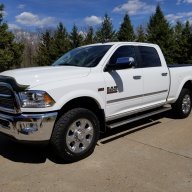
Also in the front, behind the axle it almost looks like ladder bars?(not sure if that's the correct term) On the 3500 going back. My 2500 had those as well, but it's not shown in the graphic. I know this is not a good image, but you can just make them out.
 

Attachments

  • PXL_20220806_162051037~2.jpg
    PXL_20220806_162051037~2.jpg
    125.6 KB · Views: 12
Last edited:

RamRigger

Member
Joined
Feb 2, 2022
Posts
77
Reaction score
59
Location
Vancouver, Washington
Ram Year
2021
Engine
6.7L
I think your eyes are better than mine. And even after reviewing the pics I posted, I just am at a loss for exactly what I am supposed to see. I heard 'behind the axle' but not which pic. And I've got to move on to the game right now. Back atcha tomorrow hopefully
 
Back
Top